

Sarıkaya Roman Bath and a Journey to Anatolia's Thermal Town
A Spa District in the Southeast of Yozgat Sarıkaya is a district in the southeast of Yozgat's provincial centre.

Sign in to like and rate
A Spa District in the Southeast of Yozgat
Sarıkaya is a district in the southeast of Yozgat's provincial centre. According to the History page of the Sarıkaya Municipality, the district lies 77 kilometres southeast of Yozgat. It sits on the main road route that links the Black Sea with the Mediterranean. The district centre is 1170 metres above sea level and was founded on a plateau where rolling plains take up a large area. The story of the name is interesting too. On the same page, the district was known until 1935 as Terzili Hamamı or Hamam Village, attached to Boğazlıyan. The governor of the time made the village a subdistrict centre and gave it the name Sarıkaya. Sarıkaya Subdistrict became a district centre of the same name in 1957. So even the old name of the settlement comes from the bath. The municipality page also writes that many mounds, tumuli and architectural remains in the region show that the area was a settlement continuously through history. In this article we take you to the district's best known structure, the Roman bath.
The Names Aquae Sarvenae and Basilica Therma
The names around the bath can get mixed up, so let us take them in order. The General Directorate of Cultural Heritage and Museums of the Ministry of Culture and Tourism writes that the structure was built in the Roman period, in the 2nd century CE, over the thermal spring in the region called Aquae Sarvenae. The Ministry's Kültür Portalı page gives the same date. The structure taking the name Basilica Therma is a separate stage. In the Byzantine period a basilica was added to the northern part of the bath, and the name changed in reference to this addition. We note this only as part of the architectural history of the building and the history of its name. The Sarıkaya Municipality page states that the settlement was known as Aquae Sarvenae in the Roman period and as Therma Basilica in the Byzantine period. The same page writes that the settlement shown between Tavium and Caesarea on the world map called the Tabula Peutingeriana, whose original dates to the 3rd and 4th centuries, is also said to be this place. According to the page, the Saravene region was part of the province of Cappadocia Prima in the Byzantine Empire.
Traces of the Settlement in Written Sources and History
The municipality page gathers the written traces of the settlement at several points. The place shown on the Tabula Peutingeriana lies between Tavium and Caesarea. The page states that Tavium corresponds to today's Büyüknefes Village in Yozgat. This helps you think of Sarıkaya within the ancient road network, because the settlement where the bath stands is a point mentioned between two centres. The same page says that the last information in written sources about Therma Basilica is a record of a military clash in 979 CE. According to the source, this clash took place at the settlement. In light of all this information, the page writes that it is possible to push the date of the first settlements in the district centre back to the 1st century CE. In other words, when the bath was built in the 2nd century CE, its surroundings may not have been empty land. The municipality also states that the ancient settlement continued until the 10th century. This picture helps you understand why the names and layers at the site proceed by accumulating on one another. The municipality page's own warning matters here as well. According to the page, no broad scientific study of the district's history exists. For this reason every conclusion drawn from written sources should be read with caution.
A Building Raised over Hot Water
What makes the Sarıkaya Roman Bath special is the logic of its founding. According to Kültür Portalı, the hot spring rising from underground was used directly in the building. In other words, the bath is less a building to which water was carried than a structure placed where the water emerges. The Ministry describes the Sarıkaya Roman Bath as one of the few thermal baths of the Roman period built in Anatolia. This framing lets you see the building not as an ordinary ruin but as an example of thermal architecture. In the Roman world, structures built around hot springs consisted of pools, passages and vaulted sections. At the Sarıkaya bath you can see traces of this logic. The large pool, the facade, the inner pool and the other parts suggest an arrangement in which water moved through the building. We offer this as a reading built on what the sources say; there is no certain information on how the structure worked in full. When you arrive, start from the facade and move toward the pools.
The Facade, the Pools and the Arches
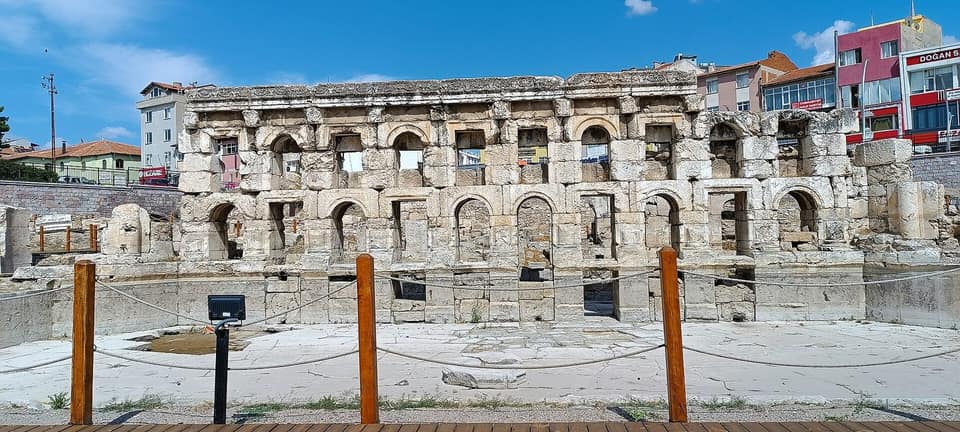
Today most of the bath has collapsed. According to Kültür Portalı, only the vaulted west facade wall, which gives passage to the rear space, has survived. In this section you see a wall with ten openings, two storeys and marble arches. The facade was built in line with the Corinthian order of entablature. The half columns on the arch piers have been destroyed except for their lowest parts. The General Directorate of Cultural Heritage and Museums gives the length of the facade as 30 metres. At the northern and southern ends of the facade there are two small pools with a semicircular plan. In front of the facade lies the large thermal pool. Behind the facade there is an inner pool, reached by stairs from two sides, and the large pool in front connects to it directly through arches. A third pool stands out to the east of the inner pool. Behind the facade you can also see the lower stones of a single storey arch with three openings and of rows of inner arches extending north of it. For photographs, choose the west facing facade at hours when the light is soft; this is only a suggestion, since the official sources offer no advice.
The Order of Reading the Facade
The most practical way to understand the structure is to follow in the field the order the sources give. First turn to the west facing facade and count the arches. The sources say there are ten openings and two storeys, and you can confirm this arrangement with your own eyes. Then look at the two ends of the facade. The small pools with a semicircular plan at the northern and southern ends frame the facade on both sides. Next move to the large thermal pool in front of it. Because it stands in front of the facade, it is the first part you meet as you approach the structure. Afterwards go behind the facade and look for the inner pool and the traces of the stairs on both sides. This part, connected to the large pool by arches, is the most enclosed section of the building. Finally turn east and find the third pool. The General Directorate of Cultural Heritage and Museums also writes that in later periods people benefited from the healing waters of the bath. This sequence helps you link the scattered remains of the structure to one another. Which sections can be reached on site is something you must learn from the current situation.
A Spa through the Centuries
This water kept attracting people for centuries. Kültür Portalı writes that Sarıkaya was an important spa centre in the Seljuk and Ottoman periods too, and that the bath was in continuous use with changes and additions. The same page also notes that the structure was badly damaged by infrastructure works in the Republican period. The History page of the Sarıkaya Municipality draws a somewhat different picture. According to it, the ancient settlements continued until the 10th century, and after the Seljuks took Anatolia the area was abandoned. It then revived and developed in the late 19th century thanks to migrants arriving from the Caucasus. This difference between two official sources means we should be careful about the nature of use in the Seljuk and Ottoman periods. We take the Ministry's page as the main source but also note the detail on the municipality page. The municipality page itself says that no broad scientific study has been carried out.
From a Traveller's Drawing to Today
The name that carried the bath into modern sources is the French traveller Chantre. According to the History page of the Sarıkaya Municipality, on his journeys in Anatolia in 1893 and 1894 Chantre saw the facade of the bath and drew it. He remarked that excavations here could bring interesting new discoveries to light. The same page also cites a Turkish source, a document from 1905 in the State Archives of the Prime Ministry. The document mentions an investigation into allocating the income of the Ilısu Spa in the Boğazlıyan district to the district education directorate. Today the structure is an area treated as an archaeological site by the Ministry of Culture and Tourism. The General Directorate of Cultural Heritage and Museums lists it as the Sarıkaya Roman Bath Archaeological Site. According to Kültür Portalı, the Sarıkaya Roman Bath was added to the UNESCO World Heritage Tentative List in 2018. A tentative list means a site may be nominated in future; it is not an inscription.
Notes for Your Visit
The bath is in the centre of the Sarıkaya district, in Kaplıca Quarter. Kültür Portalı gives the address as Kaplıca Mahallesi, Dutluk Caddesi. Access is by road; coming from Yozgat, reaching the district centre is enough, because the structure is inside the town. Before you go, check the pages of Kültür Portalı, the General Directorate of Cultural Heritage and Museums and the Sarıkaya Municipality. The Ministry of National Education page on out of school learning environments also lists the structure as a historic place in the district centre and recommends contacting the municipality before a visit. Since most of the structure has collapsed, do not expect to see a complete bath there. To put the facade, pools and arches together, follow the order used in this article. No note about the site being closed to visitors was found on the official pages. Even so, always ask about the current situation on the official site before you go.
Sources
- Kültür Portalı, Sarıkaya Roma Hamamı, https://www.kulturportali.gov.tr/turkiye/yozgat/gezilecekyer/sarikaya-roma-hamami
- General Directorate of Cultural Heritage and Museums, Sarıkaya Roma Hamamı (Yozgat) 2018, https://kvmgm.ktb.gov.tr/TR-210804/sarikaya-roma-hamami-yozgat-2018.html
- Sarıkaya Municipality, Tarihçe, https://www.sarikaya.bel.tr/sayfa/tarihce
- Ministry of National Education Out of School Learning, Sarıkaya Tarihi Roma Hamamı, https://okuldisiogrenme.eba.gov.tr/mekan-detay/sarikaya-tarihi-roma-kral-kizi-hamami-123
- Wikipedia, Basilica Therma, https://en.wikipedia.org/wiki/Basilica_Therma
- Cover image: Seraksin, Wikimedia Commons, File:Sarıkaya Roma Hamamı 2.jpg, CC BY-SA 4.0
Comments
Be the first to comment