

Rize Castle, the Hilltop Sentinel of the City
The founding of the city and the castle hill Someone looking at Rize from the sea notices the green that climbs the slopes behind the city and, within it, the hill of the castle.

Sign in to like and rate
The founding of the city and the castle hill
Someone looking at Rize from the sea notices the green that climbs the slopes behind the city and, within it, the hill of the castle. The Rize entry in the TDV Encyclopaedia of Islam says the city was founded on the east-facing slope of a small bay, protected from northwest winds by a promontory called Fenerburnu. In time the settlement spread to the shore. The castle stands on the hill behind the bay. An article in the journal Karadeniz Araştırmaları also describes Rize Castle as a structure built on a bay and the hill behind it.
This position is no accident. A small bay shelters ships and also makes it easy to watch for threats approaching by land. The TDV entry recalls that the city has been a trading port since ancient times, and writes that under the Empire of Trebizond it was an important port where Venetian and Genoese sailors called for trade. The castle is the hilltop sentinel of this port town.
The centuries before the castle hill
According to the TDV Encyclopaedia of Islam, the earliest known history of Rize goes back to the early 7th century BC, when the Milesians came by sea to the Eastern Black Sea coast and set up trading markets. The entry writes that the information given by Xenophon, who came to Trabzon in 400 BC, shows that Rize was also a trading port. In 180 BC the city came under the rule of the Kingdom of Pontus. In this period the Eastern Black Sea region supplied the Kingdom of Pontus with its needs for minerals, timber and ships. The Roman Empire, which abolished the Kingdom of Pontus in 64 BC, became influential in the region. According to the traveller Arrian, the distance from İyidere to Rize by sea was 10 miles. After the division of the Roman Empire the Byzantine period began in the region. After 1204 Rize remained within the borders of the Empire of Trebizond, centred on Trabzon. Keeping this long past in mind while looking at the castle hill helps in understanding why the structure carries the traces of more than one age. The dates given by the Culture Portal and DOKAP should also be read together with this long history of settlement.
The two parts of the structure
According to the Culture Portal, the castle stands southwest of the city centre on an area of 480 square metres and consists of an inner castle and a lower castle. Not following a regular plan, it sits on a natural hill 150 metres high. The DOKAP record also says that the castle occupies a natural hill commanding the city centre. The slope of the hill has fitted the building to the terrain rather than to a plan.
The inner castle is the part near the summit. The lower castle was surrounded by walls that spread from the inner castle toward the northeast and northwest and reached the sea. The Culture Portal notes that of these walls only a part of the western walls and some tower remains survive today. So what you see now is the hilltop core of a much wider defensive system.
Architecture
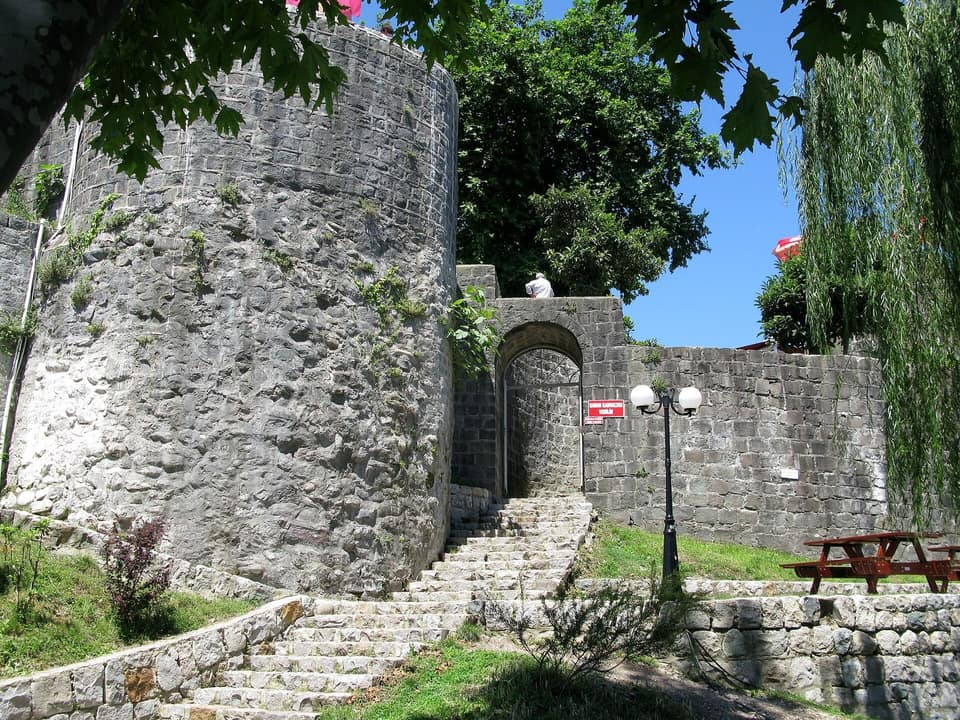
According to the DOKAP inventory, the castle was built of stone using the masonry system of rubble and dressed stone. The entrance of the inner castle faces east, and well-cut dressed stone and rubble stone are used together in the walls. The western walls, which survive to the present, have five semicircular towers. Research has established that there were nine towers and two gates on these walls.
The inventory also records that brick was used in the walls and that the towers had two storeys. These details matter. The use of brick together with stone may suggest that the structure was repaired in more than one period or extended by different workmanship, but the inventory offers no comment on this. It only states that the material was observed. As you enter through the gate, looking at the size of the stones, the order of the masonry and the round plan of the tower corners is a sufficient start.
Periods of construction
The official sources speak cautiously about dating. The Culture Portal writes that the inner castle is thought to have been built in the time of Justinian I, between 527 and 565, and the lower castle in the 13th century. DOKAP says that the castle was rebuilt in 527-565 and that the lower castle is dated in written sources to the 13th-14th centuries. The same record notes that the inner castle is known to have been used in the Genoese period.
The difference between these two accounts is small but important. One gives the 13th century for the lower castle, the other the 13th-14th centuries. One speaks of the construction of the inner castle, the other of its rebuilding. So instead of exact years, it is most correct to say that, according to the sources, the inner castle belongs to the early medieval period and the lower castle to around the 13th and 14th centuries.
The castle in the Ottoman period
According to Eyüp Kul's article published on DergiPark, the castle was included within Ottoman borders when Mehmed the Conqueror took Trabzon in 1461. Following the survey carried out in the region after the conquest, population was settled inside the castle and the castle was strengthened militarily. The article notes that Rize Castle held a less important position between the Trabzon and Gönye sancaks, but rose in importance after the Abkhaz and Georgian raids coming from the direction of Georgia.
The focus of the article is the repairs made at the castle, the munitions sent to it and its officials, especially the dizdar, or castle commander. The TDV entry writes that when the importance of the castle increased during the period of the sancak governorship of Trabzon, the situation of the garrison and the townspeople also changed. The same entry records that in 1498 a castle commander who was dismissed from his post was replaced by another official. Such details show that the castle was not merely a pile of stone but a regularly managed military unit.
The garrison and weapons of the castle
According to the TDV entry, when it came under Ottoman rule Rize had the appearance of a small castle town. In the last quarter of the 15th century a commander named Atmaca and thirty-four guards under him served in the castle. These guards came from different places such as Kalkandelen, Bosnia, Kosovo, Serres and Skopje. The garrison of Rize Castle was thus formed of people from a wide section of Ottoman geography.
The castle was also part of naval campaigns. For the ships built at Kefe in 1568 for the Astrakhan campaign, seven guards and twenty azeb soldiers were supplied from Rize Castle, just as they were gathered from the castles along the Black Sea coast. The same entry also writes that the guards began to protect the shores with their own boats; the assignment in 1574 of the Rize judge to build three boats against pirates is one example. It is also recorded that in 1621 the Don Cossacks raided Rize and caused great damage.
At the beginning of the 18th century Abkhaz raids became continuous. According to the TDV entry, in 1705 it was ordered that three cannons, 1000 cannonballs and gunpowder be given to Rize Castle against the Abkhaz attacks. In the same year 1000 kuruş was paid to the Rize judge for the repair of the castle's munitions store and the dungeon walls. These records show that the defensive order of the castle was kept alive over decades.
The port and the castle together
The TDV entry writes that once security was established along the Eastern Black Sea coast, the port of Rize became lively. In 1557 the port revenues of Rize, together with the Of landing, reached 30,000 akçe a year. Customs revenue from the flax produced in abundance around Rize, together with Of, was about 35,000 akçe in 1559. In that year a flax customs tax farm was established. The annexation of Crimea to Ottoman lands (1475) and the removal of Venice and Genoa from the Black Sea disturbed the Abkhaz living between Rize and Sukhumi, and Rize suffered from the piracy of these groups. Under Selim II order was largely restored through measures against arms smuggling and the dispersal of pirate hideouts. In addition, in 1726-1727 five şayka boats were supplied from Rize to carry the stones to be used in building Faş Castle. It is therefore possible to read Rize Castle as the hilltop part of a port system that worked together with trade revenues and naval strength.
Visiting the castle today
The Culture Portal writes that the surroundings of the castle have been arranged as a tea garden through landscaping, and that it is one of the ideal points in the city centre for viewing the city. Going up to the castle is a good way to read Rize from above. You will see the city centre, the shore and the sea in the same frame. Morning and the hours near sunset are better for light.
Restoration work carried out by the Ministry of Culture and Tourism on the structure is continuing. For this reason, which parts of the castle can be entered may change over time. For visiting conditions, get current information from the Rize Provincial Directorate of Culture and Tourism. While walking, watch the slope, the steps and wet ground, and do not take risks near the edges for photographs.
The most productive way to tour the castle is first to look at the city, then to approach the walls and towers and examine the material, and finally to picture the periods described in this article. The bay facing the northwest of the hill explains at a glance why the city was founded here.
Sources
- Culture Portal, Rize Castle, https://www.kulturportali.gov.tr/turkiye/rize/gezilecekyer/rize-kalesi
- DOKAP Cultural Inventory, Rize Castle, https://karadeniz.gov.tr/rize-kalesi/
- Eyüp Kul, Rize Kalesi, Karadeniz Araştırmaları 15/58 (2018), https://dergipark.org.tr/tr/pub/karadearas/article/1071612
- İdris Bostan, Rize entry, TDV Encyclopaedia of Islam, https://islamansiklopedisi.org.tr/rize
Comments
Be the first to comment