

Pasture Culture in Trabzon, Migration, the Sea of Clouds and Festivals
Anyone who knows Trabzon only from the coast road has seen half the city at most.

Sign in to like and rate
Anyone who knows Trabzon only from the coast road has seen half the city at most. A few kilometres inland the road turns into the valleys, climbs through the forest and finally comes out onto the meadows above the tree line. These are the yaylas, the high summer pastures. The Trabzon Provincial Directorate of Culture and Tourism describes pasture life as a social phenomenon as well as a natural and economic one, and writes that the tradition of going up to the yayla reaches far back. This article follows the yayla culture of Trabzon, that is, the summer migration, the wooden pasture houses, the sea of clouds and the festivals that fill the slopes every summer. At the end there are some practical suggestions for planning a trip to the high pastures.
Migration, spending the summer up high
The logic of the summer migration is simple. In the villages close to the coast the summer is hot and humid, while the meadows above offer fresh grass and cool air. In the words of the directorate, the people of the lower villages migrate to the yaylas in the summer months. The Küre Encyclopedia describes the same pattern for Sultan Murat Yayla. Local people go up at the end of spring, spend the summer there, and the making of cheese and butter tied to livestock continues on the pasture.
This migration is not only about grazing animals. In summer the yayla becomes the village itself. According to the directorate, bakeries, coffee houses, butchers and grocers open on the yaylas through the summer and bring life to the surroundings. This is also why high energy dishes such as kuymak are remembered together with mornings on the pasture.
Pasture houses and their order
Someone going up to a yayla for the first time may think the houses are scattered at random. The directorate's assessment says this impression is misleading. On closer look the houses turn out to be placed in the way that best serves their functions. The relationship they build with nature is the unchanging feature of yayla houses.
The houses are mostly of timber and are decorated with flowers and plants that love moisture. In winter they stay under snow, in summer they stand in fog and drizzle. In recent years new settlements have also been built in the language of this architecture. Within the Yayla Kent Project that began in Hıdırnebi in 1998, timber houses in keeping with the regional architecture were built. A similar pasture settlement also stands on Kayabaşı Yayla near Düzköy. According to the directorate, Kayabaşı lies at 1800 metres, surrounded by spruce trees, and is known for its festivals, its plant cover and its walking trails.
The growing interest in the yaylas is also reflected in official records. The Provincial Directorate of Culture and Tourism writes that six yaylas in Trabzon were declared tourism centres by decision of the Council of Ministers, and that investment on these pastures went first into roads and then into basic needs such as electricity, water and fountains. In the same text the directorate lists the crafts that accompany pasture life. Baskets woven from chestnut and hazelnut branches, shawls, kaytan cord, keşan cloth and peştamal wraps are the everyday objects of this life.
The sea of clouds
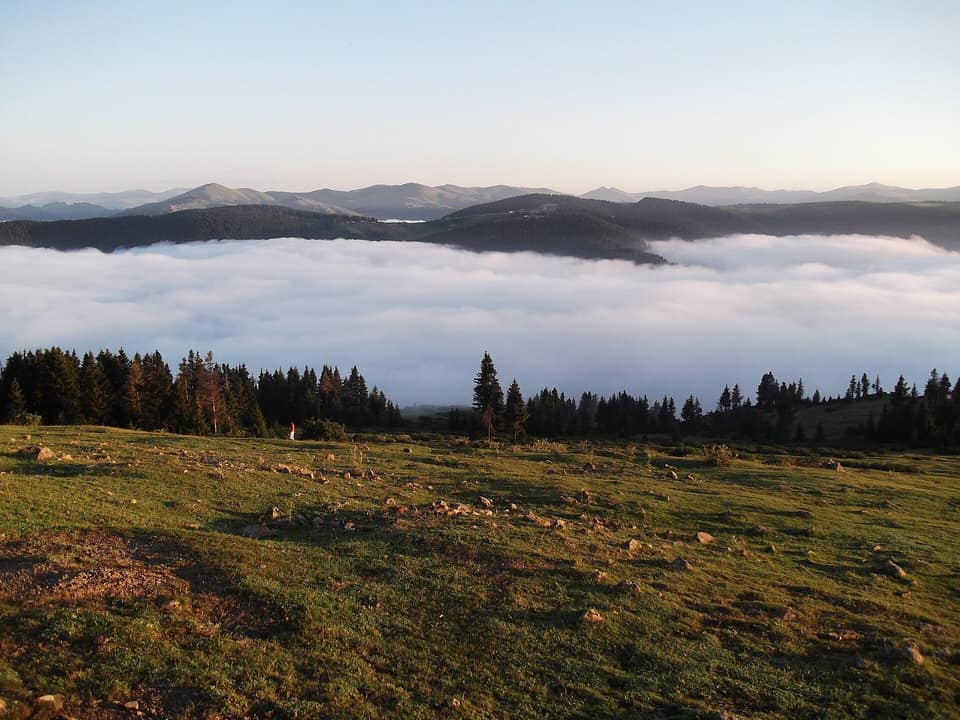
The most photographed moment on the Trabzon yaylas is the sea of clouds. Clouds fill the valleys and rest against the slopes. A person standing on the yayla stays above the clouds. Below stretches a flat white blanket, and only ridges and the tops of spruces rise out of it.
Hıdırnebi Yayla is one of the best known viewpoints for this scene. According to the district municipality, on clear days the pasture shows the district and the surrounding villages as if from a viewing terrace, and on cloudy days it lays a sea of cloud at your feet. The Provincial Directorate of Culture and Tourism also describes Hıdırnebi Hill as a natural viewing terrace.
No exact hour can be given for seeing the sea of clouds. The weather can change several times in a day, and the fog can roll in within an hour and clear within an hour. Being patient and waiting until the weather opens up is a good habit on the yayla.
Festivals, the great gathering of the pasture
The most visible face of yayla culture is its festivals. The Provincial Directorate of Culture and Tourism writes that the clearest expression of this tradition is the yayla festival. Among the most crowded are the otçu festival on Kadırga Yayla, the Sis Dağı festivals at Geyikli in Şalpazarı, the Hıdırnebi festival in Akçaabat, the festival on Lişer Yayla in Maçka and the Karadağ festivals in Vakfıkebir. At these gatherings thousands of people, women and men, old and young, form horon circles hand in hand and dance the horon for hours to the kemençe or to drum and zurna.
The origin of the Hıdırnebi festival is linked to the pasture economy. According to the Wikipedia entry, the date it began is unknown, but it is thought to have coincided with the time when shepherds coming down from the yayla sold their produce and villagers from the surroundings came to buy it. The sources give different dates; the festival is held in mid July and reaches its peak around 20 July. According to the district municipality, the festival takes place on the part of the yayla called Dernek Çimeni or Argolos Çimeni. Tents are pitched here, and a market selling local products forms among them. The last day of the festival is known locally as Orak Yedisi.
The Kadırga festival resembles a fair. In the directorate's description, tonnes of meat, bread and churned ayran are consumed during folk dance shows, contests and celebrations with drum and zurna, and the gathering looks like a great market. The directorate writes that this pasture lies at 2300 metres, above the tree line. Tens of thousands of people attend the gathering held every year on the third Friday of July. The otçu walk that starts at Eskala Obası also joins this gathering. People coming from the villages of Şalpazarı dance the horon to the kemençe at set rest points along the way and reach Kadırga dancing. Kadırga Yayla lies on the border between Trabzon and Gümüşhane, and the sources attach it to different provinces.
The Sis Dağı festivals are also held in July. According to the directorate, this pasture lies at 1850 metres and the festival is held on the third Saturday of July.
The pastures also have their own stories. On the small Çatma Obası south of Kadırga there is a spring called Mızraklı Su, the Spring of the Spear. According to the legend related by the directorate, a soldier suffering from great thirst broke his spear in two and threw the pieces to either side. Water sprang up where one piece struck the ground, and water vanished where the other struck. Today the spot where the water that disappears among the grass comes out is under protection.
Horon and kemençe
The heart of the festivals is the horon. According to the Wikipedia entry, horon is the general name for the traditional folk dances of the eastern Black Sea. It is danced at communal celebrations such as weddings, engagements, send offs for those leaving for military service and yayla festivals. Men, women or mixed groups line up in a straight row or a circle. The movements are fast and agile. The important figure that sets Trabzon horons apart from those further east is the emphasised shoulder shaking movement. The horon also has a peak. When the horon leader or the kemençe player calls out şimula or alaşağı, the dancers make the descending movement while shaking their shoulders.
The instrument of the coastal horon is the kemençe. The Black Sea kemençe is a three stringed bowed instrument. According to Wikipedia, its body is made from woods such as plum above all, juniper, mulberry and walnut, and its soundboard from spruce or fir. By tradition the best kemençes are thought to be made of plum wood. The strings also have local names; the lowest is called kapan, the highest zil and the middle one sağır.
Sultan Murat Yayla and history
South of Çaykara, at about 2000 metres, Sultan Murat Yayla is a place where history mixes with pasture culture. The Küre Encyclopedia writes that the pasture's name is said to come from Murad IV staying here during his Iranian campaign of 1635. According to the presentation of Çaykara, Şehitler Tepesi on the yayla is a memorial to the soldiers who lost their lives here in the First World War. Traces of the trenches can still be seen on the pasture.
The Provincial Directorate of Culture and Tourism mentions two gatherings on the yayla. In the second half of June a day of remembrance is held for those who died in the war, and in August the Yayla Ortası festivities take place. According to the directorate, the pasture lies on the Trabzon-Çaykara-Ataköy road and stays above the tree line.
Practical notes for a pasture trip
Most of the Trabzon yaylas can be reached by motor vehicle, but part of the roads are gravel or earth. According to the district municipality's statement, Hıdırnebi Yayla is one of the pastures easily reached by the road that leaves the Akçaabat-Düzköy road at its twelfth kilometre, a road kept open summer and winter. On higher yaylas road conditions vary. In the winter months and early spring, ask about the state of the road in advance.
On the yayla the weather changes quickly. Even in summer the evenings get cool, and when fog sets in visibility can fall sharply. Bring layered clothing, a raincoat and shoes that do not slip. If you are going to walk, do not leave the marked paths, and prefer to wait when the fog comes.
If you want to join the festivals, check the dates again every year. Sources may give different days for the same festival, and programmes are announced by the district municipalities. On festival days the yaylas become very crowded, so setting off early is a good idea.
Finally, remember that the yayla is a living space. The meadows are pasture for animals, and the houses are a family's summer home. Take your rubbish back with you, do not frighten the animals on the pasture, and ask for permission before taking photographs.
Sources
- Trabzon Provincial Directorate of Culture and Tourism, Pasture Tourism and Our Pastures, https://trabzon.ktb.gov.tr/TR-57698/yayla-turizmi-ve-yaylalarimiz.html
- Trabzon Provincial Directorate of Culture and Tourism, Çaykara, https://trabzon.ktb.gov.tr/TR-57618/caykara.html
- Habertürk, Hıdırnebi Yayla, a wonder of nature at the summit, https://www.haberturk.com/trabzon-haberleri/70038412-zirvedeki-doga-harikasi-hidirnebi-yaylasi
- Küre Encyclopedia, Sultan Murat Yaylası, https://kureansiklopedi.com/tr/detay/sultan-murat-yaylasi-921a1
- Wikipedia, Hıdırnebi Yaylası, https://tr.wikipedia.org/wiki/Hıdırnebi_Yaylası
- Wikipedia, Horon, https://tr.wikipedia.org/wiki/Horon
- Wikipedia, Karadeniz kemençesi, https://tr.wikipedia.org/wiki/Karadeniz_kemençesi
Comments
Be the first to comment