

Mudurnu and Göynük, Two Quiet Towns of Bolu
In the southwest of Bolu, squeezed between forested mountains, two small towns, Mudurnu and Göynük, hold the best preserved traditional fabric in the province.
 Radar Türkiye4 Kasım 2026
Sign in to like and rate
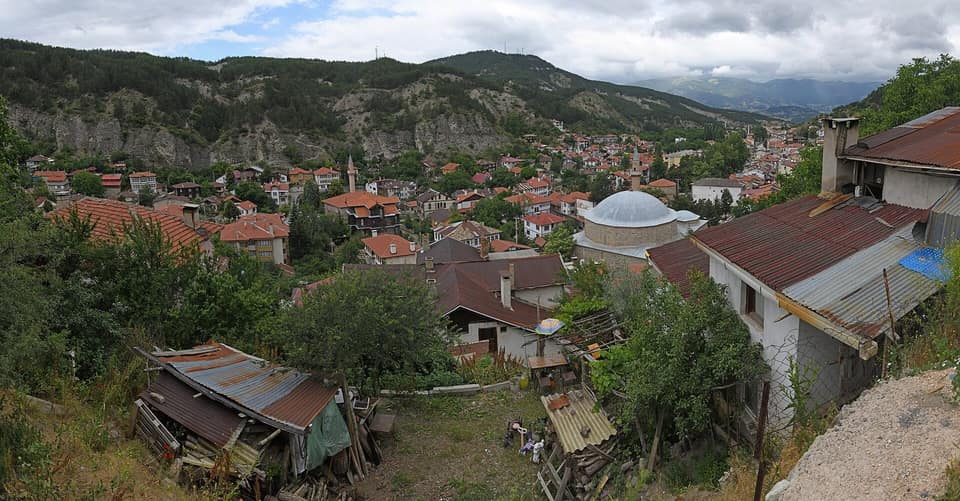
In the southwest of Bolu, squeezed between forested mountains, two small towns, Mudurnu and Göynük, hold the best preserved traditional fabric in the province. Both are designated urban conservation areas, and both are members of the Cittaslow network, which aims to protect slow living and local culture. The Bolu Provincial Directorate of Culture and Tourism makes a point of noting that the houses of Mudurnu resemble those of Göynük in their civil architecture. This article describes the two towns not monument by monument but through their houses, their street fabric, their handicrafts and their daily life. The aim is to help readers who go there read the facade of a house, the name of a lace motif or the tassel of a head covering.
Two towns at a crossroads
The character of both towns today is tied to old roads. Go Türkiye, the promotional platform of the Ministry of Culture and Tourism, writes that Mudurnu developed at a point where major trade routes such as the Silk Road and the Crimean Road met, and that it was a mid sized trading town especially in the Byzantine, Seljuk and Ottoman periods. Mudurnu Municipality describes the town as an important Ahi and guild town of the early Ottoman period and states that the Historic Ahi Town of Mudurnu was placed on the UNESCO World Heritage Tentative List.
According to the presentation of Cittaslow Türkiye, Göynük joined the Ottoman lands after 1323 and has been known as an Ottoman town ever since. The same source writes that Göynük's position as a passage between Anatolia and Istanbul, together with the saffron trade of the fourteenth century, brought the town economic growth. The history page of Göynük Municipality relates that the traveller Ibn Battuta, who reached Bolu in 1333 by way of Geyve, Göynük and Mudurnu, stayed in the guest houses of the Ahi brotherhoods in every town he passed through. So the two towns have lived on the same road for more than six hundred years, with a similar culture of craftsmen.
Reading a Mudurnu house
According to Mudurnu Municipality, the town was declared an urban conservation area because it has carried the civil architecture of several centuries ago into the present. The municipality counts 207 houses, 20 cultural buildings, 2 military buildings and 2 natural monuments, which together with fountains and a bathhouse make 231 structures of high architectural value. The page of the provincial directorate speaks of 165 houses and 8 monumental buildings, 173 structures in all; the figures may rest on surveys made at different dates, but both show that most of the town is under protection.
As the municipality describes them, Mudurnu houses usually have two or three storeys. The ground floor holds storerooms, a pantry, the kitchen and the oven room where the family ate together on special days. On the upper floors, which sit on thick stone walls, the rooms are arranged around a central hall called the sofa. Inside the rooms there are hearths, built in cupboards for bedding and low divans. Some houses have projecting bays with oriels. Balcony decoration shows examples of metalwork alongside wood carving, and doors and windows display some of the finest Ottoman woodwork. The roofs are mostly timber hipped roofs covered with traditional curved tiles, and even the chimneys rising between them were shaped with care for their appearance.
The town's great mansions are enlarged versions of this plan. According to the municipality, the best known mansions are four storeys high, square in plan and crowned with a cihannüma, a small rooftop pavilion looking out over the view; they have fifteen to seventeen rooms, four large halls and spacious sofas. In these buildings, framed in resinous pine and clad in timber, details such as ceiling decoration and door knockers catch the eye. Some of the mansions are now used as places to stay, but most are private homes.
Reading a Göynük house
Cittaslow Türkiye describes Göynük as a typical Ottoman town built at the foot and on the slopes of facing hillsides, in valleys crossed by streams among high hills, and writes that the town was declared an urban conservation area in 1987. According to the provincial directorate, the houses of Göynük date from the early twentieth century. Their roofs are usually hipped and covered with local tiles. The houses have one or two storeys above the ground floor, their staircases are inside, and in front of them are courtyards called hayat. In some houses the sitting rooms have ceilings decorated with various motifs.
Göynük Municipality describes the town's fabric through streets shaped by the terrain, houses set in gardens along those streets, and buildings that look out over one another. Each house built on the slope is placed so as not to block the view of the one in front. So when you walk the streets of Göynük, raise your eyes; the stepped rise of roofs and facades is the town's true image. According to the record of the provincial directorate, Göynük was declared a Cittaslow, a slow city, in 2017.
The solidarity of craftsmen
The common heritage of the two towns is ahilik, the tradition of trade brotherhoods that held craftsmen and tradesmen together and regulated business ethics and solidarity. Mudurnu Municipality lists the four principles on which this tradition rests as reason, ethics, knowledge and work, and states that Mudurnu is the only place in Türkiye that holds an Ahi celebration at district level. The most vivid form of the tradition is şed kuşatma. A journeyman who has worked for a long time beside a master and learned the finer points of the craft and its ethics is ceremonially girded with a piece of cloth resembling a bath wrap. In the municipality's words, this cloth is like a licence or a diploma, and the young person who wears it is now considered a master.
This tradition can still be felt in the town's bazaar. Mudurnu Municipality writes that blacksmiths and coppersmiths still forge iron, and that although the Blacksmiths' Bazaar has lost its former liveliness, a few masters keep the handicrafts alive through their efforts. As you walk through the bazaar and pass the workshops, you can ask the masters what they make.
The needle lace of Mudurnu
Mudurnu was once famous for its needles. According to Mudurnu Municipality, the town sent its handmade needles all over Anatolia, and Evliya Çelebi, who passed through in 1640, praised the Mudurnu bazaar with its rows of needle makers' shops. Go Türkiye reports the same. Today the most visible form of this heritage is the needle lace made by women, and the provincial directorate also associates Mudurnu with needle lace work.
As the municipality explains, the laces are usually sewn onto the edges of scarves and headscarves, and in recent years they have also been used in small accessories such as lapel roses, necklaces, earrings, rings and bookmarks. The names of the motifs come from the women's own lives and from the plants of the Mudurnu mountains. Kaynana Dili (Mother in Law's Tongue), Kaynana Yüreği (Mother in Law's Heart), Elti Eltiye Küstü (The Sisters in Law Fell Out), Hanım Göbeği, Kiraz Oya, Karanfil and Meşe Yaprağı are just a few of them. Flowers such as ivy, cornelian cherry, daisy, violet, crocus and poppy have also given their names to lace motifs. According to the municipality, the laces are made of pure silk, nylon thread is used when durability is wanted, and the silk is dyed by natural methods. Sericulture still continues in the town on a small scale, and silk from the cocoons is used in the lace.
Lace also has a place in the town's wedding traditions. The municipality relates that at henna nights, girls wearing the three skirted üç etek and the embroidered bindallı put on a bridal crown made entirely of needle lace, resembling a branch of wild rose. It is also customary for girls' dowries to include many lace edged covers, which are passed down from generation to generation.
The tokalı örtme of Göynük
The symbol of Göynük's handicrafts is the tokalı örtme. According to the geographical indication record of the provincial directorate, örtme means headscarf in the local speech. The Göynük tokalı örtme is a covering produced in Göynük, where weaving has long been a tradition, made by joining two pieces of fine cotton cloth and finished with red tassels on its short edges. Because these tassels are called toka locally, the covering is known as tokalı örtme. According to the registration text, the two pieces are woven identically, only the pattern that sits on top of the head differs, and the pieces are joined along their plain long edges with a decorative seam. If cords are used only in the warp it is called çubuklu or fitilli, and if they are used in both the weft and the warp it is called çatkılı.
Göynük Municipality writes that the tokalı örtme was the first geographically indicated product of Bolu, and that it is woven by women of Göynük at the local handicrafts training centre opened by the municipality. The provincial directorate also notes that wood carving is the foremost handicraft in Göynük; you can see traces of this skill in the town's wooden doors and ceilings.
The table of the two towns
The oven rooms and large kitchens of the houses have shaped the table of both towns. The geographical indication list of the provincial directorate includes kaşık sapı and basma helva from Mudurnu. Mudurnu kaşık sapı is a pasta dish made by sticking together two opposite corners of square pieces of dough with the help of a wooden spoon handle, topped with a mixture of walnuts, keş and butter. Basma helva is a flour halva made by adding syrup to roasted flour and served with walnuts. The municipality also counts among the town's famous treats Mudurnu saray helvası, which is said to have taken its name from reaching the palace.
Among the registered specialities of Göynük are uğut tatlısı, kabaklı yufka tatlısı and Bombay beans. According to the registration text, uğut tatlısı is a wheat sprout marmalade made by sprouting Çalıbasan wheat grown in Göynük, and it is prepared for weddings and for Hıdırellez. In kabaklı yufka tatlısı, a filling of pumpkin, onion, sugar and mint is placed between sheets of yufka, milk syrup is poured over it, and the slices are rolled up and served in copper dishes.
Tips for a visit
The two towns are close enough to be visited on the same day. Göynük Municipality writes that visitors coming from Bolu turn off towards the Göynük junction after the Mudurnu entrance, and that from there 32 kilometres remain to Göynük; according to the municipality, Göynük is 98 kilometres from the centre of Bolu. Public transport options are limited, so travelling by car makes things easier.
In Mudurnu, the City Museum and the Pertev Naili Boratav Culture House mentioned by the municipality are two stops that tell the story of the town's folk culture; check visiting conditions with the municipality before you go. In Göynük a traditional fair is held in October, and its dates are announced by the municipality each year. People live in most of the houses in both towns. When taking photographs, do not step into courtyards or look through windows; the view from the street is rich enough. If you want to buy lace or an örtme, asking about the work of the women who made it and the names they gave it will be the best part of the purchase.
Sources
- Bolu Provincial Directorate of Culture and Tourism, Mudurnu Houses, https://bolu.ktb.gov.tr/TR-356606/mudurnu-evleri.html
- Bolu Provincial Directorate of Culture and Tourism, Göynük Houses, https://bolu.ktb.gov.tr/TR-356605/goynuk-evleri.html
- Bolu Provincial Directorate of Culture and Tourism, Handicrafts and Souvenirs, https://bolu.ktb.gov.tr/TR-69954/el-sanatlari-ve-hediyelik-esya.html
- Bolu Provincial Directorate of Culture and Tourism, Geographically Indicated Products, https://bolu.ktb.gov.tr/TR-362580/cografi-isaretli-urunler.html
- Mudurnu Municipality, Mudurnu Houses, https://mudurnu.bel.tr/mudurnu/mudurnu-evleri
- Mudurnu Municipality, Mudurnu Handicrafts, https://mudurnu.bel.tr/mudurnu/mudurnu-el-sanatlari
- Mudurnu Municipality, Ahilik, https://mudurnu.bel.tr/mudurnu/ahilik-ve-esnaf-duasi
- Mudurnu Municipality, About Mudurnu, https://mudurnu.bel.tr/mudurnu/mudurnu-hakkinda
- Mudurnu Municipality, Mudurnu Culture, https://mudurnu.bel.tr/mudurnu/mudurnu-kulturu
- Göynük Municipality, About Göynük, https://www.goynuk.bel.tr/goynuk-hakkinda/
- Göynük Municipality, History of Göynük, https://www.goynuk.bel.tr/goynukun-tarihcesi/
- Göynük Municipality, Göynük Tokalı Örtme, https://www.goynuk.bel.tr/bolunun-ilk-ve-tescilli-cografi-urunu-goynuk-tokali-ortmesi/
- Cittaslow Türkiye, Göynük, https://cittaslowturkiye.org/goynuk/
- Go Türkiye, Touch Bolu, https://goturkiye.com/bolu/touch
- Go Türkiye, Mudurnu, a Slow City within 2 Hours of İstanbul, https://goturkiye.com/blog/mudurnu-a-slow-city-within-2-hours-of-istanbul
- Wikipedia (Turkish), Mudurnu, https://tr.wikipedia.org/wiki/Mudurnu
Comments
Be the first to comment