

Kemençe, Tulum and Horon, the Highland Tunes of Rize
In Rize, music is heard in the highlands Anyone who comes across a highland festival in Rize hears the sound first and sees the circle afterwards.
 Radar TürkiyeNovember 24, 2026
Sign in to like and rate
In Rize, music is heard in the highlands
Anyone who comes across a highland festival in Rize hears the sound first and sees the circle afterwards. On one side there is a sharp, bright bowed instrument, on the other a wind instrument holding a continuous drone. The Rize Provincial Directorate of Culture and Tourism describes the folk music of the region through two instruments, the kemençe and the tulum. Under the heading of folk dances, a single name stands out, the horon. The three cannot be thought of separately; the instrument sets the pace of the horon, and the horon explains why the instrument is built the way it is.
Two different kemençes
In Türkiye the name kemençe is used for two different bowed instruments. According to the provincial directorate, one is the classical kemençe of Ottoman music and the other is the Black Sea kemençe, a folk instrument of the Black Sea region. The classical kemençe is a small instrument about 40-41 centimetres long and 14-15 centimetres wide; its body, shaped like half a pear, its head and its neck are carved from a single piece of wood. Its notes are produced by touching the strings lightly from the side with the fingernails.
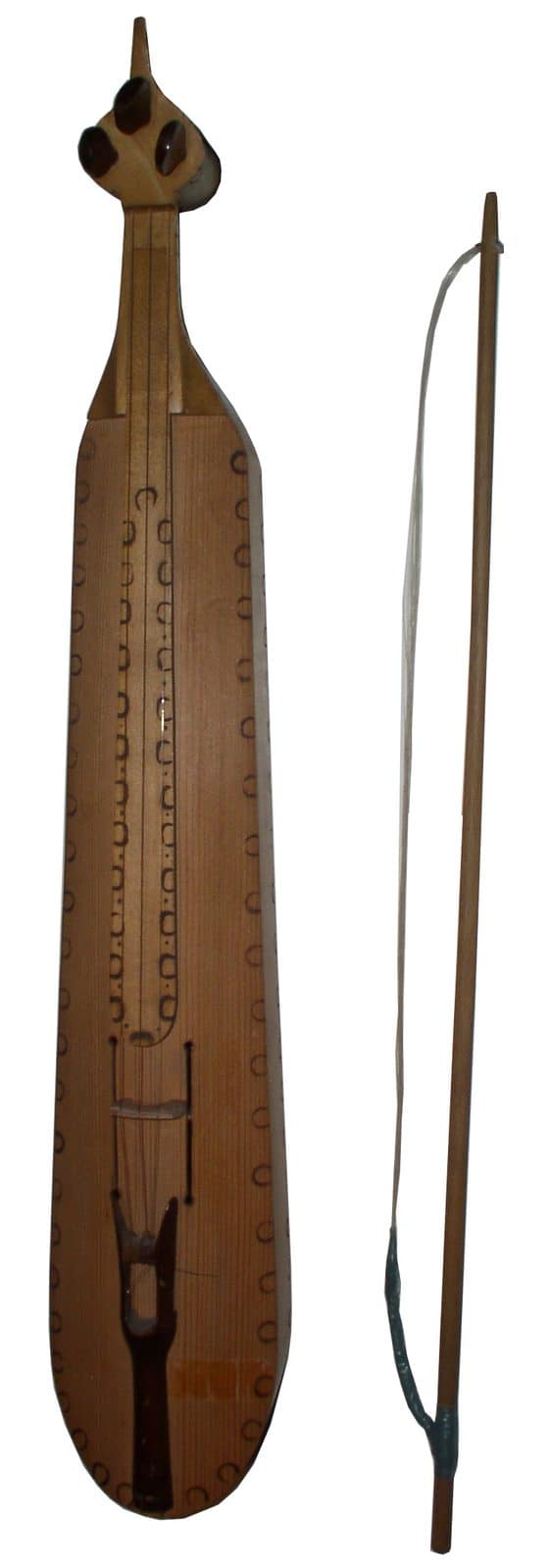
The Black Sea kemençe is also carved from a single piece of wood, but its shape is entirely different. The directorate writes that it is hard to speak of standard measurements for folk instruments, yet the kemençes used by experts and professional performers are usually 56 centimetres long. The body, with straight sides and a flat back, is mostly made of plum or juniper wood. The soundboard is made of fir or spruce and is kept very thin. To withstand the pressure that the strings pass on through the bridge, the soundboard is given a lengthwise ridge and its surface takes a slight dome shape. The tuning pegs are small and enter the pegbox from the front.
On the Black Sea kemençe the strings lie very close to the fingerboard, because the notes are produced by pressing the strings directly with the fingertips. A standing player holds the kemençe up in the air with the left hand, while a seated player rests it between the knees.
The tulum, an air store made of skin
According to the provincial directorate, the tulum is the oldest wind instrument of the region and is usually played in the mountain villages. It is heard at weddings, at festivals and in the road tunes played on the way up to the highland pastures. As the directorate describes it, the instrument has three main parts. The dudula is the mouthpiece, made from a round piece of wood with a hole bored through it, through which the tulum is inflated. The body is the skin in which the air is stored. The nav is the part that produces the sound; it consists of two pipes, each with five holes and each holding a reed called the çibu. The directorate also notes that the word nav means hollowed wood in Persian.
The player inflates the tulum by mouth and tucks it under the arm. Squeezing the skin with the inside of the elbow, the player sends the air into the pipes and turns the sound into notes with the movement of the fingers. The wooden pipe fitted to the right front leg of the tulum, used to fill the skin with air, is called the guda or lülük. The part that holds the drone is called the narter, and the part that plays the melody is called the zimok. Large tulums are sometimes also called guda. The terms change from place to place; a 2018 article based on a master's thesis carried out in Çamlıhemşin examines the instrument in five parts, the skin, the mouthpiece, the nav, the reed and the chanter.
The same article reports that the skin of a kid goat five or six months old, or under a year old, is generally preferred in the region, because it sits better under the arm. Although the two reeds lie side by side and sound at the same pitch, in the hands of a skilled player it is as if two separate melodies can be heard. According to the article, what most clearly sets the tulum apart from other wind instruments is that the air is stored in the skin and two sounds are heard at the same time.
Clues to the history of the instrument are kept in old sources. The article states that the first person to describe the tulum in theoretical terms was Abdülkadir of Maragha, and that according to his account the instrument has a history of at least 600 years. The travel notes of Evliya Çelebi also show that the tulum has been played in the Eastern Black Sea for at least 300 years. Another feature of the tulum is that it can be played on its own, without any accompanying instrument. At communal celebrations such as weddings, henna nights and highland festivals, a single tulum player can lead the whole circle.
Which horon is danced to which instrument
The provincial directorate writes that the folk dances performed in Rize are generally called horon. The horon is usually danced to the tulum or the kemençe, and sometimes it is performed without any instrument, to song alone. The dancers form a mixed circle of women and men around the tulum or kemençe player in the middle. The figures are varied and extremely lively.
Rize has two great horon traditions, and they are distinguished by their instrument. According to the directorate, the Hemşin horons are danced to the tulum and the Rize horons to the kemençe. The area of the Hemşin horons begins in the mountainous parts of Çayeli and takes in the line of Hemşin, Pazar, Ardeşen and Fındıklı. The Rize horons are danced in the area that stretches from the line of İkizdere and İyidere to the coastal part of Çayeli. In other words, the sound of the kemençe dominates in the west of Rize, and the sound of the tulum in the east and in the high valleys.
According to the directorate, the trembling, shaking and shivering figures of the horon depict the sea and the struggle of a fish pulled out of the water. The person who leads the circle and guides the other dancers is called the horoncu başı. The horoncu başı keeps the order of the horon with various calls, deciding when to speed up and when to change direction. According to the directorate's list, the horons danced and staged in the region include Hemşin, Sallama, Siya Siya, Yüksek Hemşin, Topaloğlu, Atlama, Hemşin İki Ayak, Rize İki Ayak, Rize Sıksarayı, Papilat, Çinçiva and Rize Kız Horonu.
The rhythm of the horon is distinctive too. A study of the Ardeşen horons published in 2019 reports that metres of five, seven and nine beats can be used in their plain form in horon tunes, and that compound metres are also common. The same study notes that the horon can be read less as an individual display than as a figurative expression of facing hard natural conditions together on steep slopes, and that traces of waves, of rowing, of flowing streams and of the move to the highlands can be seen in its figures.
Fora, where the horon catches its breath
One of the most interesting features of the Ardeşen horons is the sections called fora. According to Saral's study, the fora is the part of the horon in which the dancers rest and perform the sung sections. The word is used in the sense of resting, relaxing and shaking off fatigue. When the person leading the horon calls out fora, the tulum player begins to play the fora tune, and the circle stands in place or moves slowly to the left.
The fora sections usually consist of seven syllable quatrains. The study reports that the rhyme schemes are aaba, abab and abcb, and that the lyrics come sometimes from anonymous verses and sometimes from improvised songs made up on the spot. The subjects relate to everyday life and are mostly about love. In these sections the rhythmic structure is in two and five beats, and the tulum is used as the accompanying instrument. Exchanges between women and men also take place within the fora; in this way the horon becomes both a dance and a contest of words.
Music at the highland festivals
The Eastern Black Sea Cultural Inventory writes that, when traditional folk entertainment in Rize is mentioned, the first thing that comes to mind is the highland festivals. Horons danced to the kemençe and the tulum, improvised songs, verses and various contests are the striking elements of these festivals. According to the inventory, the festivals were once held to make the move to the highlands and the work done there more enjoyable. Today, bringing together people who have not seen each other for a long time is also an important part of their purpose.
One of the festivals mentioned in the inventory is the Vartevor festival, held at the Kavon highland, one of the Ayder highland pastures at the foot of the Kaçkars. Local people also call this festival the middle of the highland season. The festival takes place in mid July; it consists of celebrations with horon, songs and the tulum, and of outings around the highland. Families who have moved away from their villages and guests who come up to the highland also join in.
Another tradition is Hodoç, the hay mowing festival held in Ayder in mid August. As the inventory describes it, the highlanders who mow the meadows in the heat of the day gather in the cool of the evening, sing improvised songs to one another and shake off their fatigue by dancing the horon to the tulum. After the mowing is over, the festival goes on for another week. According to the inventory, the kemençe and the horon are not missing at the Snowman Festival held in Ayder in the winter months either.
Where to hear this music
To hear the music of Rize in its most natural setting, it is worth keeping an eye on the highland festivals of the summer months. The inventory notes that most of the festivals are organised within a set programme with the support of the governorship, municipalities, district governorships, associations and village heads. Because festival dates can change from year to year, check the current announcements of the Rize Governorship, the relevant municipality or the district governorship before setting out.
At the festival ground, stay close to the musician in the middle of the circle; the bright sound of the kemençe and the drone of the tulum are best heard from there. If you join the circle, follow the calls of the horoncu başı, because it is the horoncu başı who keeps the order of the horon. When taking photographs, asking people for permission before a close up is a good habit.
If you are interested in how the instruments are made, look closely at the plum and juniper wood used for the body of the kemençe, at the thin layer of fir or spruce on its soundboard, and at how the two pipes with their holes are attached to the skin of the tulum. Watching a tulum player squeeze the skin under the arm, or a kemençe player hold the instrument in the air, brings how the instruments and the horon work before your eyes within a few minutes.
Sources
- Rize Provincial Directorate of Culture and Tourism, Kemençe, https://rize.ktb.gov.tr/TR-113100/kemence.html
- Rize Provincial Directorate of Culture and Tourism, Tulum, https://rize.ktb.gov.tr/TR-113101/tulum.html
- Rize Provincial Directorate of Culture and Tourism, Horon, https://rize.ktb.gov.tr/TR-113715/horon.html
- Eastern Black Sea Cultural Inventory (DOKA), Entertainment in Rize, https://www.karadeniz.gov.tr/eglence-unsurlari-2/
- Oğuz Yılmaz, The Structural and Performative Characteristics of Tulum, EJMD, 2018, https://dergipark.org.tr/tr/download/article-file/610322
- Erkan Saral, The Fora Form in the Horon Practice of Ardeşen, Akademik Sanat, 2019, https://dergipark.org.tr/tr/download/article-file/909465
Comments
Be the first to comment