

Kayseri Castle and the Covered Bazaar, a Historic Walk in the Heart of the City
Rising at the edge of Cumhuriyet Square in the centre of Kayseri, the city walls are among the first structures anyone arriving in the city sees.

Sign in to like and rate
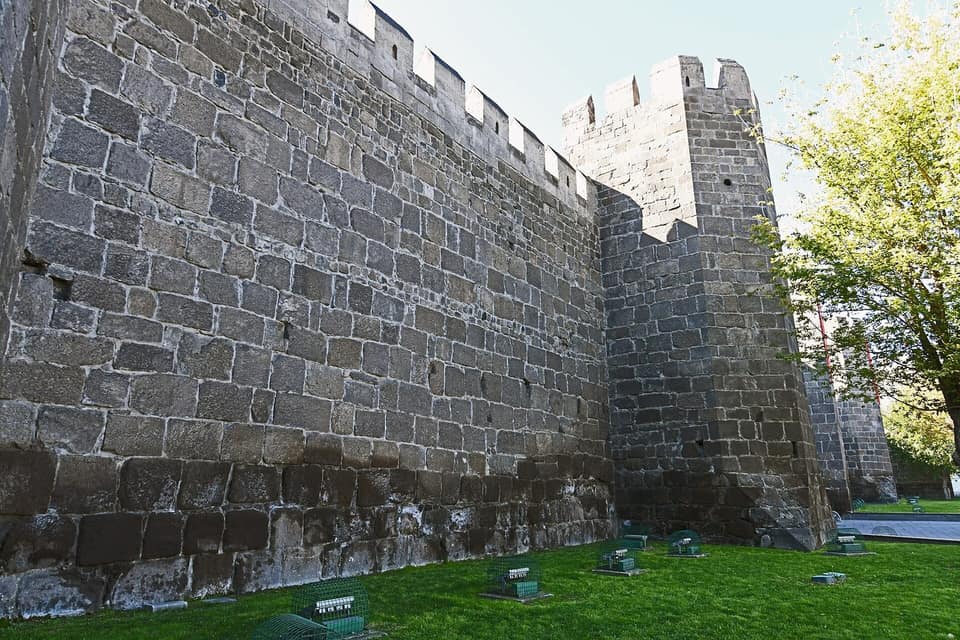
Rising at the edge of Cumhuriyet Square in the centre of Kayseri, the city walls are among the first structures anyone arriving in the city sees. The castle houses a museum, and right beside it stretch the Kapalı Çarşı (Covered Bazaar), the Bedesten and Vezir Hanı, where trade has gone on for centuries. Within a few hundred metres you can see traces of the Roman, Byzantine, Seljuk, beylik and Ottoman periods one after another. For anyone who wants to read both the defensive and the commercial memory of the city in a single day, this walk is a good place to start.
A Castle in the Middle of the City
According to the entry on the Ministry of Culture and Tourism's Kültür Portalı, Kayseri Castle stands in the city centre. It was built to protect a city that sat on the transport passes of Central Anatolia. The Kayseri Provincial Directorate of Culture and Tourism also notes that the region lay on important roads used for military and commercial purposes, and that many castles were built within the province to control these routes. Kayseri Castle is the one that remains inside the city and is the easiest to reach. Being built on flat ground sets it apart from the many Anatolian castles that lean against hilltops. Today streets and the square surround it; yet when you stand in front of the walls, you can easily sense how the castle shaped the fabric of the city for centuries.
A Past Reaching from Rome to the Seljuks
According to the provincial directorate's text on Kültür Portalı, the castle and walls were first built in the 3rd century, in the Roman period. In the 6th century, under the Byzantines, the walled area was reduced. The castle's present form, however, dates from the time of the Seljuk Sultan Alaeddin Keykubat I. In the following centuries it was repaired twice, under the Karamanids and under the Ottoman state. The same source describes it, together with the additions made over time, as a typical medieval castle. In other words, the walls you see today are not the work of a single period but the sum of interventions layered over different centuries. Trying to tell these layers apart by eye, by watching for differences in the masonry, changing block sizes and traces of repair, is one of the most enjoyable parts of the visit.
The Inner Castle and the Outer Castle
The castle has two parts. The Outer Castle consists of the outer wall and towers; it was built to protect the city and enclosed the seat of government and most of the settlement. The Ok Tower and Yoğun Tower of the northern outer castle, built by Alaeddin Keykubat I, have survived to the present day. The Inner Castle was built higher than the Outer Castle and, with the walls added around it, became a separate castle in its own right. During the period of the Turkish beyliks the walls, towers and gate towers of the Inner Castle were raised and the way it was used also changed. In the Ottoman period, when the city no longer needed defending, neighbourhoods were established inside the Inner Castle.
The Provincial Directorate of Culture and Tourism notes that the castle resembles an irregular octagon. The same source lists its gates as Sivas, Kiçi, Boyacı, Meydan, At Pazarı and Yeni. These names also tell you which direction and which market each gate opened onto. In Mehmet Çayırdağ's article on the Kayseri Covered Bazaar, At Pazarı (the Horse Market) is identified as today's Cumhuriyet Square. Not all the gates have survived; Çayırdağ records that the Boyacı Gate disappeared in 1965. If you keep the gate names in mind while walking around the walls, it becomes easier to work out which entrances of the old city today's streets and squares correspond to.
The Museum Inside the Castle
Today the interior of the castle is home to the Kayseri Archaeology Museum. According to Kültür Portalı, the city's first museum was founded in 1930. As the number of works from Kayseri and its surroundings grew, the museum served in different buildings, and in 2019 it moved to its present home inside the castle and opened to visitors. Alongside works collected, purchased and donated from around Kayseri, the collection includes finds uncovered in particular during the Kültepe excavations. The works are displayed in chronological order, which lets you follow the city's past step by step from the earliest periods. The museum's address is given as Cumhuriyet Mahallesi, Kazancılar Caddesi, and according to the portal's transport note all city buses pass in front of it. Entering the castle on a museum visit also gives you the chance to see what the walls look like from the inside. Because visiting days and hours can change, check the current information on the Ministry of Culture and Tourism's official pages before you set out.
A Bazaar That Began with the Bedesten
The Covered Bazaar right next to the castle is the place that best tells the story of the city's trading past. According to Çayırdağ's article, there was no bazaar or commercial building inside the walls in the Seljuk period. The present bazaar began to take shape on its current site after the middle of the 15th century, when Kayseri passed under Ottoman rule. The first building of the bazaar complex is the Bedesten. According to its inscription, the Bedesten was built in 1497 by Mustafa Bey, the governor of Kayseri at the time; the provincial directorate also gives 1497 as the year of construction. According to the endowment deed dated 1501, shops were added around the Bedesten, and the first rows of the bazaar took shape in this way.
According to the provincial directorate, the Bedesten's roof is covered by three large domes and smaller domelets. Çayırdağ writes that the central section has a high dome and exits in four directions, while the northern and southern sections are domed in the middle and vaulted on either side. The endowment deed assigned the southern section to jewellers and the northern section to shoemakers. Evliya Çelebi, who came to Kayseri in 1649, described the city's bazaars at length and wrote that valuable fabrics and jewellery were sold in the bedesten. Towards the end of the 16th century the bazaar expanded inside and around the walls, and each trade began to gather in its own street. Jewellers, coppersmiths, felt makers, carpenters and furriers are just a few of these trade groups.
Vezir Hanı and the Streets of the Bazaar
Vezir Hanı, right next to the Bedesten, is one of the most striking buildings in the bazaar. The Provincial Directorate of Culture and Tourism states that the two-storey inn was built by Damat İbrahim Paşa in 1727 and has a fountain in its centre. Çayırdağ, however, writes that the inn was built in 1723 and links the date 1727 to an imperial decree concerning the move of tradesmen into the inn. The inn consists of a section with a large courtyard and smaller sections at either end connected to each other by passages. Çayırdağ's article describes wool dealers, cotton dealers, carpet and kilim sellers and leather workers working in the inn. Near Vezir Hanı stands Gön Hanı, built by Pir Mehmed Paşa and apparently later assigned to leather workers; the word gön means leather.
The present layout of the bazaar largely took shape in the 19th century. The provincial directorate states that the Covered Bazaar, which has four entrance gates, was built by the townspeople in 1859. Çayırdağ, on the other hand, writes that the bazaar was rebuilt as a covered market after the great fire of 1871, that the old trade groups took their places in the new bazaar and that the streets were named after them. Having lost much of its roofing in the 20th century, the bazaar was restored to its former state through a long restoration carried out in the 1990s. During this work, the remains of the Seljuk-era Pervane Bey Madrasa came to light beneath the foundations of the bazaar. Today the name Uzun Çarşı refers to the main street between the Kazancılar Çarşısı and the Bedesten. Street names such as Hacı Efendi, Urgancılar and Katrancılar carry the memory of the old trade groups.
How to Plan the Walk
The castle and the bazaar are within walking distance of each other, and you can comfortably see both in a single day. Starting the day outside the castle is a good idea. Walk around the walls to see the towers and the traces of the gates, then enter the Archaeology Museum. After following the chronological sequence in the museum, move on to the bazaar. First look at the domed sections of the Bedesten, then step into the courtyard of Vezir Hanı to examine the two-storey building and the fountain in the middle. Following the street names inside the bazaar is the easiest way to understand which trade group gathered where. The bazaar is a lively place of business; when taking photographs, respect the wishes of the tradespeople and shoppers and take care not to block shop fronts. Since the castle and the bazaar are in the city centre, they are easy to reach by public transport. For the opening hours of the museum and the bazaar and for entry conditions, check the current pages of the Ministry of Culture and Tourism and the Kayseri Provincial Directorate of Culture and Tourism.
Continuing on a Castle Route
For those whose interest in castles grows after seeing Kayseri Castle, the provincial directorate lists further stops outside the city. Zamantı (Melikgazi) Castle in the village of Melikgazi in Pınarbaşı district was built at a point overlooking the Zamantı basin and was used to defend the old Kayseri-Malatya and Kayseri-Maraş roads. Most of the walls of this castle, which has cliffs on three sides, are still standing. Develi Castle, about 50 kilometres from Kayseri, stands on a rocky hill in the district's Yukarı Mahalle, and two towers and some wall sections have survived. Within the city, the Taşlıburun walls can be seen at the Beştepeler locality on the Hacılar road. In this way, a walk that begins with the castle in the centre can turn into a wider exploration reaching the defensive structures in different corners of the province.
Sources
- Kültür Portalı, Kayseri Kalesi, https://www.kulturportali.gov.tr/turkiye/kayseri/gezilecekyer/kayseri-kalesi-ve-surlari
- Kültür Portalı, Kayseri Arkeoloji Müzesi, https://www.kulturportali.gov.tr/turkiye/kayseri/gezilecekyer/arkeoloji-muzesi777797
- Kayseri İl Kültür ve Turizm Müdürlüğü, Kayseri Kaleleri, https://kayseri.ktb.gov.tr/TR-183231/kayseri-kaleleri.html
- Kayseri İl Kültür ve Turizm Müdürlüğü, Han ve Kervansaraylar, https://kayseri.ktb.gov.tr/TR-55118/han-ve-kervansaraylar.html
- Mehmet Çayırdağ, Kayseri Kapalı Çarşısı, Türk Dünyası Araştırmaları, 2006 (İSAM), https://makale.isam.org.tr/server/api/core/bitstreams/f023df05-59cb-4cb1-81be-ca592800574f/content
Comments
Be the first to comment