

Istanbul's Clock Towers from Tophane to Dolmabahçe
Time arrives with the towers Today we read the time on a phone screen, but in nineteenth-century Istanbul time was often read from the face of a tower.
 Radar TürkiyeNovember 24, 2026
Sign in to like and rate
Time arrives with the towers
Today we read the time on a phone screen, but in nineteenth-century Istanbul time was often read from the face of a tower. The clock tower entry of the TDV Encyclopedia of Islam explains that the tradition of building tower clocks emerged in the West, and that the earliest examples of these structures, seen from the 13th century onward, include the towers at Westminster in England and Padua in Italy. The tradition spread across Europe in the 14th century and is accepted to have begun in Ottoman lands at the end of the 16th century. Early towers in Banja Luka and Skopje are cited as examples of this beginning. The tradition spread from west to east in the 18th and 19th centuries, and it reached deep into Anatolia after the edict that Abdülhamid II sent to provincial governors in 1901, the twenty-fifth year of his accession.
Istanbul holds an interesting place in this story. The capital does not have a crowd of towers, but those still standing are among the most ornate examples of the period. The TDV entry lists the Tophane, Yıldız Palace and Dolmabahçe clock towers, together with those of İzmir and İzmit, as the most decorated towers. All three stand on a short line between Beyoğlu and Beşiktaş and can be seen on the same day. Drawing on the research of Hakkı Acun, the same entry also reports that a total of 115 clock towers were identified across the former Ottoman lands, from Anatolia to the Balkans and the Middle East.
How a clock tower works
It helps to understand the inside of a tower before looking at it. Clock towers generally consist of three parts called the base, the shaft and the kiosk. The base holds a room and the stairs that lead up the tower; in some towers a fountain sits on the base. The clock mechanism is in the kiosk on the top floor. A shaft connected to the mechanism turns the hour and minute hands on the dials outside and works the hammer of the bell at the top. Between the gears there are two steel cables wound on pulleys, each with a weight at its end. As the weights rise and fall, the clock is wound and keeps running. Clocks driven by large weights could be wound weekly, every fifteen days or monthly, depending on their design.
The bell is the voice of the tower. The bell at the top of the kiosk is sometimes covered by a dome or a conical cap, and windows and openings are left on the sides so that the sound can travel far. Some clocks strike as many times as the hour on each hour, while others make do with a single stroke. There are also clocks that strike the half hours, and clocks that repeat the hourly strokes after an interval of a minute or two.
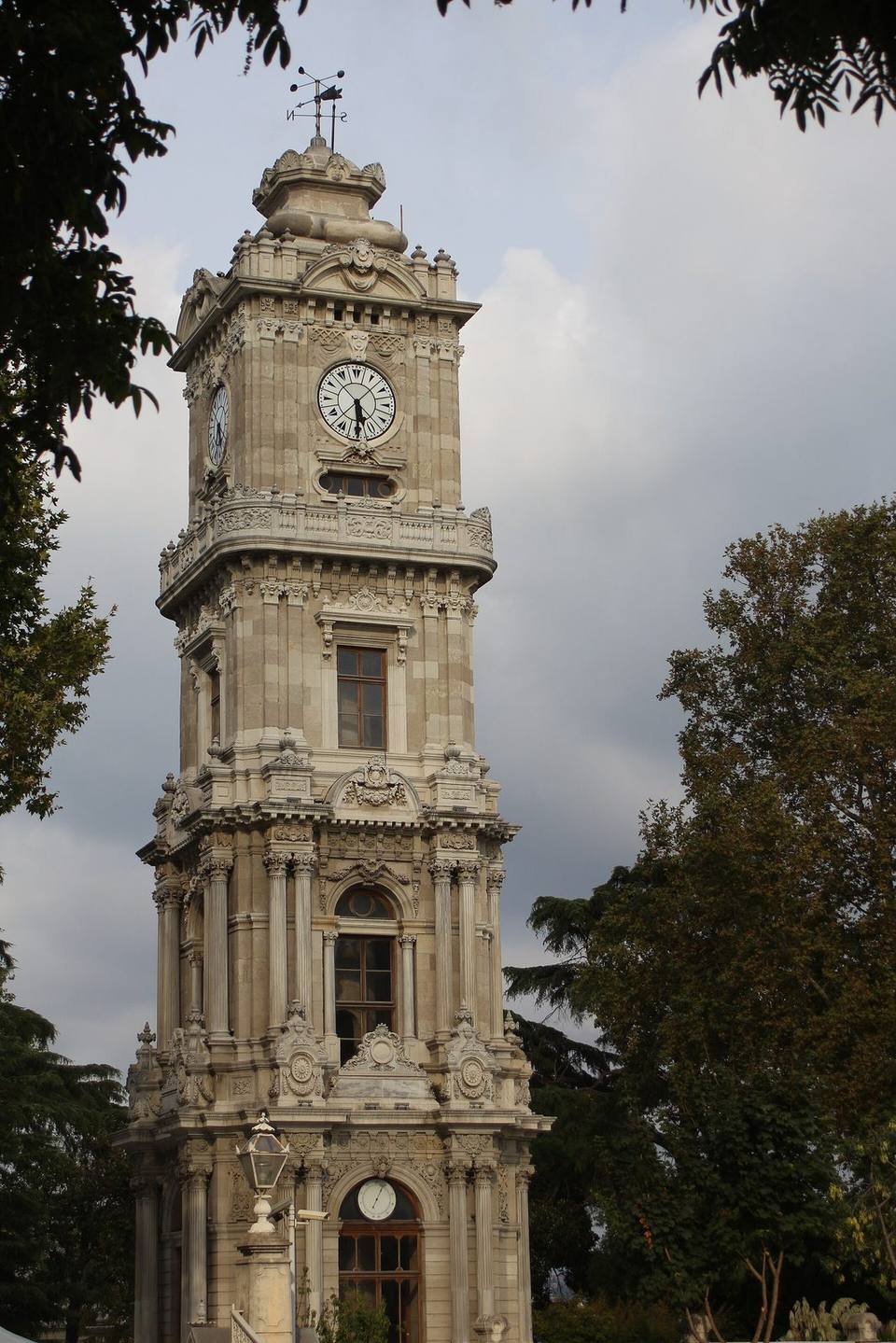
Towers did more than show the time. The TDV entry mentions towers that served as public fountains thanks to the fountain on their base, towers used as fire and watch towers thanks to their balconies, and towers carrying weather instruments such as weather vanes and barometers. The Dolmabahçe Clock Tower is cited among these multipurpose towers both for the fountain on its base and for the room beneath it.
Alaturka and alafranga dials
The dials of the towers also bear witness to a transformation. The article on the Nusretiye Clock Tower by Elif Gelmez and Meriç Altıntaş of Istanbul Kültür University describes a period in which two dials of four-faced towers were set to alaturka time and the other two to alafranga time. According to the article, alaturka time was abolished completely in 1925, and after 1926 the clocks were adjusted to the new system. With the alphabet reform, Latin numerals were placed on the dials of some towers, while others continued in use with their old numerals. Paying attention to the numerals on a dial therefore turns into a small reading of history.
Tophane, the first clock tower of the city
The logical starting point of the walk is Tophane. The article by Gelmez and Altıntaş presents the structure known as the Nusretiye or Tophane Clock Tower as the first clock tower of Istanbul. The tower takes its name from its neighbor, the Nusretiye Mosque. The imperial monogram above the southern window shows that the building was erected by order of Sultan Abdülmecid in 1848-1849. The square tower measures 4.35 meters on each side at ground level, narrows step by step as it rises, and its shaft, divided into four floors by three rows of eaves, reaches about 15 meters.
Standing in front of the tower, it is a good idea to read the floors from bottom to top. On the ground floor four columns stand at the corners, independent of the facade, and the tall doors between them have round arches. On the first floor the fluted engaged columns wrapping the corners have Ionic capitals, and Baroque arches are used for the windows. On the second floor framed wreaths and plant ornaments at the corners stand out. The four clocks are on the top floor and are covered with lead-clad vaults. The article also notes that when the tower was built it had a pole at the top for raising flags during ceremonies, and that this element is no longer in place.
The story of the tower is full of relocations. When it was first built, it stood at the center of the drill ground of the Tophane Barracks as a focal point defining an open square around it. This square was also used as one of the entrances where sultans returning from the sea and envoys arriving in the city were welcomed. Damaged in a fire, the tower was removed from its original site during the road works and expropriation policies of the 1950s and moved to the part of the shore where the customs buildings stood. Today it stands south of the Nusretiye Mosque on the Tophane shore, surrounded by buildings much larger than itself.
Dolmabahçe, the tower in front of the palace
From Tophane it is possible to walk along the shore through Fındıklı and Kabataş to Dolmabahçe; the T1 tram line also runs from Tophane to Kabataş. The National Palaces page on Dolmabahçe Palace lists the clock tower among the structures added to the palace in the reign of Sultan Abdülhamid II (1876-1909). The TDV entry states that the tower was built by order of Abdülhamid II between 1890 and 1894. Since the palace had been in use from 1856, the tower is a piece added about forty years after the main building.
Compared with the relatively plain and stepped shaft at Tophane, the decoration at Dolmabahçe spreads over every facade. Columns, arch curves, frames for the imperial monogram and the railed balcony on the upper floor turn the tower almost into an architectural showcase. Each of the four faces of the tower carries a dial, and a weather vane catches the eye at the very top. For photographs, shooting the tower from below, with an angle that frames the stepped rise of its floors, gives the best result. Because the tower stands inside the palace complex, those who want to see it up close should check visiting conditions on the National Palaces website; the palace is stated to be closed on Mondays.
Clocks inside the palace too
At Dolmabahçe time mattered not only in the tower but also in the halls. According to the National Palaces, most of the palace clock collection consists of 19th-century clocks, with a smaller part from the 18th century. Some of these clocks were gifts, some were purchased and some were specially commissioned, and they were chosen to show the time and also to complete the furnishings among the great halls, high ceilings and fireplaces. French clocks with bronze, gilded, marble and silver cases take the largest place in the collection. They are followed by English clocks, including weight-driven standing, musical and calendar clocks. German and American clocks, mostly wall clocks, point to the end of the 19th century and the beginning of the 20th, while Austrian clocks are known for small porcelain table clocks and wooden wall clocks.
One of the most interesting parts of the collection belongs to Ottoman clockmakers. These masters produced outstanding examples in the form of the skeleton clock, in which every movement and every turn inside is visible. Clocks by Eflaki Dede, Mehmed Muhsin and Mehmed Şükrü, who each made only one or two clocks in their lifetime, are also in the collection. The Dolmabahçe Clock Museum, which displays this collection, is shown on the National Palaces website as closed to visitors because of restoration work. For its reopening, the announcements of the institution should be followed. The article by Gelmez and Altıntaş also counts the mechanical clock collection of the Topkapı Palace Museum among the remarkable clock collections of the world; if you are spending time on the historic peninsula, this collection is a good option.
Toward the Yıldız hill
If you climb the slope behind Beşiktaş after Dolmabahçe, you reach the hill where Yıldız Palace stands. The Yıldız Palace clock tower, which the TDV entry counts among the most ornate towers, is on this hill. Seeing the tower at Yıldız after the two towers on the shore gives you a third example for comparing how the clock tower was used as an indicator and an ornament around a palace. The National Palaces website states that Yıldız Palace is closed on Wednesdays; those who want to visit the palace sections should check current conditions there.
Clocks without towers
Looking for clock towers in Istanbul also teaches you to notice clocks that have no tower. The TDV entry gives Haydarpaşa Station, Galatasaray High School and Çiçek Pasajı as examples of buildings with a clock in the pediment of their facade. Walking along İstiklal Avenue, raising your head to look at the gate of Galatasaray High School and the facade of Çiçek Pasajı is an easy way to see how the clock became an ornament in the architecture of the city. If you cross to the Asian side by ferry, the facade of Haydarpaşa Station joins this list.
A walking suggestion
The shoreline between Tophane and Dolmabahçe suits a half-day walk. After walking around the tower at Tophane, you can head toward Kabataş and plan your time at Dolmabahçe according to the visiting conditions of the palace. If you want to give the second half of the day to the Yıldız hill, you need to climb the slope from Beşiktaş. As the road is steep, comfortable shoes are useful. To see the pediment clocks of Beyoğlu, you can climb uphill from Tophane to İstiklal Avenue. Since opening hours and prices for palaces and museums can change, remember to check the current pages of the National Palaces.
Sources
- TDV İslam Ansiklopedisi, Saat Kulesi, https://islamansiklopedisi.org.tr/saat-kulesi
- Gelmez and Altıntaş, Kent Odağı Olarak Saat Kuleleri, Nusretiye Saat Kulesinin Değişen Ölçeği, TOJDAC 2018, https://dergipark.org.tr/en/download/article-file/408333
- Milli Saraylar, Dolmabahçe Sarayı, https://www.millisaraylar.gov.tr/Lokasyon/3/dolmabahce-sarayi
- Milli Saraylar, Dolmabahçe Saat Müzesi, https://www.millisaraylar.gov.tr/Lokasyon/16/dolmabahce-saat-muzesi
- Milli Saraylar, Yıldız Sarayı, https://www.millisaraylar.gov.tr/Lokasyon/5/yildiz-sarayi
Comments
Be the first to comment