

Hittite Traces on the Shores of Lake Beyşehir, Eflatunpınar and Fasıllar
West of Konya, around Lake Beyşehir, two Hittite monuments stand carved in stone. One is Eflatunpınar, built around a water source on the eastern side of the lake.

Sign in to like and rate
West of Konya, around Lake Beyşehir, two Hittite monuments stand carved in stone. One is Eflatunpınar, built around a water source on the eastern side of the lake. The other is the Fasıllar Monument, an unfinished rock sculpture near the village of Fasıllar. Both are regarded as belonging to the same period and show traces of Hittite art at the southwestern edge of Anatolia. This article describes the two monuments, explains their dates and measurements on the basis of sources, and sets out a practical frame for a visit.
An Old Settlement Basin around Lake Beyşehir
An article published in 2021 in Tarih Araştırmaları Dergisi says that the Lake Beyşehir basin, in the west of Central Anatolia, holds an important position both historically and geographically. According to the article, the basin has been settled since the Neolithic period and has hosted various cultures. In the Hittite period, its position on routes leading west and south shows the importance of the region.
This background helps explain why the two monuments rose here. Eflatunpınar is generally said to mark the southwesternmost known point of Hittite expansion. In other words, the lake area is a transitional zone on the edge of the Hittite world. Keeping this geographic context in mind lets you read the two monuments not as separate stops but as two parts of the same basin.
The Eflatunpınar Water Monument
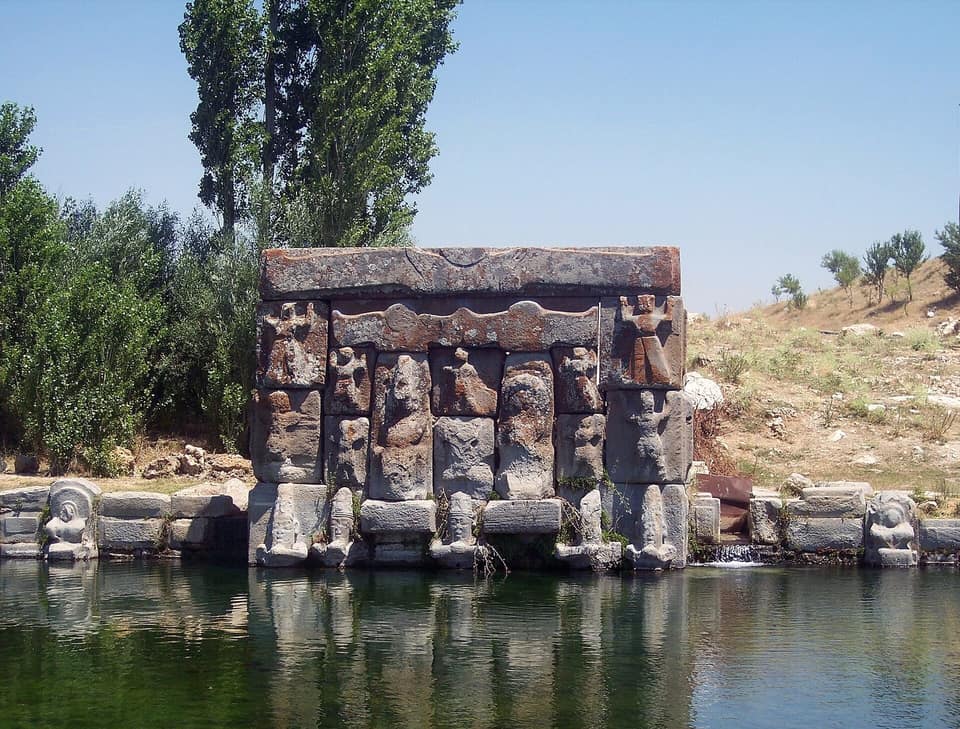
Eflatunpınar lies on the eastern shore of Lake Beyşehir. According to Turkish Archaeological News, Hittite craftsmen created an artificial pool here fed by a nearby spring and set a powerful stone monument beside it. The monument is about 7 metres high and 7 metres wide and consists of 19 stone blocks. The blocks are described as trachyte, with figures carved on them.
The pool in front of the monument is rectangular. Its sides measure about 30 and 34 metres, and it is surrounded by a low wall. Because the monument carries no inscription, its dating rests on its relationship to nearby Hittite sites, and it is dated to the second half of the 13th century BC.
Other sculpture fragments can be seen around the pool. On the south side stand the busts and front parts of three bulls. This piece is not in its original position, as it was used in the fill of a dam built on the southwest side of the pool in Roman times. When you visit, walking around the pool before looking at the main face lets you see the monument as part of a water arrangement.
The Reliefs of the Monument
The central part of the monument has two main figures, which the source names as the Storm God and the Sun Goddess. Winged sun discs appear above the figures. Ten hybrid creatures that hold the discs surround these figures. The hybrid creatures combine human and animal forms.
The lower part of the monument is decorated with five figures. According to the source, these are mountain and underground figures. The reliefs showing the underground figures have openings that once worked as a fountain. On the low wall of the pool, reliefs of a goddess of streams are placed symmetrically on both sides of the central monument. On the wall to the south there are further reliefs depicting a seated couple, but they are very poorly preserved.
One interesting detail is that the figures are shown from the front. According to the source, this is one of the few Hittite sites where human figures are shown frontally. On the function of the monument, some researchers think the structure may have been the base of another monument. There is no single definite interpretation, and for a visitor it is enough to read the monument as it appears.
The Fasıllar Monument
According to Kültür Portalı, the Fasıllar Monument is in the village of Fasıllar, attached to Konya's Beyşehir district. It is also known as the Kurt Beşiği Monument. It lies on its side on the western foot of a small hill south of the village. Kültür Portalı gives its dimensions as about 2.25 x 2.75 x 8.30 metres and its weight as about 72 tons. The Hittite Monuments site gives the width as 2.75 metres, the height as about 8 metres and the weight as about 70 tons. The small difference may come from measuring methods.
Kültür Portalı says the monument is carved on a 20 square metre face of a giant rock. The Hittite Monuments site states that the sculpture is made of basalt. Because the monument lies on its side, you can take in its length at a glance and walk around it to compare which parts are finely worked and which are roughly shaped.
The sources on the date of the monument should be read with care. Kültür Portalı attributes it to the Hittite King Muvattali, while the Hittite Monuments site dates it to the second half of the 13th century BC. According to the sources, then, the safest statement is that the monument was made in the second half of that century.
The monument consists of two gods and a pair of lion reliefs. There is one larger and one smaller god figure. A pair of lions appears on either side of the lower figure. The Hittite Monuments site describes the large figure as a Storm God standing between two lions and above a mountain god. While many Hittite monuments are carved into natural rock surfaces, the Fasıllar monument was made by shaping a single block of stone.
From Quarry to Monument
The most striking thing about Fasıllar is that it is unfinished. Kültür Portalı says that the roughly worked parts show it was prepared to be set up in a place visible from afar. According to the Hittite Monuments site, the monument was found near the quarry it was cut from, which indicates that this was not its final place. The monument was left where it was found.
This matters for a visit. Some parts of the monument are detailed and others are only roughly shaped. Noticing this difference up close is a good way to understand how the stone was worked.
One distinction is important. A copy of the monument is displayed at the Museum of Anatolian Civilizations in Ankara. The Hittite Monuments site places the copy in the museum's garden. The original in Fasıllar stands outdoors on the hill near the village and is not in a closed museum. This is enough to tell which photographs show the original.
Reading the Two Monuments Together
Eflatunpınar and Fasıllar are often mentioned together in the research literature. The Mellaart article listed among the related publications on the Hittite Monuments site dates from 1962, and its title treats the two monuments together as Late Bronze Age monuments. This view is not certain and does not limit how you read the monuments on a visit.
Still, seeing both places on the same day gives you the chance to compare finely worked reliefs shown from the front on one side with an unfinished task left near the quarry on the other. Hittite stonework is thus seen both in its completed form and in mid process, side by side.
Research History
According to Turkish Archaeological News, researchers have known of the Eflatunpınar monument since the early 19th century, but archaeologists have not carried out systematic study there. In 1996, an excavation under the Konya Museum uncovered the lower part of the monument and the ancient water reservoir. For Fasıllar, the Hittite Monuments site lists a 1962 article by Mellaart among related publications. That article treats the two monuments together.
The research history of the basin is not limited to these. The article cited above points out that the region was also settled in the Iron Age, and that the Hellenistic and Roman periods can be followed through ancient sources and inscriptions. The two Hittite monuments therefore represent only one period of a many layered region.
Route and Practical Notes
The two places lie on different sides of the lake. Eflatunpınar is on the eastern shore side, while Fasıllar is in a village attached to Beyşehir district. A vehicle is therefore needed for the trip. Turkish Archaeological News says there are no public transport options to Eflatunpınar and that the best way is by car. The same source says to turn off the D695 road between Isparta and Konya at a crossroads on the eastern shore of the lake and to follow the signs. After the turn, about 2 kilometres along the roads bring you to Eflatunpınar. The source also mentions marked paths and wooden footbridges around the pool, and notes that cattle frequently pass through the area, so keep an eye on your surroundings as you walk.
For exact current visiting conditions at Eflatunpınar and Fasıllar, the Konya Provincial Directorate of Culture and Tourism should be contacted. The Konya Governorship's Fasıllar Monument page is also one of the official addresses to consult before a visit.
Go early in the morning or in the afternoon, because low light brings out the depth of the reliefs. At Eflatunpınar, take a lap around the pool and then look at the main face. At Fasıllar, walk around the monument and compare the unfinished surfaces. If you combine the two stops in one day, work out the travel time in advance and bring basics such as water and a hat.
Sources
- Kültür Portalı, Fasıllar Hitit Kaya Anıtı, https://www.kulturportali.gov.tr/turkiye/konya/gezilecekyer/beysehir-fasillar-hitit-aniti
- Konya Governorship, Fasıllar Anıtı, https://www.konya.gov.tr/konya-fasillar-aniti
- Kurt and Atcı, Orondeis Bölgesi'nin Tarihi Coğrafyası, Tarih Araştırmaları Dergisi, 2021, https://dergipark.org.tr/tr/pub/tariharastirmalari/article/908530
- Turkish Archaeological News, Eflatun Pınar, https://turkisharchaeonews.net/site/eflatun-p%C4%B1nar
- Hittite Monuments, Fasıllar, https://www.hittitemonuments.com/fasillar/index-t.htm
- Wikipedia, Fasıllar Anıtı, https://tr.wikipedia.org/wiki/Fas%C4%B1llar_An%C4%B1t%C4%B1
Comments
Be the first to comment