

From the Sphinx Gate to the Royal Tombs, a Walk Through Alacahöyük
A mound in the Alaca plain The Alacahöyük archaeological site lies in the village of Alacahöyük, in the Alaca district of Çorum.

Sign in to like and rate
A mound in the Alaca plain
The Alacahöyük archaeological site lies in the village of Alacahöyük, in the Alaca district of Çorum. According to the Ministry of Culture and Tourism's Culture Portal, the site is 49 kilometres from the centre of Çorum and only 8 kilometres from the Çorum-Ankara highway. The introduction published by the Alaca District Governorate places the mound about 15 kilometres northwest of Alaca and 34 kilometres north of Boğazkale. This location makes Alacahöyük a natural addition to a trip toward Boğazkale. Even so, it is rich enough to fill half a day on its own. A höyük is an artificial hill formed by settlements that were built and destroyed again and again on the same spot over the centuries. The ground under your feet is made of stacked layers of habitation. At Alacahöyük those layers are distinct enough to notice as you walk around the site. Before you go, check the opening hours and entry conditions at muze.gov.tr, because the hours can change between summer and winter.
From discovery to the present day
The Alaca District Governorate explains that Alacahöyük was introduced to the world of scholarship by a traveller in 1835, and it has attracted visitors ever since. The mound first drew attention for its reliefs, which are not seen in any other Hittite city, and for two monumental sphinxes carved half in the round. After a few short investigations, the first major excavation season began on the orders of Atatürk. A village then stood on top of the mound, and it was relocated to make way for the dig. According to the Culture Portal, the excavation began in 1935 on behalf of the Turkish Historical Society under the direction of R. O. Arık, and it is counted among the first national excavations of Turkey. In the very first year, the discovery of the tombs of pre-Hittite Hatti princes and princesses made the importance of the place clear. After Arık, Hamit Zübeyr Koşay and Mahmut Akok continued the work until 1983. During these campaigns, 15 successive settlements were identified, distributed across four cultural layers. The excavations paused in 1983 and resumed in 1996 under Prof. Dr. Aykut Çınaroğlu. This long record of work explains why the site can be read in such detail today.
Four cultural layers
The Culture Portal lists four layers of civilisation. At the bottom lies the Late Chalcolithic Age, which reflects the first civilisation founded on virgin soil. Above it comes the Early Bronze Age layer, placed between 2500 and 2000 BC. This layer contributed greatly to our understanding of the native Hatti civilisation, the foremost of the cultures that formed the basis of Hittite culture. The third layer is the Hittite layer. The source attaches monumental buildings, special block houses, streets, water channels and the city wall to this layer. At the top lies the layer representing the Hellenistic, Roman, Byzantine and Seljuk-Ottoman periods. In the same layer, during the Late Phrygian period, every part of the mound was settled and small houses were built. According to the Alaca District Governorate, of the four cultural layers only two are visible at the site today. Keeping this distinction in mind makes it easier to understand which age a structure in front of you belongs to.
The Sphinx Gate and its reliefs
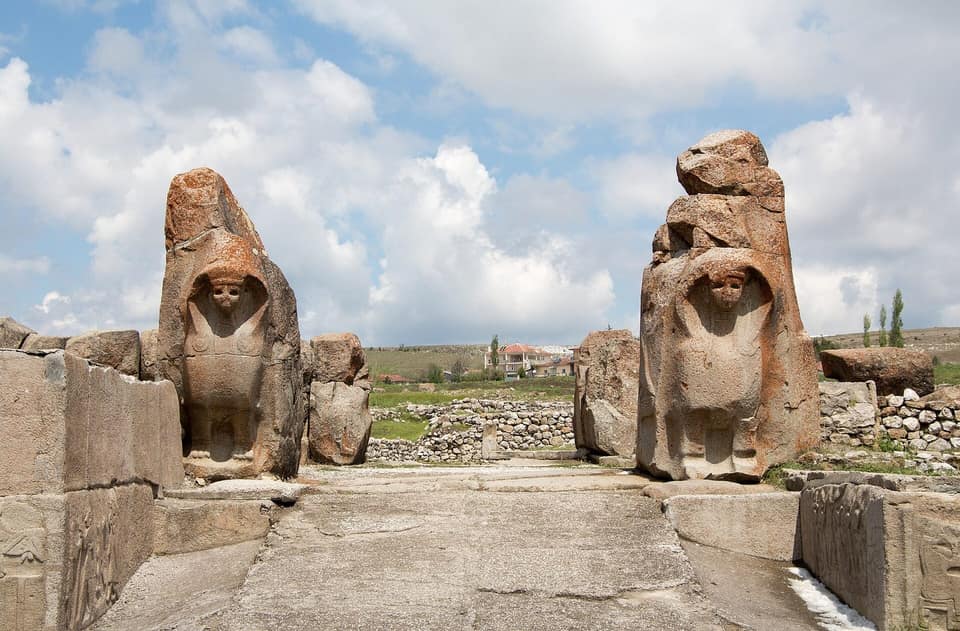
The most memorable structure at the site is the Sphinx Gate. It was built of andesite blocks on a limestone foundation, and it is 10 metres wide. The Culture Portal describes it as the monumental passage into the large building. The jamb blocks on both sides of the gate were carved in the shape of sphinxes. In other words, the figures are not free-standing statues but are half sculpture, half relief. A sphinx is a winged composite creature with a human head and a lion's body. The inner and outer faces of the two towers that carry the sphinxes are decorated with relief orthostats. An orthostat is a large stone slab set upright along the lower course of a wall. According to the Alaca District Governorate, the surface on the left side of the gate depicts a bull, a king in front holding a curved sword, and a procession following a queen behind him. The reliefs on the right show people advancing toward a figure seated on a throne. The Culture Portal also highlights the bull figure on the western tower. For photographs, it works well to look at the gate from a little distance first and capture the towers as a whole, then move closer to photograph the rows of reliefs. Side light early in the morning and late in the afternoon brings out the relief on the stone surface.
The Temple-Palace building, granaries and the Postern
Passing through the gate, you reach the building known as the Temple-Palace. According to the Alaca District Governorate, this building consists of rooms arranged on two sides of an open-air courtyard paved with stone. As you walk across the courtyard, look at the stone paving and at how the rooms are placed around it. The plan becomes clear once you walk the building from one end to the other. To the east of the Sphinx Gate and the Temple-Palace stand a Hittite-period enclosure wall, uncovered in the recent campaigns, and in front of it granaries with stone-paved floors. The same source notes that the larger of these granaries is the most magnificent room uncovered and preserved in Hittite cities to date. On the western side of the mound is the hidden passage called the Postern. According to the source, a visitor passing through this passage can feel the excitement of the Hittites in wartime. As you descend toward the Postern, watch the ground under your feet and read the narrow section of the passage as an architectural defence solution.
The Early Bronze Age royal tombs and finds
To the left of the stone-paved courtyard and below it, tombs of Early Bronze Age princes and princesses can be seen. According to the Culture Portal, the rectangular tombs, whose sides were lined with stone, were roofed with wooden beams, and the heads and legs of sacrificed cattle were placed on top of the roofs. The intramural tombs, meaning tombs inside the settlement, were gathered in a specially set aside area. In these 13 tombs, thought to belong to princes and princesses, excavators found ornaments, sun discs, stag and bull figures, weapons such as daggers, swords and axes, and works made of terracotta, stone, gold, silver, bronze, copper and electrum. The hammered, cast and inlaid techniques of the gold and silver vessels and the fine gold ornaments are, according to the same source, the product of a long development. The Alaca District Governorate attributes these tombs to the pre-Hittite period and to the Hatti lords, and notes that the standards known as the Hittite Sun Disc came from them. Standing in the tomb area and trying to picture the stone masonry walls together with the arrangement of timber beams is a good exercise in observation. To see the finds up close, you need to move on to the display cases in the museum.
The site museum
The first local museum at Alacahöyük was opened in 1940. The museum moved into its building within the site in 1982 and was rearranged in 2011. The finds from the excavations are displayed in halls named after the excavation directors. The wall panels in the Hamit Zübeyr Koşay hall explain the place and importance of the Alacahöyük excavations in Turkish archaeology. The case that covers the history of the excavation shows excavation materials and some of the scholarly publications. Works from the Chalcolithic, Early Bronze Age and Hittite periods are in the Remzi Oğuz Arık hall. Works from the Hittite and Phrygian periods are displayed in the Mahmut Akok hall. According to the Ministry of National Education's Out-of-School Learning Portal, the finds from the royal tombs in the museum provide information on the metalworking of the period. The same portal says that the collection also includes local carpets and kilims, wooden farming tools, a weaving loom and Ottoman-period weapons. In this way a single building lets you follow a line from the Chalcolithic Age to recent times. A meaningful order is to get to know the finds in the museum first, then go outside and see the places where they were found.
How to visit
The visitor notes on the Ministry of National Education portal ask that visitors do not touch or climb the excavation areas, historic structures and stones. No stone, pottery or find should be removed or moved from its place. Visitors should stay on the walking paths and not enter protected areas. It is best to keep away from slippery or high places and from excavation areas. For an open-air visit, shoes and clothing suited to the season, a hat, sunglasses and water are recommended. Flash photography may be prohibited in some sections. You can plan your walk close to the order used by the Alaca District Governorate. Begin with the Sphinx Gate, then the Temple-Palace courtyard, the royal tombs, the granaries and the enclosure wall, and finish with the Postern and the museum. Because the visiting hours of the museum and the site may differ between summer and winter, check current information at muze.gov.tr. If you want to add Alacahöyük to a day trip toward Boğazkale, take the 34 kilometres between the two places into account.
Sources
- Kültür Portalı, Alacahöyük Müze ve Ören Yeri, https://www.kulturportali.gov.tr/turkiye/corum/gezilecekyer/alacahoyuk-muze-ve-orenyeri
- Alaca Kaymakamlığı, Alaca Höyük Hitit Diyarı, https://www.alaca.gov.tr/alaca-hyk-hitit-diyari
- MEB Okul Dışı Öğrenme Portalı, Alacahöyük Müzesi ve Ören Yeri, https://okuldisiogrenme.eba.gov.tr/place-detail/alacahoyuk-muzesi-ve-oren-yeri-1870
- Wikipedia, Alaca Höyük, https://en.wikipedia.org/wiki/Alaca_H%C3%B6y%C3%BCk
Comments (1)
İstanbul Buyuksehir Alacahoyuk ve Hitit Tarihi müzesi için organizasyon yapabilmeli. su an özel sektör gezi turları çok fahiş fiyatlarla ve kötü organizasyonlarla halkı yalan/yanlış yonlendirmekte. Güvenilir bir kaynak olarak bu kültür turları düzenlemesi hem halka iyi bir olanak hem de bu " piyasa"da bir çeki/ düzen sağlar