

From the Kızılçullu Aqueducts to the Dönertaş Sebil, the Water Structures of İzmir
A city in search of water It may seem odd at first that water should be a problem for a city built on the shore of a gulf.
 Radar Türkiye24 Kasım 2026
Sign in to like and rate
A city in search of water
It may seem odd at first that water should be a problem for a city built on the shore of a gulf. Yet throughout its history one of İzmir's greatest concerns was carrying drinking water into the city from beyond the hills and valleys. The traces of that effort can still be seen today. The arches that cross a valley in Buca, the marble sebils in the side streets of Kemeraltı, the inscribed fountains on district squares and the Byzantine arches in Selçuk are all parts of the same story. The İzmir Provincial Directorate of Culture and Tourism records the aqueducts, bridges and fountains of the province under separate headings. When these records are brought together with academic studies, a map of water emerges that stretches from Roman arches to a nineteenth-century pumping station.
The Kızılçullu aqueducts
The arches that catch the eye of anyone entering İzmir from the direction of Aydın rise over the Melez stream, in the area once called Kızılçullu or Paradiso. Today this area is the Şirinyer neighbourhood of the Buca district. The Provincial Directorate of Culture and Tourism writes that the aqueducts were built by the Romans in the reign of Emperor Augustus to carry water to the city around Kadifekale. The structure is also known as the Gaius Sextilius Pollio aqueduct. The arches stand in two tiers, built of cut stone and brick and bound with Roman mortar. According to the directorate, egg white was added to the mortar to make it more durable. The middle arch is wider and rounder than the others and is supported on both sides by cut stone buttresses. The other arches are smaller, with slightly pointed tops. Repaired and used in the Byzantine, Seljuk and Ottoman periods, the aqueducts have survived to the present day.
To see the arches, a trip to Şirinyer is all it takes. As the directorate also notes, the structure is a monument that is easy to spot near the road entering the city from the Aydın direction. The wide opening at the centre of the two-tier row of arches is easy to pick out even from a distance.
The Vezirağa aqueduct and seventy-three fountains
In the seventeenth century İzmir's trade grew rapidly and the city attracted the attention of senior officials of the state. A master's thesis prepared at the İzmir Institute of Technology describes how the grand vizier Köprülü Fazıl Ahmet Pasha, realising that the city lacked an adequate water supply, had an aqueduct built in the Melez valley and fountains built in the city centre. According to the thesis, this system was completed in 1674. Alongside the Vezirağa aqueduct, ten old fountains were restored and seventy-three new fountains were added to the city centre. The thesis stresses that the aqueduct carries historical, documentary and aesthetic value, but that there are structural problems threatening both the structure and these values.
The Dönertaş Sebil
Walking through the busy streets of Kemeraltı, a marble building catches the eye on the corner where Anafartalar Street meets 945 Sokak. According to the Provincial Directorate of Culture and Tourism, the Dönertaş Sebil was commissioned in 1814 by Osmanzade Seyit İbrahim Rahmi Efendi. The rectangular building is covered by a dome and roofed with traditional Turkish tiles. The sebil is entered through a door on the 945 Sokak side, and it has a water-serving window facing each of two directions. The building is made of cut stone and its facade is entirely clad in marble. Decorated capitals at the corner, a round marble column between the windows, floral motifs and inscription friezes enrich the facade. It is this corner column that gives the building its name, since the column is said to turn on its own axis.
When you stand in front of the sebil, look in turn at the metal grilles of the windows, the capital of the column and the reliefs on the lower section.
The fountain of Ali Paşa Square
The octagonal fountain standing in the middle of Ali Paşa Square in Konak has, according to Visit İzmir, been the symbol of the square since 1828. Also known as the Hacı Salih Paşa Fountain, it was commissioned by Salih Pasha, the grand vizier of the time, and its construction was carried out by Çeşmeli Ahmed Reşid, one of the notables of İzmir. The fountain was repaired in 1894 in the reign of Sultan Abdülhamid II, and a second inscription recording this repair was added to its mirror stone. According to the description, it is the only one of its kind in İzmir as a freestanding square fountain not attached to any building. Each face has round arches resting on columns, and the top is covered by a dome. The inside of the dome is plastered and the outside is clad in lead. The octagonal reservoir is made of marble. Floral motifs can be seen on the column capitals and arch corners, along with a six-pointed star inside a medallion. A long building inscription can be read on the inner face of the dome's skirt. The fountain once served caravans and stood at the centre of the commercial life of the square.
A pumping station at Halkapınar
The nineteenth century opened a new era in İzmir's water. An article published in 2024 in the architecture journal GRID explains that the water distribution technologies developed in Europe with the Industrial Revolution entered the Ottoman Empire through concessions granted to foreign companies. According to the article, La Compagnie Ottomane des Eaux de Smyrne, the Ottoman Company of İzmir Waters, built the Halkapınar Water Pumping Station in 1898. The building still serves its original function today and stands within the facility of the İzmir Water and Sewerage Administration. The article regards the station as one of the rare examples of industrial heritage reflecting nineteenth-century water distribution technology. The authors identify poor-quality later additions and the removal of original elements as the main problems, and propose that the building be preserved with its original function and opened to visitors.
Fountains in the districts
For those who want to follow water structures beyond the city centre, the districts offer a rich selection. The Provincial Directorate of Culture and Tourism writes that the exact date of the Hafsa Hatun Fountain in Tire is unknown, that local tradition attributes it to Hafsa Hatun and that its style suggests the seventeenth century. The rectangular, single-faced fountain has an arch that begins round and ends pointed, and it is covered by a hipped roof. Its walls show rubble stone and brick laid in alternating courses. Its most interesting detail is that its trough, no longer in use, was made from a sarcophagus of the Hellenistic period.
Two fountains stand out in Urla. The first stands on the square in front of the Hacı Turan, or Kapan, Mosque on Kapan Sokak in the Yenice neighbourhood. According to the directorate, the fountain was commissioned in 1818 by Ahmet Bey; eight columns are linked to one another by arches, and the structure resembles the fountains of Bursa. The ceiling of its wooden roof is painted with scenes from nineteenth-century Urla. The second is the Marble Fountain, or Bazaar Fountain, on Mustafa Kemal Street. Made entirely of marble, it has a tap and a marble basin on each of its four faces. The obelisk above the fountain rises in memory of the Turkish War of Independence.
The water channels of Ephesus and Selçuk
One of the oldest chapters of İzmir's water history can be read in Selçuk. The Provincial Directorate of Culture and Tourism writes that, because its water sources were far from the city, Ephesus first relied on wells and cisterns. Later the Değirmendere springs south of Kuşadası, known in antiquity as Kenchrios, and the Keltepe springs were used. The water of these springs, 42.5 kilometres from Ephesus, was carried in channels that wound around Bülbüldağı. The directorate records that one of these channels was 0.8 metres wide and 0.9 metres high, and another 0.65 metres wide and 0.45 metres high. The Klaseas spring, known as Pranga Water, was carried for about ten kilometres along the İzmir road through stone-walled terraces and rock-cut channels, and with the help of several arches it was brought up to Ayasuluk Hill.
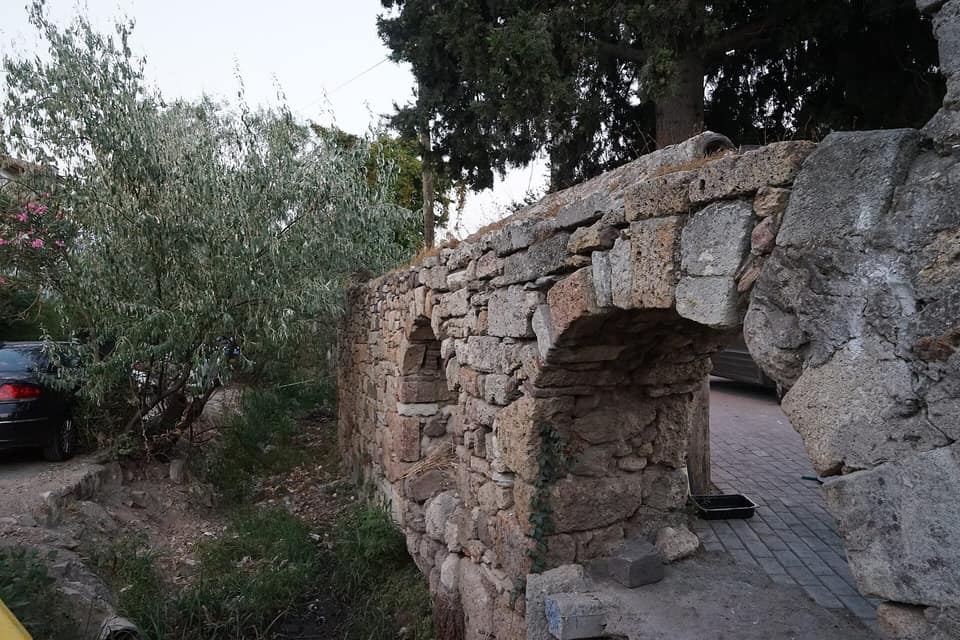
Foremost among the water structures that can be seen in Selçuk today are the Byzantine arches that run from the east towards Ayasuluk Hill. Part of the piers, built of very large cut stones and bricks and joined to one another by round arches, are in fairly good condition.
The Foça aqueduct
In Old Foça, on İzmir's northern coast, a historic aqueduct also still stands. The Provincial Directorate of Culture and Tourism writes that it was used until the beginning of the twentieth century and supplied most of the area's drinking water. Its construction date is uncertain. The French researcher Felix Sartiaux suggested that it was built in the Middle Ages. Le Bruyn, who visited the area in the seventeenth century, counted 180 arches. Built of rubble and cut stone, with thin, long round arches, the structure is largely intact.
A one-day water route
Those who want to set aside a day in the city can spend the morning in Kemeraltı with the Dönertaş Sebil and the fountain on Ali Paşa Square. In the afternoon, heading to Buca to see the Kızılçullu aqueducts in Şirinyer makes it possible to follow the city's Roman water line within its present-day fabric. The arches of Selçuk and the archaeological site of Ephesus are the subject of a separate day. Urla and Foça can easily be fitted into a trip to the peninsula or to the northern coast. For the visiting hours and fees of archaeological sites and museums, check the current information on their official websites.
Sources
- İzmir Provincial Directorate of Culture and Tourism, Aqueducts and Bridges, https://izmir.ktb.gov.tr/EN-243128/aqueducts-and-bridges.html
- İzmir Provincial Directorate of Culture and Tourism, Fountains, https://izmir.ktb.gov.tr/EN-243127/fountains.html
- Visit İzmir, Hacı Salih Pasha Fountain (Ali Pasha Square Fountain), https://www.visitizmir.org/en/Destination/15270
- İzmir Institute of Technology, Identification of Vezirağa Aqueduct in İzmir as a Historical Monument (master's thesis, 2016), https://gcris.iyte.edu.tr/handle/11147/4872
- Şener, İ. E. and İpekoğlu, B., Assessment of Halkapınar Water Pump Station for its conservation as industrial heritage, GRID 7(1), 2024, https://dergipark.org.tr/en/pub/grid/article/1189350
Comments
Be the first to comment