

From Terkos to the Tap, the Modern Water History of Istanbul
Istanbul was not founded on the shore of a large lake or river, so throughout its history it has always had to bring its water from far away.

Sign in to like and rate
Istanbul was not founded on the shore of a large lake or river, so throughout its history it has always had to bring its water from far away. İSKİ's own history divides this long story into three periods, Roman and Byzantine, Ottoman and Republican. Aqueducts, dams, cisterns and fountains are the best known face of that story, and the city already has routes that lead you through them. This article looks at the less told final chapter instead, the period from the end of the nineteenth century to today, when water began to be pushed by steam pumps, to enter homes through pipes and to be stored behind dams. At the end we also describe where this history can still be seen on the ground today.
From the fountain to the pipe
The Ottoman city distributed its water by gravity, that is, by the water's own flow. Water taken from a spring passed through clay pipes and galleries, crossed valleys on aqueducts, was divided at distribution houses called maksem, had its pressure regulated by water towers known as su terazisi, and finally reached the fountains. According to İSKİ, water was measured at every distribution point and the unit used was the lüle. This system was enough to feed a neighbourhood fountain, but it could not lift water to the upper floors of the new multi storey buildings. The apartment blocks rising in Beyoğlu and Galata in the second half of the nineteenth century heralded a new city that needed water under pressure.
The solution came with a concession. According to İSKİ's history, in 1868, during the reign of Sultan Abdülaziz, a concession was granted to a French company, and an enterprise was born whose official name was the Dersaadet Anonymous Water Company but which the public called the Terkos Company. The company was to supply water taken from Lake Terkos to Beyoğlu, Galata, the western shore of the Golden Horn and the European side of the Bosphorus. A thesis prepared at Marmara University explains that it was a multi partner Ottoman joint stock company and that it sold water through subscriptions and water meters. According to the same study, the contract also required free water for hospitals, military units and firefighting. The idea of the meter that now sits in every home entered Istanbul with this company.
The steam pumps at Terkos
The company's first facility was the pumping station built on the shore of Lake Terkos in 1883, and in 1888 a weir that raised the level of the lake was also built around it. A master's thesis prepared at Istanbul Technical University in 2003 studies this building in detail. According to the thesis, the station was built with engineers, architects and craftsmen brought from France and became the first pumping station built for Istanbul's drinking water. Inside were Fargo pumps running on superheated steam, and a total of six pumps in three groups were commissioned between 1883 and 1885. Each group had a power of 100 horsepower, and the greatest height to which it could push water was 127 metres. One group pumped 11 thousand cubic metres of water a day, and the three together reached 33 thousand cubic metres. High calorie coal brought from Zonguldak was used to fire the boilers.
These figures were very large for the city of that time. To compare, it is enough to recall that according to İSKİ, in the early 1930s the daily water supplied to the whole of Istanbul was about 35 thousand cubic metres. İSKİ's water resources page states that the station was operated until 1967 and is preserved today as an industrial museum. The lake itself now appears in the city's list of water sources under the name Terkos Dam, and its year of entry into service is still given as 1883.
The Asian side's company and Elmalı
The Asian side got its own company in the same years. According to İSKİ's account, the Üsküdar Kadıköy Water Company was founded in 1888 and in 1893 built the first Elmalı Dam on the Elmalı stream. A network was laid along the shore stretching from Anadolu Hisarı to Bostancı. A plant to treat the dam's water, a pumping station, a main line reaching Bağlarbaşı and the Bağlarbaşı Water Reservoir were also the work of this company. The Elmalı 2 Dam on the Çavuşbaşı stream was added in 1950. Today the two dams together are among the city's smallest sources, but this is where the word dam first took on a meaning in Istanbul.
Hamidiye Water and the station at Cendere
While pressurised networks were being built, spring water supplies also kept growing. İSKİ's history names the most important of them as the Hamidiye Water, built during the reign of Sultan Abdülhamid II. Taken from springs at Kemerburgaz, this water was supplied to barracks and palaces around Beyoğlu and to some fifty fountains. The sources differ slightly on the date; İSKİ gives 1904 for the system, while the sources describing the station write that the pump house at Cendere began operating in 1902.
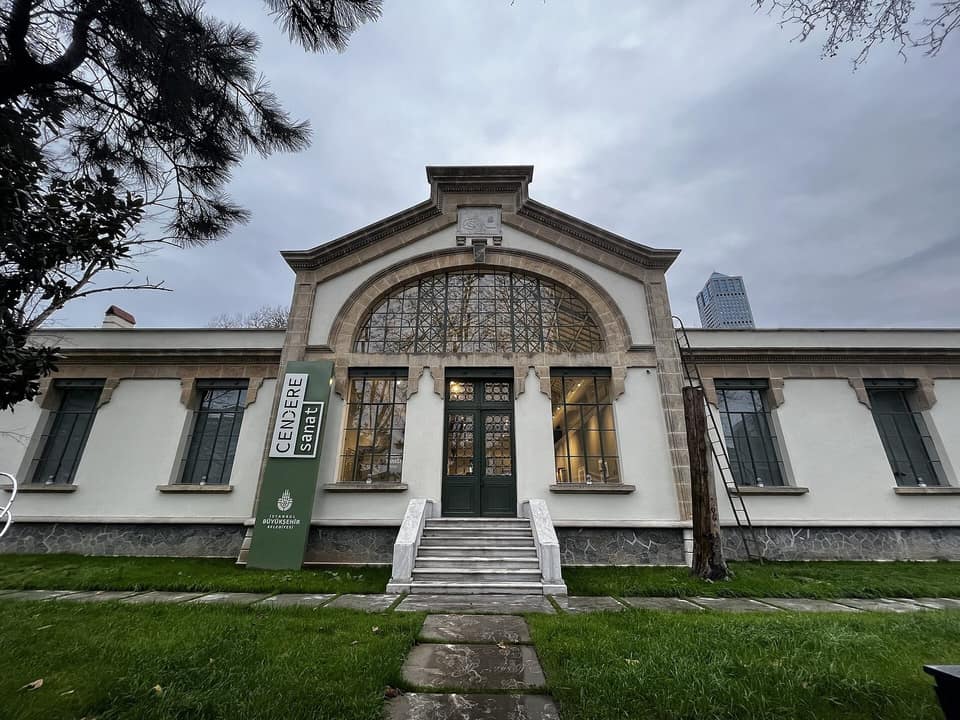
The Cendere Hamidiye Pumping Station was built in the Cendere valley to push the spring water collected in its reservoirs into the city. According to the library page of the Istanbul Metropolitan Municipality, the station was built when the Taksim water could no longer meet growing demand, and it delivered about 1,200 cubic metres of water a day to around a hundred fountains, including those along the road to Yıldız Palace. The building worked until the 1990s and then supplied only a few fountains. According to the Wikipedia article, its boilers were made in Switzerland, and in the 1960s the steam engines were moved to the old station at Terkos and replaced with electric pumps. The building's 33 metre brick chimney collapsed over time.
After the 1999 earthquake, work began to turn the building into a cultural facility, and the restoration was completed in 2009, but the building stayed closed for a long time. On 24 October 2022 it opened to visitors under the name Cendere Sanat, after a restoration by İBB Miras. Inside there is a library on art and water culture, along with exhibition and event spaces. The great plane tree in front of the building is described in the library's own introduction as about 390 years old.
The beginning of treatment and the Istanbul Water Administration
Lake water had to be cleaned before it was given to the city. According to İSKİ, Istanbul's first water treatment plant was built on the slopes of Kağıthane in 1926, and for the first time water was treated and chlorinated before entering the network. Kağıthane is still one of the city's largest treatment points; the plant treats water coming from the Alibey Dam and Terkos and distributes it to the central districts of the European side.
The era of the companies came to an end in the 1930s. The Terkos Company was purchased by the Istanbul Municipality, and the Istanbul Water Administration was founded by Law No. 2226 dated 27 May 1933. The administration was set up as a body attached to the municipality but with its own legal personality. In this period the capacity of the Terkos pumping station and the Kağıthane treatment plant was increased, and electric pumps replaced the steam driven ones. A power line was run between Terkos and Silahtarağa, artesian wells were drilled at Çırpıcı and a pumping station was set up there as well.
The age of dams
As the population grew rapidly, lake and spring water were no longer enough, and Istanbul entered the age of dams. According to İSKİ's list, the Ömerli Dam and the Alibey Dam entered service in 1972, and the Darlık Dam in Şile and the Büyükçekmece Dam in 1989. Ömerli is still the city's largest source by annual yield, and almost the whole of the Asian side receives water from it. At Büyükçekmece the lake's connection with the sea was cut and a reservoir was created. In 1981 the Istanbul Water and Sewerage Administration, İSKİ, was founded, and in 1984 it was placed within the metropolitan municipality.
In the 1990s the search for water reached deep into Thrace. On the Istranca streams the Düzdere, Kuzuludere, Büyükdere, Sultanbahçedere and Elmalıdere dams were completed between 1995 and 1997. Kazandere opened in 1997 and Pabuçdere in 2000. According to İSKİ's account, these two dams were connected by a tunnel 2,507 metres long, and the surplus water of Kazandere was transferred to Pabuçdere. The Sazlıdere Dam entered service in 1998 near Lake Küçükçekmece.
Water from under the Bosphorus
The last major step came from the east. In 2004 the Yeşilçay regulators, which take water from the Göksu and Çanak streams beyond Şile, came into operation. In 2007 the first water arrived from the Melen river on the border between Düzce and Sakarya; according to İSKİ, 268 million cubic metres a year could be taken in the first stage, and 575 million cubic metres a year after the second stage. A tunnel was dug under the Bosphorus to carry Melen water to the European side. According to the Wikipedia article, the Bosphorus Water Tunnel runs between Sarıyer and Beykoz about 135 metres below the surface and is 5.5 kilometres long. The story that began with six steam pumps at Terkos thus reached a pipe that joins two continents underground.
Where to see this history today
The easiest stop is Cendere Sanat. The building stands on Cendere Caddesi in Huzur Mahallesi in Sarıyer, and with its large arched facade, stone framed windows and brick body it shows how an industrial building can be reused. According to the library page it is closed on Mondays; check the official page for opening hours and the exhibition programme before you go. Sitting for a while under the plane tree in the garden and looking at the symmetry of the building is enough to imagine that boilers once worked here.
The second stop is Terkos. According to İSKİ, the old pumping station on the lakeshore is preserved as an industrial museum; since visiting conditions change from time to time, ask İSKİ for information before setting out. We also have a trip article about the lake and the forests around it, so you can link the same day to that.
The best places to see the dams are Ömerli and Büyükçekmece. The Ömerli reservoir stretches through the forests between Çekmeköy and Şile; since its shores are a drinking water protection zone, you look at it only from the points the road allows and follow the warning signs in the area. Lake Büyükçekmece, close to the coast road, is one of the water sources most easily reached from the city.
Practical notes
Most of the places in this article are far apart, so do not try to see them all in a single day. It is wiser to add Cendere to an afternoon in the city, Terkos to a weekend trip to the north, and Büyükçekmece to a route along the western coast. Most water facilities lie within protection zones; take the wire fences, warning signs and photography bans seriously. And the next time you turn on the tap, remember that the water may have come from Istranca, from Ömerli or from Melen.
Sources
- İSKİ, History of Water in Istanbul, https://iski.istanbul/kurumsal/hakkimizda/istanbul-da-suyun-tarihcesi
- İSKİ, Water Resources, https://iski.istanbul/kurumsal/hakkimizda/su-kaynaklari/
- H. Saltuk Akatay, Survey, Restitution and Restoration Projects of the Terkos Water Pumping Station (İTÜ, 2003), https://polen.itu.edu.tr/items/78558626-8b12-4935-ba7e-a845691b15a7/full
- Halil İbrahim Gül, The Terkos Water Company (Marmara University, 2009), https://openaccess.marmara.edu.tr/entities/publication/7348dd5a-24de-41ac-86f4-235ee9e84dac
- IMM Libraries and Museums, Cendere Sanat Library, https://ataturkkitapligi.ibb.gov.tr/en/Kitaplik/Kutuphanelerimiz/IMM-Cendere-Sanat-Library/53
- Wikipedia, Cendere Sanat Müzesi, https://tr.wikipedia.org/wiki/Cendere_Sanat_M%C3%BCzesi
- Wikipedia, Boğaziçi Su Tüneli, https://tr.wikipedia.org/wiki/Bo%C4%9Fazi%C3%A7i_Su_T%C3%BCneli
Comments
Be the first to comment