

From Simit to Boza, the Story of Istanbul Street Food
In Istanbul, eating on the street is not about rushing a meal; it is a way of keeping pace with the city's calendar.

Sign in to like and rate
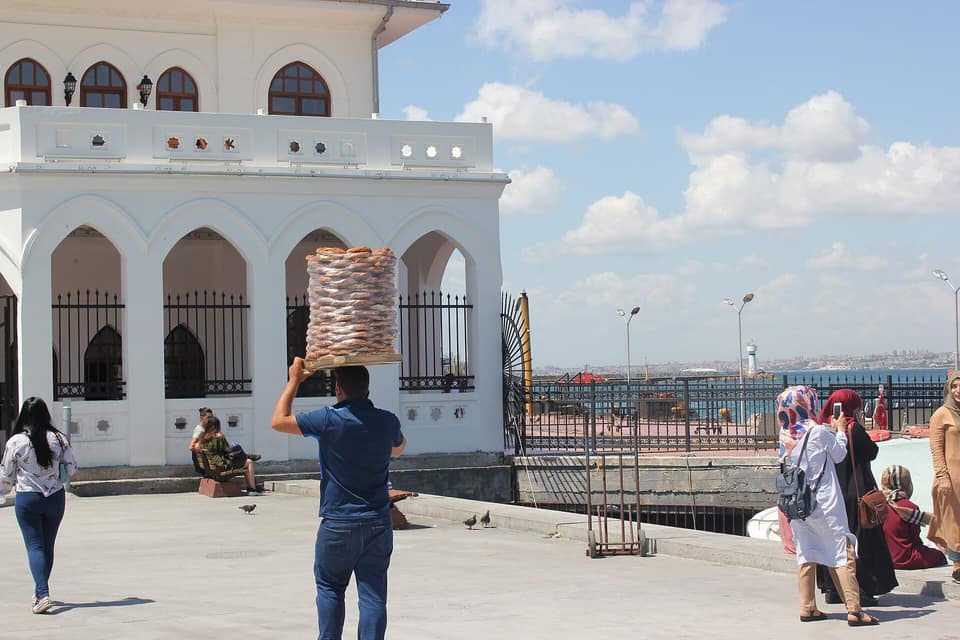
In Istanbul, eating on the street is not about rushing a meal; it is a way of keeping pace with the city's calendar. The simit grabbed on the way to the morning ferry, the fish sandwich eaten by the pier in the late afternoon, the paper cone of chestnuts held in gloved hands on a winter night and a glass of boza with cinnamon in Vefa each belong to a different hour and a different season of the city. This piece tells the story of Istanbul's street food as far as the sources allow: how long each has been around, which season and which neighbourhood suits it best, and what to watch out for when eating on the street. Since we cover coffee and tea culture at length in a separate article, they get only a brief mention here.
The Morning Simit
The sesame ring's history in Istanbul rests on written records. According to the oldest archival sources cited in the Turkish Wikipedia article, simit has been eaten in Istanbul since 1525. In 1593 the weight and price of simit were officially fixed in the court registers of Üsküdar, bringing it under the price controls known as narh. The 17th century traveller Evliya Çelebi wrote that there were 70 simit businesses in Istanbul in the 1630s. The palace knew simit too: the TDV Encyclopedia of Islam entry on the palace kitchen lists simit among the breads baked in the palace ovens.
What makes a simit a simit is the dip in grape molasses thinned with water, followed by a coat of sesame before baking; its colour and faint sweetness come from this. The method also sets it apart from the ring breads of Eastern Europe, which are poached in boiling water. Regional versions have developed across Turkey; the Ankara simit, which holds a geographical indication, is smaller than the Istanbul simit and more heavily coated in molasses. The way it is sold has hardly changed in centuries. Sellers either carry trays on their heads or push glass fronted carts, calling out that their simit is fresh and hot. Visual records from early 19th century engravings to illustrations of 1906 capture this familiar figure of Istanbul's streets.
A good traveller pairs simit with a journey. Early in the morning, crowds gather at the carts by the piers and metro exits, and that is your best chance of a ring straight from the oven. Eating it with a glass of tea, with white cheese or on its own keeps alive one of the city's oldest breakfast habits.
Fish Sandwiches by the Pier
The fish sandwich has its roots on Istanbul's shores, once crowded with fish and workers. The study by Mustafa Zengin and Aylin Ulman on the history of bonito describes how, along the Golden Horn where porters, labourers and boatmen gathered, and in districts such as Karaköy, Üsküdar and Kadıköy, bonito or mackerel was cooked and sold in boats moored at the shore, a tradition that continues today. For families who could not afford meat, fish that was plentiful in season was a cheap and filling meal.
Today's picture is a little different. The study by Ulman and colleagues on Turkey's lost fish notes that the custom of eating bluefish and mackerel in bread survives in Istanbul, but now with imported mackerel. Atlantic and chub mackerel stopped migrating through the Bosphorus as they used to around 1970. The English Wikipedia article on Eminönü says the area became known for grilled mackerel sandwiches sold from boats moored by the Galata Bridge, that the authorities have intervened in these sales from time to time, and that three boats were still operating as of 2022.
The best known spot for a fish sandwich is still the Eminönü waterfront, but you will find similar stalls in most shoreline districts from Karaköy to Üsküdar. The bread is filled with tomato, greens and onion. Do not hesitate to ask which fish is in your sandwich; one made with bonito or horse mackerel in season is a different experience from one made with imported mackerel. If you are curious about the Bosphorus fish calendar, see our article From Bluefish to Anchovy.
Stuffed Mussels and Shoreline Culture
Midye dolma, stuffed mussels, is one of the most familiar stalls of the Istanbul night. The shell of a cooked black mussel is filled with spiced rice and eaten with a squeeze of lemon. Melceü't-Tabbahin, published in 1844 by Mehmed Kamil and known as the first printed Turkish cookbook, describes the dish in detail: the mussels are cleaned and opened without breaking the hinge, filled with a pilaf of onion, olive oil, nuts, currants and spices such as allspice, cinnamon, clove and black pepper, and cooked in their own juices.
The English Wikipedia article notes that the dish is historically attributed to the Armenians of the Ottoman Empire, and that a source from 1888 records Armenians preparing large mussels with sheep's tail fat. The same article relates that in the 1960s the making and selling of stuffed mussels in Galata passed into the hands of migrants from Mardin, spreading spicier Mardin style versions. Today most stalls are small carts, and they stay open late into the night.
The mussel story has a sea side too. The Ministry of Agriculture and Forestry's commercial fishing regulation for 2024 to 2028 bans gathering black and hairy mussels in the southern Bosphorus, in the area between the line joining Ahırkapı and Kadıköy and the line joining Paşabahçe and Yeniköy. In the open parts of the Bosphorus and other territorial waters, mussel harvesting is banned from 15 April to 30 June. Where the mussel on the tray came from is as important a question as what you are eating.
Roasted Chestnuts and Corn
As the air cools and autumn arrives, carts roasting chestnuts over charcoal appear on street corners. The English Wikipedia article on roasted chestnuts lists them as a popular autumn and winter street food in Istanbul, alongside East Asia, Europe and New York.
Corn has an Istanbul story of its own. According to Turkish Wikipedia, the plant reached Istanbul from Egypt by way of Syria in the 1600s under the names Mısır buğdayı and Mısır darısı, Egyptian wheat and Egyptian millet, which is why Turkish still calls corn mısır. When buying chestnuts, choose ones whose shells have split slightly and whose insides are hot and soft; the paper cone warms your hands and keeps you company on a cold evening walk.
Boza on Winter Evenings
Boza is a thick, slightly tangy winter drink made by fermenting grains such as millet. The Turkish Wikipedia article notes that Ibn Battuta recorded the Turks of the Kipchak Steppe drinking it in the early 14th century. In the mid 17th century Evliya Çelebi wrote that Istanbul had more than 300 boza shops and some 1,100 boza makers.
Today boza in Istanbul is linked almost to a single neighbourhood: Vefa. Hacı Sadık Bey, who came to Istanbul from Prizren in Kosovo in 1870, developed a new method at a time when some 200 tradesmen in the city made a thin, dark and sour boza; his was thicker, light yellow and only mildly sour. After six years of selling it on winter nights from copper jugs carried on his shoulder, he opened the shop now known as Vefa Bozacısı in Vefa in September 1876. According to the archive of the Century Old Brands Association, Atatürk visited the shop on 18 November 1937, and the glass he drank from is kept as a memento. The business is still run by the fourth generation of the same family.
According to Küre Encyclopedia, Vefa's boza is made from millet flour, water and sugar through natural fermentation. Turkish Wikipedia notes that the shop's founding coincided with 1876, the year the first Ottoman constitution was proclaimed. Boza is served with a sprinkle of cinnamon and roasted chickpeas on the side. Its best moment is a cold winter evening. Drinking a glass on your way down the back streets of Vefa after a walk around Süleymaniye is the best way to meet it in its historical setting. Bottled boza has been sold in supermarkets since the 2000s, but the texture of boza poured into a glass at the counter is something else.
Salep and Cold Mornings
Salep is a flour made from the tubers of certain orchids, containing a starchy substance called glucomannan, and it is thickened and drunk hot. According to Turkish Wikipedia, salep spread in the Ottoman period and, before coffee and tea became common, reached England and Germany, where it was served in coffee houses under the name saloop in the 17th and 18th centuries.
In winter today, salep is easy to find on ferries, at piers and in patisseries. But this warm drink has a cost: the same article notes that rising demand has left wild orchid species facing local extinction in parts of Greece, Turkey and Iran. Three regional salep names in Turkey are protected by geographical indications: Akdağmadeni and Bucak in Burdur were registered in 2021, and in Kahramanmaraş local orchids supply the salep that gives the city's ice cream its texture. Enjoy your salep, but if you plan to take a packet home as a gift, ask where it comes from.
Turkish Delight and Akide, Bahçekapı's Sweet History
Pausing at the confectionery windows as you pass Bahçekapı in Eminönü means pausing before one of Istanbul's oldest sweet traditions. According to Turkish Wikipedia, Bekir Efendi, who came to Istanbul from Araç in Kastamonu province, opened a small sweet shop in Bahçekapı in 1777. After his pilgrimage to Mecca between 1817 and 1820, the shop came to be known as Hacı Bekir. Now known as Ali Muhiddin Hacı Bekir, the business won gold medals at the 1897 Brussels and 1906 Paris exhibitions, opened branches in Cairo and Alexandria, and continues in its fifth generation as Turkey's oldest confectionery company.
The name lokum comes from the Arabic rahat al hulkum, meaning soothing to the throat. Turkish Wikipedia notes that the arrival of refined loaf sugar and especially starch in the 17th century changed both how sweets once made with honey or molasses were produced and how they tasted. It is also said that Hacı Bekir introduced lokum to Europe and won a competition held by Sultan Abdülhamid I; this is a legend. Afyon lokum, Safranbolu lokum and Osmaneli quince lokum are now protected by geographical indications. The study by Aysu Hatipoğlu and Orhan Batman also recalls that Turkish coffee was traditionally brewed slowly over a low fire and served with double roasted lokum; lokum is not just a souvenir but coffee's companion.
Akide is part of an even older tradition. Its name comes from the Arabic akit, meaning contract. This hard candy was handed out to the Janissaries at their pay ceremonies in the Ottoman period and was seen as the token of a pact expressing the soldiers' loyalty to the sultan. Rose, cinnamon, mastic, orange and lemon flavoured akide still sit in the same windows today.
A Cup of Coffee, a Slim Glass of Tea
Street food has two constant companions, coffee and tea. According to the TDV Encyclopedia of Islam entry on coffee houses, the historian Peçevi wrote that Istanbul's first coffee houses were opened in Tahtakale in 962 of the Hijri calendar (1554 to 1555) by Hakem of Aleppo and Şems of Damascus; Murad IV ordered the coffee houses closed in 1633, but the ban did not last. Turkish coffee culture and tradition was inscribed on UNESCO's Representative List of the Intangible Cultural Heritage of Humanity in 2013. UNESCO's description brings together the fine grinding of freshly roasted beans, the slow brewing with water and sugar to build foam, coffee's place in conversation and hospitality, and fortune telling from the grounds left in the cup. Tahtakale is still where the smell of freshly ground coffee spills into the street.
Tea's story is more recent. According to English Wikipedia, the first tea trials in Rize began in 1912, the Central Tea Nursery was set up in 1924, and large scale production settled between 1939 and 1945. At 3.16 kilograms per person a year, Turkey drinks more tea per head than any other country. A glass of tea in a slim, tulip shaped glass from the tea seller next to the simit cart is the essential companion of a street breakfast. For tea gardens and coffee houses, see our separate article.
Neighbourhood Stops
Street food is more fun placed on a map than in a list. The flavours that sources tie to particular neighbourhoods can be lined up like this:
- Eminönü waterfront: fish sandwiches from the boats and, one street away, the coffee aroma of Tahtakale.
- Bahçekapı: windows of lokum and akide.
- Vefa: boza with cinnamon and roasted chickpeas on a winter evening.
- Ortaköy: according to the English Wikipedia article on Beşiktaş, the district's best known street food is kumpir, the loaded baked potato.
- Bebek: the same article associates Bebek with almond paste.
- Galata and Karaköy: the shore where stuffed mussel stalls have clustered since the 1960s.
- Every pier and metro exit: simit and tea in the morning, salep and chestnuts in winter.
A Seasonal Street Calendar
Most street food follows the seasons, and being in the right place at the right time changes the experience.
- All year: simit, tea, fish sandwiches and stuffed mussels. Keep in mind that gathering mussels from the sea is banned from 15 April to 30 June.
- Autumn: the chestnut carts appear; the bonito and bluefish season opens on the Bosphorus, and your chance of a fish sandwich made with seasonal fish goes up.
- Winter: the best time for boza and salep; roasted chestnuts keep you company on cold evenings.
- Spring and summer: simit and fish sandwiches carry on, while hot drinks give way to cooling ones. This is the season when asking where stuffed mussels come from matters most.
- With coffee in any season: lokum is the traditional sweet served alongside.
Practical Notes for Clean and Safe Eating
Eating on the street is one of the most enjoyable ways to get to know Istanbul, but it calls for a little care. With seafood sold raw or at room temperature, the risk is real. In a study of street sold stuffed mussels in Ankara, published in the Indian Journal of Microbiology in 2011, about half of 30 samples (600 mussels in total) were unfit for consumption because of Salmonella; by the criteria of the Turkish Food Codex, 30 per cent failed for E. coli, 80 per cent for Bacillus cereus and 76.6 per cent for Staphylococcus aureus. Another study showed that lemon juice reduced Salmonella in mussels only slightly; lemon is a flavour, not a safety measure.
- Choose food served hot and cooked in front of you; simit, chestnuts, corn and grilled fish carry less risk.
- For stuffed mussels, pick busy stalls where stock turns over quickly. Avoid trays that have sat in the sun for a long time.
- Ask where the mussels come from. Gathering mussels in the southern Bosphorus is banned, and sea mussel harvesting is closed in late spring and early summer.
- If your stomach is sensitive, it is wise to postpone seafood before a journey or in the middle of a long day of sightseeing.
- Ask which fish is in your sandwich; out of season or imported fish is not bad, but you have a right to know what you are eating.
- Buy drinks such as boza and salep where the glasses and ladles look clean.
- Ask for lokum freshly cut from the display rather than an open box that has been sitting around, and check the production date on boxed lokum.
- Historic shops are places in their own right: in Vefa and Bahçekapı, take a few minutes beyond your purchase to look at the windows, the old bottles and the photographs on the walls.
Sources
- Turkish Wikipedia, Simit, https://tr.wikipedia.org/wiki/Simit
- TDV Encyclopedia of Islam, Matbah-ı Amire entry, https://islamansiklopedisi.org.tr/matbah-i-amire
- TDV Encyclopedia of Islam, Kahvehane entry, https://islamansiklopedisi.org.tr/kahvehane
- UNESCO, Turkish coffee culture and tradition (2013), https://ich.unesco.org/en/RL/turkish-coffee-culture-and-tradition-00645
- Mustafa Zengin, Aylin Ulman, The Historical Journey of the Bonito (Sarda sarda) Population in the Black Sea, Journal of the Black Sea Research Institute (2026), https://dergipark.org.tr/tr/download/article-file/4062628
- Aylin Ulman et al., The Lost Fish of Turkey, Frontiers in Marine Science (2020), https://www.frontiersin.org/articles/10.3389/fmars.2020.00650/full
- Wikipedia, Eminönü, https://en.wikipedia.org/wiki/Emin%C3%B6n%C3%BC
- Wikipedia, Stuffed mussels, https://en.wikipedia.org/wiki/Stuffed_mussels
- Turkish Wikipedia, Melceü't-Tabbahin, https://tr.wikipedia.org/wiki/Melce%C3%BC%E2%80%99t-Tabb%C3%A2h%C3%AEn
- Mustafa Ateş, Aslı Özkızılcık, Cengiz Tabakoğlu, Microbiological Analysis of Stuffed Mussels Sold in the Streets, Indian Journal of Microbiology (2011), https://doi.org/10.1007/s12088-011-0174-6
- Official Gazette, Communiqué No. 6/1 on Commercial Fishing (11.08.2024), https://www.resmigazete.gov.tr/eskiler/2024/08/20240811-3.htm
- Wikipedia, Roasted chestnut, https://en.wikipedia.org/wiki/Roasted_chestnut
- Turkish Wikipedia, Mısır (bitki), https://tr.wikipedia.org/wiki/M%C4%B1s%C4%B1r_(bitki)
- Turkish Wikipedia, Boza, https://tr.wikipedia.org/wiki/Boza
- Century Old Brands Association, Vefa Bozacısı, https://yuzyillikhikayeler.com/en/historic-brands/vefa-bozacisi/
- Küre Encyclopedia, Tarihi Vefa Bozacısı, https://kureansiklopedi.com/tr/detay/tarihi-vefa-bozacisi
- Turkish Wikipedia, Salep, https://tr.wikipedia.org/wiki/Salep
- Turkish Wikipedia, Ali Muhiddin Hacı Bekir (company), https://tr.wikipedia.org/wiki/Ali_Muhiddin_Hac%C4%B1_Bekir_(%C5%9Firket)
- Turkish Wikipedia, Lokum, https://tr.wikipedia.org/wiki/Lokum
- Turkish Wikipedia, Akide şekeri, https://tr.wikipedia.org/wiki/Akide_%C5%9Fekeri
- Aysu Hatipoğlu, Orhan Batman, Comparison of Gastronomic Elements of the Ottoman Palace Cuisine With Today's Turkish Cuisine (2014), https://dergipark.org.tr/tr/download/article-file/117632
- Wikipedia, Turkish tea, https://en.wikipedia.org/wiki/Turkish_tea
- Wikipedia, Beşiktaş, https://en.wikipedia.org/wiki/Be%C5%9Fikta%C5%9F
Comments
Be the first to comment