

From Nallıhan to Mogan, a Birdwatching Guide to Ankara
The birds' route across the steppe For many people, Ankara means steppe, wide boulevards and institutions.
 Radar Türkiye24 Kasım 2026
Sign in to like and rate
The birds' route across the steppe
For many people, Ankara means steppe, wide boulevards and institutions. Yet within the province there are wetlands on migration routes, reed beds, a salt lake and old black pine forests. These places host different bird communities in every season, and a quiet day out with binoculars reveals a side of the city that few people know. The four areas below are very different habitats: one is a wetland formed north of a dam reservoir, one is a pair of natural lakes just south of the city, one is an inland salt sea, and the last is a forest of birds of prey. Visiting all of them in different months of the same year is the best way to learn Ankara's bird calendar with your own eyes.
Nallıhan Bird Sanctuary
According to the Türkiye Culture Portal, the Nallıhan Bird Sanctuary is an artificial wetland ecosystem that formed north of the Sarıyar Dam, which entered service in 1959, where the Aladağ Stream meets the reservoir. Willow thickets, reed beds and tamarisks line the stretch where the stream flows into the reservoir, surrounded by farmland, poplar groves, steppe, rocky cliffs and hills. This variety of habitats and plentiful food allow large flocks of many kinds of birds to live in the area. The section where birds are most concentrated has been declared a Wildlife Development Area, and hunting is banned there. The same source notes that the facilities on site make it one of the few most suitable wetlands in the country for day trips devoted to nature photography and birdwatching.
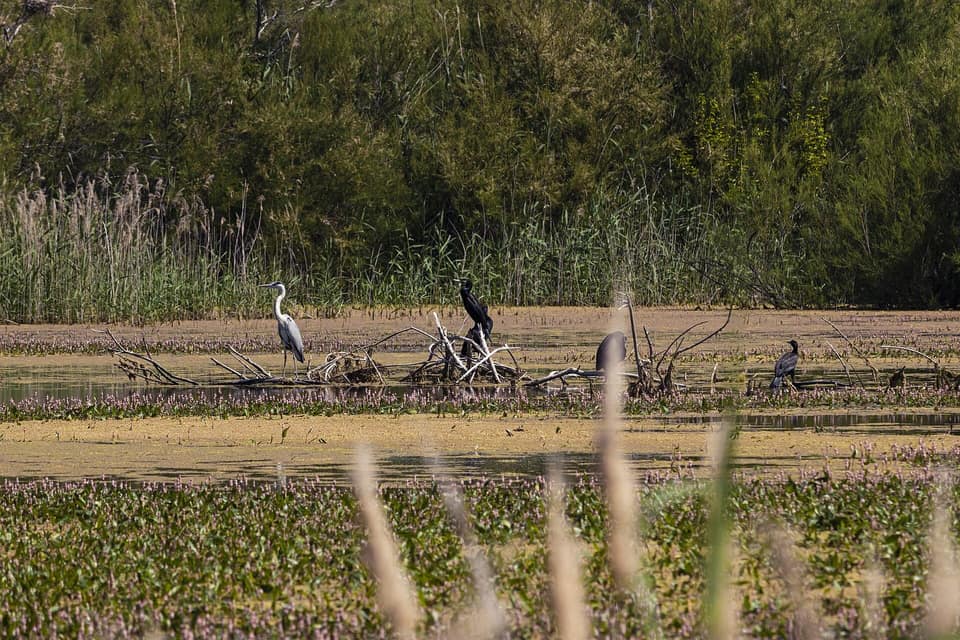
First-time visitors to Nallıhan are surprised by the hills in the background as much as by the birds. The Culture Portal describes the area as an extraordinary landscape in which yellow, brown and reddish layers repeat one above the other. These colourful slopes slip naturally into the frame when you photograph a heron in the reeds or a cormorant on the water, and they make Nallıhan photographs instantly recognisable.
A study carried out at Hacettepe University between 2011 and 2013 monitored the waterbirds that breed in colonies in the area. According to the study, the great cormorant, grey heron, little egret and black-crowned night heron breed regularly every year in colonies in poplar and willow trees between March and August. That is why nests in the treetops, adults coming and going, and the calls of chicks are Nallıhan's liveliest sight in spring and early summer. Approaching the colony trees disturbs the birds; watching from a distance with binoculars or a long lens is the right approach both for the birds and for a good observation.
Mogan and Eymir, two lakes at the city's door
The bird area that stands out for its closeness to the city centre is formed by the Mogan and Eymir lakes in Gölbaşı. According to an introductory document from the Ministry of Environment, Urbanisation and Climate Change, the area was declared a Special Environmental Protection Area by a Council of Ministers decision dated 22 October 1990. The protected area covers 273.94 square kilometres; Lake Mogan has a surface of about 5 square kilometres and Lake Eymir about 1.2 square kilometres. The document states that Mogan's average depth is around 2.8 metres and that the lake holds a small volume of water relative to its basin. This shallowness, together with the reed beds and marshes along the shore, creates a rich feeding ground for waterbirds.
The ministry document explains that the reed beds, freshwater marshes, meadows and pastures of the area allow thousands of birds to feed, shelter and incubate, and that observations have recorded 227 bird species there. Among the breeding species are the white-headed duck, which is globally endangered, and the ferruginous duck, which is near threatened. The common pochard, red-crested pochard, ruddy shelduck and mallard are ducks that breed widely in the reed beds. The northern pintail, northern shoveler, common teal, gadwall, Eurasian wigeon, garganey and tufted duck spend their migration and winter periods in the area. According to the document, all seven heron species seen in Türkiye have been observed at Mogan during breeding, wintering or migration.
The ministry's habitat and species monitoring report stresses that the squacco heron, little bittern, white-headed duck and lesser kestrel, which are on the Bern Convention's list of strictly protected species, must be absolutely protected in this area. The same documents explain that the reed area south of Mogan, also known as the Çökek marsh, was registered as a first-degree natural site in 2001. For birdwatchers, these southern reed beds and the walking paths along the lakeshore are the most productive spots. The ministry document lists bird, plant and butterfly watching among the recreational activities in the area. Flocks of ducks in winter and the songs rising from the reeds in spring make Mogan worth a visit in every season.
Tuz Gölü and the flamingos
Tuz Gölü, on whose shore Ankara's Şereflikoçhisar district lies, is an entirely different world. The Türkiye Culture Portal describes Tuz Gölü, which lies within the borders of Ankara, Konya and Aksaray, as the second largest lake in Türkiye. In the basin, which has been declared a Special Environmental Protection Area, 85 bird species, 129 insect species, 15 mammal species and 38 endemic plant species have been recorded. The portal notes that the absence of any other significant wetland in the middle of the steppe draws migratory birds to the lake. Because of its high salt content, the lake does not freeze in winter and becomes a good refuge for migratory birds.
Flamingos, cranes, wild geese, pied avocets and ruddy shelducks live on the lake, along with plovers and wild ducks in groups. Marsh terns, shelducks, ruddy shelducks and gull species can be seen in the small lakes, pools and marshes around it. The portal writes that the lake's water, which rises in winter, begins to recede from May, and that from June onwards it is possible to walk on the lake. At sunset, the red glow falling on the lake surface and the backlight create photographers' favourite moment for flamingo silhouettes. Remember that the salt crust and mud near the shore can easily deceive you; it is best to watch the birds from the shore, on firm ground.
Cinereous vultures in the Soğuksu forests
Soğuksu National Park in Kızılcahamam offers an observation experience very different from the wetlands. According to an article in TÜBİTAK's Bilim Çocuk magazine, the cinereous vulture is one of the four vulture species living in Türkiye and the country's largest bird of prey. This bird, with a wingspan of up to three metres and a weight of about 14 kilograms, is most often encountered in Türkiye on Türkmenbaba Mountain in Eskişehir and in Soğuksu National Park in Ankara.
The article explains that cinereous vultures live in high forested terrain and build their nests at the very top of large trees such as old black pines. Nest building begins in autumn, the female lays a single egg in late February or early March, and the chick hatches about two months later, at the end of April. When flying, vultures make use of thermals created by air warmed by the morning sun. For this reason the best time to watch is late morning, when the air begins to warm; at that hour the huge wings glide over the valleys with hardly a beat. The article also points out that the greatest threats to this species are the destruction of forests and poisoned meat left out in nature.
Where to go in which season
The cycles described by the sources are enough to build a year-long bird calendar. In winter, Tuz Gölü, which does not freeze, and the flocks of ducks on Mogan stand out. February and March are the incubation period of the cinereous vultures in Soğuksu; during this time nesting areas are not entered, and the birds are watched from a distance and from open ground. Between March and August, the heron and cormorant colonies at Nallıhan are at their busiest. With its waters receding from May, Tuz Gölü is visited throughout the summer for flamingos and shorebirds. In autumn, the wetlands on the migration route become crowded once again.
Practical notes for birdwatching
A good pair of binoculars, a folding stool and a field guide are enough for the first day. Moving quietly and slowly along the reed-lined shores, and choosing natural tones rather than brightly coloured clothes, lets you see the birds from closer. Colony trees, nest sites and the inside of protected reed beds are off limits; respecting the rules in the wildlife development area at Nallıhan and in the protection areas at Gölbaşı and Tuz Gölü is the visitor's responsibility. Reaching Nallıhan, Tuz Gölü and Soğuksu generally requires a private vehicle, while Mogan and Eymir, being close to the city, are suitable for a half-day outing. Before setting off, check the current announcements of the relevant institutions for visiting conditions and possible access restrictions. Recording your observations by date, place and species lets you see the changes when you return to the same place the following season.
Sources
- Türkiye Culture Portal, Nallıhan Bird Sanctuary, https://www.kulturportali.gov.tr/turkiye/ankara/gezilecekyer/nallihan-kus-cenneti
- Ministry of Environment, Urbanisation and Climate Change, Gölbaşı Special Environmental Protection Areas, https://webdosya.csb.gov.tr/db/tabiat/icerikler/golbas--20211124130942.pdf
- Ministry of Environment, Urbanisation and Climate Change, Gölbaşı SEPA Habitat and Species Conservation Monitoring Project, https://webdosya.csb.gov.tr/db/destek/icerikler/golbas-_ozel_cevre_koruma_bolges--20191128075048.pdf
- Türkiye Culture Portal, Tuz Gölü, https://www.kulturportali.gov.tr/turkiye/ankara/gezilecekyer/tuz-golu
- TÜBİTAK Bilim Çocuk, The Cinereous Vulture, Türkiye's Largest Bird of Prey, https://bilimcocuk.tubitak.gov.tr/wp-content/uploads/sites/157/2025/09/ff7bf07b-aa31-408c-aad6-67bd4b92431d.pdf
- Hacettepe University, Bio-Ecological Research on Colonially Breeding Waterbirds in the Nallıhan Bird Sanctuary, https://openaccess.hacettepe.edu.tr/handle/11655/2083
Comments
Be the first to comment