

From Nallıhan Needle Lace to Ayaş Mulberries, Ankara's Geographical Indication Products
A product's identity card Ankara's districts have flavours and handicrafts passed down from generation to generation.
 Radar Türkiye24 Kasım 2026
Sign in to like and rate
A product's identity card
Ankara's districts have flavours and handicrafts passed down from generation to generation. Some of them are now registered in the geographical indication register of the Turkish Patent and Trademark Office. Each entry in the register is like a product's identity card; it sets out where and with which ingredients the product is made, how it is made, and the features that distinguish it from similar products. Two types appear in the records, designation of origin and geographical indication of provenance. Along the line from Nallıhan to Beypazarı and from Ayaş to the city centre there are many products that have entered the register, and each record also tells you where and how to recognise that product.
On its page describing what to buy in the city, the Ankara Provincial Directorate of Culture and Tourism also lists Beypazarı kurusu, carrot lokum, Ayaş mulberry molasses, Beypazarı filigree, mulberry pestil and walnut sucuk. The directorate's handicrafts page presents Nallıhan as one of Türkiye's important centres of needle lace, and mentions Beypazarı for silverwork and filigree and Çamlıdere for wood carving and stonework.
Nallıhan needle lace
Nallıhan İğne Oyası, Nallıhan needle lace, was registered as a geographical indication of provenance under number 325 on 15 February 2018; the registering body is the Nallıhan Development Foundation. The record defines needle lace as three-dimensional handwork made by forming loops of different shapes or knots with a needle and joining them together. Generally produced by women in the region, this lace is the product of long effort. According to the record, the use of silk spread in Nallıhan, which lies on the historic Silk Road, and lace making that began with silk threads continued over time with other kinds of thread.
The most important feature that sets Nallıhan lace apart is the thread twisting technique. The thread is first twisted to the left, then its two ends are joined and it is twisted to the right; the record states that this movement is repeated thirty-five to forty times. The twisted thread gives the lace a stiff, almost starched stance and removes the need for wire or fishing line to shape the motifs. That is why Nallıhan lace withstands washing and no chemical stiffener is used. The second distinguishing feature is the root; the root of the lace is never made directly on a headscarf or fabric. When the cloth wears out, the lace can be unpicked and sewn onto another cloth. The motifs include plant designs such as fruit, leaves and flowers, figures such as butterflies, symbolic names such as rake's moustache and palace broom, and objects such as baskets and bags.
The Nallıhan örtme
The district's second registered product is a weaving. Nallıhan Örtmesi was registered as a geographical indication of provenance under number 342 on 9 April 2018. The record defines the örtme as a wrap worn to cover the head together with the upper part of the body. Silk, a mix of silk and cotton, or cotton thread is used in the weaving, and the soaping of the warp thread called kız kıvrağı is unique to the Nallıhan örtme.
The two long edges of the örtme carry stripes of brown, mustard or yellow cocoon silk coloured with natural dyes. Triangular motifs are woven into the middle of the long edges with the brocade technique, and when the örtme is worn these motifs sit on top of the head. Because the motifs are made on both edges, the örtme can be used on either side. The record lists the most common patterns as Göbekli, Albaşlı, Zülüf Tarağı, Sarıgöz, Guguk, Bibercik, Hambarcık, İlikli Para, Köy Gezen and Koç Boynuzu. Looking at an örtme while knowing the names of its patterns is like learning to read the weaving.
Beypazarı kurusu
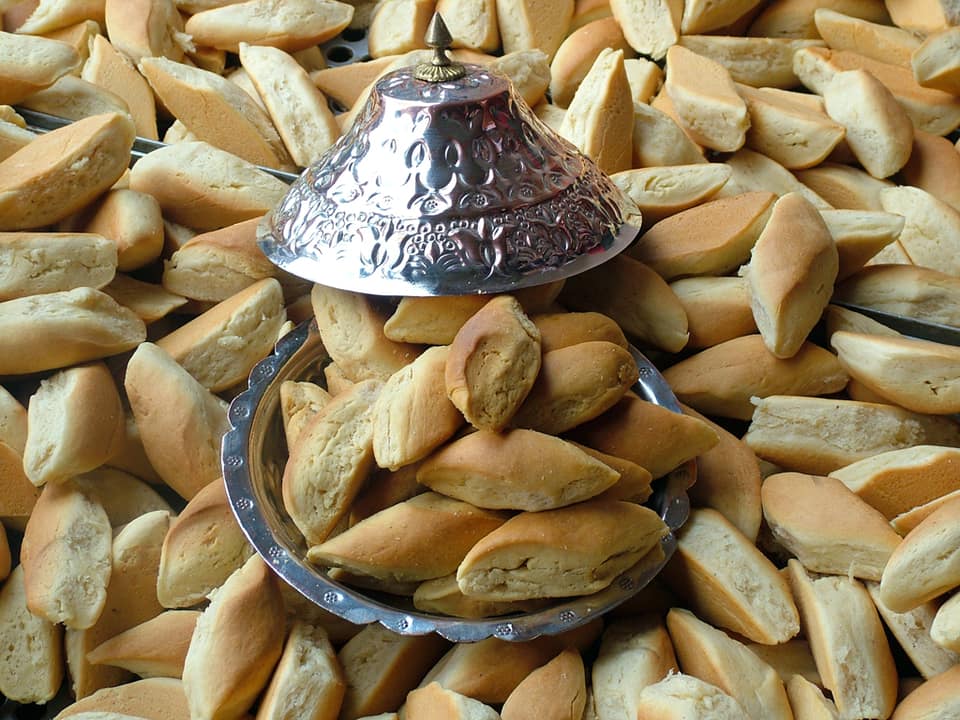
Beypazarı Kurusu was registered as a geographical indication of provenance under number 173 on 14 May 2013; the registering body is the Beypazarı Chamber of Commerce. According to the record, kurusu is a long-lasting bakery product the size of a finger, shaped like a diamond and made with flour, milk and butter, and no additives are used in its production. Because it is usually eaten with tea, it is made small enough to fit into a slim tea glass. Baked slowly in a stone oven, kurusu keeps for a year when stored in a dry place.
The record also explains the secret that distinguishes kurusu from other rusks; milk is used in the dough instead of water, which makes the product melt easily in the mouth, stay crisp and keep its colour. Cinnamon, allspice or mahleb added to the dough give kurusu its distinctive aroma. The milk used must be fresh from the same day, and for this reason it is sourced from Beypazarı.
Beypazarı carrot lokum and höşmerim
Beypazarı Havuç Lokumu, Beypazarı carrot lokum, was registered as a geographical indication of provenance under number 999 on 20 January 2022. According to the record, the lokum is made with carrots that are boiled and puréed; it is matt orange, smooth, coated with coconut and cut into cubes of about two centimetres. The record notes that Beypazarı has been an important carrot-growing centre throughout history and that the lokum holds an important place in the district's culinary culture. The mixture is cooked for six to seven hours, poured into trays, rested for at least a day and cut with a special knife.
Beypazarı Höşmerim Tatlısı, Beypazarı höşmerim dessert, was registered under number 1170 on 19 July 2022; the registering body is the Beypazarı Municipality. The dessert is made by cooking a batter of milk, brown wheat flour, salt and clotted cream in butter. Depending on preference, syrup, grape molasses or honey is poured over it. According to the record, höşmerim is served at daily meals as well as on special days such as weddings, holidays and festivals.
Ayaş mulberries and Ayaş tomatoes
Both of Ayaş's registered products are designations of origin, which means the product's identity is tied directly to the district's soil and climate. Ayaş Dutu, the Ayaş mulberry, was registered under number 900 on 22 September 2021 on behalf of the Ayaş Chamber of Agriculture. According to the record, the Ayaş mulberry comes from white mulberry trees, Morus alba in Latin, and is sold both fresh and dried. Every year in the first week of July, the Traditional Ayaş Mulberry Festival is held in Ayaş. The record attributes the mulberry's slightly sour taste to malic acid. The Provincial Directorate of Culture and Tourism also lists Ayaş mulberry molasses and mulberry pestil among the products to take home from the city.
Ayaş Domatesi, the Ayaş tomato, was registered under number 1236 on 5 October 2022. According to the record, this tomato, grown from local ecotype seeds and seedlings, is thin-skinned and very juicy, and has been grown in the district since the 1960s. The large, fleshy fruits weigh between 250 and 300 grams, are a dull pinkish red, and have hollows on the outer surface that make them look segmented. When the tomato is cut in half, a frost-like whiteness can be seen in the flesh. Because of its high acidity it has a slightly salty, lemony aroma. The record gives Ayaş's altitude as 910 metres; cold winters and hot, dry summers shape the character of this tomato.
Ankara erkeç pastırması
A designation of origin covering the whole province is Ankara Erkeç Pastırması, Ankara billy goat pastırma. Registered under number 408 on 8 January 2019 on behalf of the Ankara Chamber of Commerce, the pastırma is made, according to the record, from the meat of male Angora goats over four years old. The meat is coated with a mixture of crushed garlic and ground fenugreek seed and dried in the sun under suitable conditions. The record notes that Evliya Çelebi mentions goat pastırma in Ankara in his Book of Travels, and that for centuries the pastırma has been produced mainly in Ayaş as well as in other districts.
Where and how to recognise them
The easiest way to recognise a geographical indication product is by the wording and emblem on its packaging. Most of the records require the product's name and the geographical indication emblem to appear on the product itself or on its packaging, and where this is not possible, to be displayed where it can easily be seen in the business. Looking for this emblem when shopping is a way to support local producers and to be sure the product is made by the method defined in the record.
You get to know these products best in their own districts. In Beypazarı's historic market, filigree workshops can be seen alongside kurusu and carrot lokum. In Nallıhan, lace-edged cloths and örtmes can be seen where the craftswomen make them. Going to Ayaş in July for mulberries and in late summer for tomatoes is the way to find the produce at its freshest. The Provincial Directorate of Culture and Tourism notes that handicraft markets set up especially in the summer months in places such as Hamamönü, Beypazarı and Nallıhan give visitors a chance to get to know the craftspeople's work up close. Because festival and market dates can change every year, check the current announcements of the district municipalities and the directorate before setting off.
Sources
- Ankara Provincial Directorate of Culture and Tourism, What to Buy, https://ankara.ktb.gov.tr/TR-152361/ne-alinir.html
- Ankara Provincial Directorate of Culture and Tourism, Turkish Decorative and Traditional Handicrafts, https://ankara.ktb.gov.tr/TR-257755/turk-susleme-ve-geleneksel-el-sanatlari.html
- Turkish Patent and Trademark Office, Nallıhan İğne Oyası, Registration No 325, https://ci.turkpatent.gov.tr/files/legacy/GeographicalSigns/97ab0864-78f2-4400-a3c3-3c6d08cd70d6.pdf
- Turkish Patent and Trademark Office, Nallıhan Örtmesi, Registration No 342, https://ci.turkpatent.gov.tr/files/legacy/GeographicalSigns/342.pdf
- Turkish Patent and Trademark Office, Beypazarı Kurusu, Registration No 173, https://ci.turkpatent.gov.tr/files/legacy/GeographicalSigns/12f13dd5-c356-4824-af49-0fd4f70c03e0.pdf
- Turkish Patent and Trademark Office, Beypazarı Havuç Lokumu, Registration No 999, https://ci.turkpatent.gov.tr/files/legacy/GeographicalSigns/7f823a62-60e2-4885-b33b-1f4375b0a555.pdf
- Turkish Patent and Trademark Office, Beypazarı Höşmerim Tatlısı, Registration No 1170, https://ci.turkpatent.gov.tr/files/legacy/GeographicalSigns/68cf6c74-c118-41bc-b78a-4513c4eb4ccf.pdf
- Turkish Patent and Trademark Office, Ayaş Dutu, Registration No 900, https://ci.turkpatent.gov.tr/files/legacy/GeographicalSigns/1b07ab3e-ac62-48d9-ac6e-c0829493082a.pdf
- Turkish Patent and Trademark Office, Ayaş Domatesi, Registration No 1236, https://ci.turkpatent.gov.tr/files/legacy/GeographicalSigns/6adef5f3-983e-4a7c-a1d0-f3b0d4d8fc6d.pdf
- Turkish Patent and Trademark Office, Ankara Erkeç Pastırması, Registration No 408, https://ci.turkpatent.gov.tr/files/legacy/GeographicalSigns/906ff713-1af6-4218-b173-bbb19a33c2a9.pdf
Comments
Be the first to comment