

From Menemen Pottery to Bergama Carpets, the Crafts of İzmir
A city of hands İzmir usually brings to mind the bay, the Kordon and its ancient cities.
 Radar Türkiye24 Kasım 2026
Sign in to like and rate
A city of hands
İzmir usually brings to mind the bay, the Kordon and its ancient cities. Yet across the province's districts there is a map of crafts that has passed from generation to generation and still lives on at the loom, the kiln and the wheel. The İzmir Provincial Directorate of Culture and Tourism treats pottery, the evil eye bead, beledi weaving, felt making, needle lace and embroidery as separate topics under the heading of folk culture. Some of these crafts have also been registered with a geographical indication by the Turkish Patent and Trademark Office. The Bergama hand-made carpet, the Görece evil eye bead, Tire beledi weaving, the Helvacı kilim and Ödemiş silk are on that list. The lines below explain, one by one, where each craft was born, how it is made and where it can be seen today.
From clay to jug in Menemen
Menemen lies north of İzmir, in the plain that bears its name, and GoTürkiye writes that the soil of this plain has supplied abundant raw material for pottery. The Provincial Directorate of Culture and Tourism writes that the soil of the area is rich in pottery clay and that the need to store products such as olive oil nourished the craft. The same source notes that the oldest pottery in Anatolia dates to the Neolithic period, around 7000 BC, and that the first vessels were shaped by hand with the coiling method and fired in open fires. The potter's wheel came into use around 3000 BC. Finds from excavations at Bayraklı, Urla and Foça show that İzmir and its surroundings were also an important ceramic centre in ancient times.
In the Menemen workshops the work begins by turning the clay into slurry in special ponds. The slurry is filtered, cleaned and dried until it reaches a workable consistency. It is then shaped by hand on the wheel, dried and placed in the kiln. According to the Directorate, Menemen clay makes it possible to obtain both glazed and unglazed pieces in a single firing. The wheels that were once turned by human power have today been replaced by electric motors. Visit İzmir, the city's tourism portal, notes that vessels made from Menemen soil are not used as cooking pots and that potters instead make flower pots, water jugs, storage jars, yoghurt bowls, chimney pieces, handled cups and lampshades. GoTürkiye's article on İzmir's crafts also states that the Menemen jug is the most sought after souvenir. On a workshop visit you can watch the master at the wheel and see a lump of clay turn into a thin walled jug within a few minutes.
Blue glass in Görece and Nazarköy
The evil eye bead is one of İzmir's best known symbols, and its story leads back to Kemeraltı. The Provincial Directorate of Culture and Tourism relates that bead making reached Anatolia through Egyptian craftsmen who made anklets and bead bracelets at the Arap Han in Kemeraltı. It also writes that Turkish glassmaking goes back to the Seljuk period and that the eye motif was added to the mule bead once coloured glass became widespread. Today production continues in two villages. One of them is Görece in the Menderes district. The Görece Evil Eye Bead was registered as an indication of source in 2005 on the application of Menderes Municipality. The other is Nazarköy in the Kemalpaşa district. The village was once called Kurudere because it was founded in a stream bed, and its name was changed to Nazarköy by a decision dated 20 March 2007 because of the intensity of bead production there.
The heart of production is the round or oval kiln that the masters build with their own hands in the village. Glass of different colours is melted on shelves called pans, and the kiln is fired only with pine wood. The master takes the molten glass from the kiln opening with an iron rod and shapes it on a piece of rail iron. The beads are named after the colours used and are sorted as large, medium and small. Karagöz, walnut, cylinder, egg, plate, plate heart, dice and danagöz are among these names. According to the Directorate, the plate shaped bead is regarded as one of İzmir's symbols. Alongside the beads, the kilns also produce small glass objects such as rings, jugs and fish figures.
The knot of the Bergama carpet
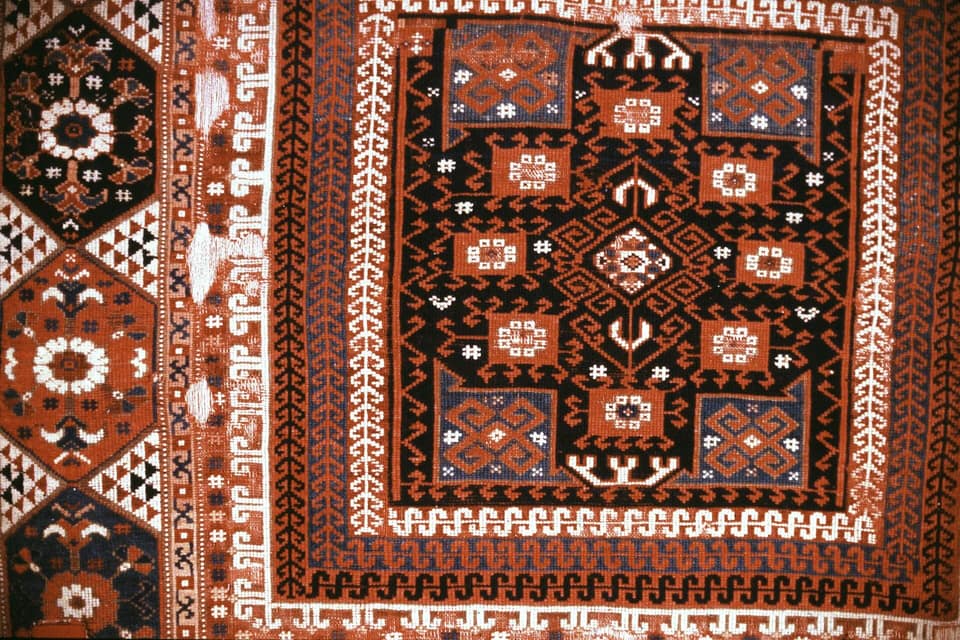
Bergama is known for its carpets as well as for its ancient city. GoTürkiye writes that Bergama carpet weaving has been handed down through the master and apprentice relationship and through family ties, that every piece is unique and that a shared feature of the carpets is their red coloured weft. The same source states that Bergama carpets from the 15th century are preserved in museums in Türkiye and abroad. The Bergama Hand-Made Carpet was registered as an indication of source in the name of Bergama Municipality in 1997, and with registration number 14 it is among Türkiye's earliest geographical indication records.
The registration document describes the technical identity of the carpet in figures. The Bergama type carpet uses the double Turkish knot and has 1,280 knots per square decimetre. The pile height is between 7 and 10 millimetres. The knot, warp and weft yarns are all wool, and about 4.6 kilograms of wool go into one square metre of carpet. These measurements explain why the Bergama carpet is known as a thick, full and long lasting weave. According to the document, the Bergama name cannot be used on carpets that do not meet these technical specifications.
The kilim loom in Helvacı
The Helvacı neighbourhood in the Aliağa district holds one of the province's newest geographical indications, the Helvacı Kilim, registered in 2025. According to the registration document, the kilim is woven from the wool of sheep raised in the area or from a yarn blending wool and cotton. The yarns are dyed with the roots, stems, leaves, fruits and bark of local plants, and the natural colour of the wool is used as well. The weaving is done on upright looms called ip ağacı and beaten down with a weaving comb. The basic technique is plain weave, to which the cicim and zili techniques are added. Cicim is woven by two people, the weaver in front of the loom and the weaver behind it passing the pattern yarn between them to create a raised surface.
Helvacı kilims are named after the place where they are used. The Pandır kilim, woven entirely of cotton, is laid down in summer because it keeps a room cool and is known as the summer kilim. The woollen Şamı kilim is the winter rug used from autumn to spring. Large kilims spread in the middle of village rooms are called Koca or Goca kilims. The yük perdesi is stretched in front of the alcove where mattresses and quilts are stacked. The meldin, laid over babies' cradles, is called kara zili when its ground is black, and the cat's head motif is repeated across it.
Tire's double layered beledi weaving
According to the Provincial Directorate of Culture and Tourism, Tire's beledi weaving is one of the oldest cotton weaving types in Türkiye, and its records go back to the 16th century. The Aydın Province Yearbook of 1908 counted 60 hand looms in Tire. The most important feature of the fabric, registered as an indication of source in the name of the Tire Chamber of Commerce in 2020, is that it is double layered. The registration document explains that the black and white warp threads are separated with different pedals and that the weft is passed so that the pattern forms on top and a white lining forms underneath. The result is a very strong, two sided fabric.
The beledi loom is also unique. Frames with 24 heddles each at the top and bottom work with a set of 13 pedals. The beater that holds the reed is made of apricot wood, and four threads pass through each of the 960 dents of the reed. The fabric is 62 to 64 centimetres wide. According to the document, between 40 and 50 motifs are used in the weaving, and the most common is the star motif. The Directorate lists pattern names such as almond, butterfly, six finger, plain weave and basket. The ground colours are green, red and dark blue, while the motifs are white and yellow. These fabrics have been used for upholstery, mattress covers and curtains. The Directorate notes that the number of looms has fallen over the years and that very few masters continue the craft today.
Felt and needle lace
The Provincial Directorate of Culture and Tourism counts Tire, Bergama and Ödemiş among İzmir's important felt centres. In the traditional felt workshops, where wool is compressed and pressed into felt, saddle felts, mattress felts and the kepenek, the felt cloak worn by shepherds, were once made. With the decline of animal husbandry the number of traditional workshops has fallen, and workshops that have turned to products such as shoe linings, slippers, vests, saddlebags, bags, shawls and cushions have come to the fore.
Needle lace, or oya, is a handicraft found almost everywhere in the province. Made with a needle, crochet hook, shuttle and hairpin, oya has over time been enriched with sequins, beads and fabric. According to the Directorate, needle lace is made in nearly all of İzmir's districts, and its finest examples come from Ödemiş and Tire. Notable examples of dowry embroidery are found in the city centre, Karaburun, Urla, Ödemiş and Tire.
From mulberry leaf to silk in Ödemiş
Ödemiş Silk was registered as an indication of source in the name of the Ödemiş Chamber of Commerce in 2022. The registration document writes that the district's mild and rainy winters suit the mulberry tree and that mulberry leaves reach the maturity needed to feed silkworms from 1 April onwards. The silkworm spins its cocoon in 11 days, and the cocoons are gathered between 15 and 25 May. The cocoons are treated with steam, dried for a long period and boiled in a copper cauldron until the end of the silk thread is found. Between 1,500 and 2,000 metres of continuous thread can be obtained from a single cocoon. GoTürkiye relates that Birgi, in the district, is famous for its bürümcük fabric and that there were 3,250 hand looms in Birgi in the 1940s.
Where and how to see them today
The best way to see these crafts is to go to the district where they are still practised. The pottery workshops of Menemen, the bead kilns of Görece and Nazarköy, and the weaving and felt workshops of Tire and Bergama can often be watched while they are at work. Before a visit it is a good idea to check with the district municipality or the Provincial Directorate of Culture and Tourism whether the workshops are open. Looking at the label is also useful when buying a product with a geographical indication. According to the registration documents, the indication of source emblem appears on the product itself or on its packaging, and where this is not possible it is displayed in an easily visible place in the business. Setting aside an hour for these workshops while visiting the hans of Kemeraltı where the story of the evil eye bead began, the acropolis of Bergama, the market of Tire or the mansions of Birgi is a way of getting to know not only the city's stones but also its hands.
Sources
- İzmir İl Kültür ve Turizm Müdürlüğü, Pottery (Çömlekçilik), https://izmir.ktb.gov.tr/EN-240856/pottery.html
- İzmir İl Kültür ve Turizm Müdürlüğü, Evil Eye Bead (Nazar Boncuğu), https://izmir.ktb.gov.tr/EN-240859/evil-eye-bead.html
- İzmir İl Kültür ve Turizm Müdürlüğü, Beledi Weaving (Beledi Dokuma), https://izmir.ktb.gov.tr/EN-240814/beledi-weaving.html
- İzmir İl Kültür ve Turizm Müdürlüğü, Felt Works (Keçecilik), https://izmir.ktb.gov.tr/EN-240815/felt-works.html
- İzmir İl Kültür ve Turizm Müdürlüğü, Laces and Embroideries (Oya ve İşleme), https://izmir.ktb.gov.tr/EN-240857/laces-and-embroideries.html
- Türk Patent ve Marka Kurumu, Bergama El Halısı coğrafi işaret kaydı, https://ci.turkpatent.gov.tr/cografi-isaretler/detay/37877
- Türk Patent ve Marka Kurumu, Görece Nazar Boncuğu coğrafi işaret kaydı, https://ci.turkpatent.gov.tr/cografi-isaretler/detay/37925
- Türk Patent ve Marka Kurumu, Tire Beledi Dokuması coğrafi işaret kaydı, https://ci.turkpatent.gov.tr/cografi-isaretler/detay/1762
- Türk Patent ve Marka Kurumu, Helvacı Kilimi coğrafi işaret kaydı, https://ci.turkpatent.gov.tr/cografi-isaretler/detay/10144
- Türk Patent ve Marka Kurumu, Ödemiş İpeği coğrafi işaret kaydı, https://ci.turkpatent.gov.tr/cografi-isaretler/detay/2723
- GoTürkiye, The Talented Hands of the Turkaegean Culture, The Artisan Towns of İzmir, https://goturkiye.com/blog/the-talented-hands-of-the-turkaegean-culture-the-artisan-towns-of-izmir
- Visit İzmir, Çömlekçilik (Menemen), https://www.visitizmir.org/en/Destinasyon/13241
Comments
Be the first to comment