

From Galleys to Museum Ships, the Shipyard Past of the Gulf of İzmit
A shipyard at the head of the gulf Today the Gulf of İzmit is known for its industrial plants, ports and shore roads. Yet for centuries its narrow, sheltered waters were also a stage for shipbuilding.
 Radar TürkiyeNovember 24, 2026
Sign in to like and rate
A shipyard at the head of the gulf
Today the Gulf of İzmit is known for its industrial plants, ports and shore roads. Yet for centuries its narrow, sheltered waters were also a stage for shipbuilding. Galleys and galleons were built on this shore, and the timber of the forests behind it was carried to shipbuilding and on to İstanbul. According to İdris Bostan, author of the İzmit entry in the TDV Encyclopaedia of Islam, the city had a shipyard long before the Ottomans. After the Ottomans took the city in 1337, this yard began to work as a regular shipyard. Its original form is not precisely known; the sources place it on the shore, near the Hünkar Palace. This little known side of the gulf lies in the story of timber, galleys, galleons and the two museum ships that wait on its shores today.
Shores inherited from Byzantium
When the Ottomans reached the sea, they did not start from scratch. According to the encyclopaedia's entry on the Tersane-i Amire, in the early period they made use of old shipyards left by Byzantium and the Anatolian principalities. İzmit, Gemlik, Edincik, Gelibolu and the Kadırga Harbour in İstanbul are counted among these yards. The same entry records that until the early 18th century a total of 65 shipyards and building stocks had been identified: 44 on the Black Sea coast, 6 on the Danube and 15 on the Marmara and Aegean coasts. Warships were built as hulls at these provincial stocks and taken to the Tersane-i Amire in İstanbul to be fitted out. Among the important provincial yards, İzmit and Kefken on Kocaeli's Black Sea coast are named along with Gelibolu, Sinop and Samsun. Within today's provincial borders, then, there were two separate shipbuilding sites, one on the Marmara and one on the Black Sea.
A boat called karamürsel
The name of Karamürsel, on the southern shore of the gulf, also lives on in Ottoman maritime history as the name of a type of vessel. The encyclopaedia's entry on ships mentions the karamürsel as the first Ottoman çektiri. Çektiri is the general name for vessels driven by oars and partly by sail. In later periods karamürsel came to describe a small, deckless boat with one and a half masts and pointed triangular sails, used in transport. Larger types were also built, and karamürsels were generally run over short distances. When necessary they were allowed to sail as far as Egypt to carry grain or timber. This boat, which shares its name with the coastal district, is a small trace of how early the gulf became entwined with seafaring.
From galley to galleon
The İzmit shipyard was repaired and enlarged in the 16th and 17th centuries. According to Bostan, besides small boats, warships of the galley and galleon types were also built here. In the reign of Süleyman the Magnificent the old yard was put back into operation. These two ship types are a good measure of the kind of craftsmanship that went on in the gulf. According to the entry on ships, the galley was the most common warship of the navy from the foundation of the state until the end of the 17th century. It was a long, narrow and fast hull of some 41 to 42 metres between stem and stern posts. It had twenty five benches and forty nine oars, each oar was pulled by four or five men, and its crew numbered about 330. The galleon was a large, three masted sailing warship; it carried between 80 and 120 guns, and about 800 men served on a two decked galleon. From the end of the 17th century galley building declined and galleon construction gathered pace. The encyclopaedia notes that some ninety separate names were recorded for the timber pieces used in galleys and the larger baştarda. That number shows how refined the wood knowledge of the shipwrights on the shore was.
Timber from forest to slipway
What made İzmit a shipyard town was the forest behind it. According to the Tersane-i Amire entry, procuring the timber needed for shipbuilding was the duty of the shipyard superintendent. Timber was supplied from forest districts, called ocaklık, near to or far from the yard. The İzmit entry shows how far back this link goes: before the conquest of İstanbul, the timber and workers used to build Rumelihisarı were brought from İzmit. In 1591 Grand Vizier Koca Sinan Paşa put into action a project to cut a canal between the Sakarya, Lake Sapanca and the Gulf of İzmit. The aim was to carry by water the produce of the region reaching as far as Bolu, and above all the timber needed by the İstanbul shipyard. The project was never completed, but it makes clear that the gulf was seen as a gateway for timber.
Evliya Çelebi writes that most of the city's merchants dealt in timber and that there were two hundred timber stores in the market. The French traveller Tavernier also records in 1632 that the timber depots in the town were prepared for building houses and ships. The gulf was not always calm water either: the encyclopaedia relates that in 1751 forty ships in the gulf sank in a storm known as the tree breaker.
After Çeşme, after Navarino
The busiest periods of the İzmit shipyard came after the years in which the navy suffered great losses. After the Ottoman fleet was burned off Çeşme in 1770, Grand Admiral Cezayirli Hasan Paşa went to İzmit to rebuild the navy and personally directed the inspection and dispatch of the timber to be used in shipbuilding. According to Bostan, the yard came to the fore again after this date. The fleet destroyed at Navarino in 1827 was also rebuilt under the lead of Grand Admiral Ahmed Fevzi Paşa, and many ships were built at İzmit. Mahmud II visited the city twice, in 1833 and 1836. On his first visit he toured the shipyard and the fez factory then under construction; on the second he attended the launching ceremony of a newly completed galleon.
In the 19th century, as sail gave way to steam, the gulf's sea traffic changed as well. According to the encyclopaedia, in 1844 a ship named Mesir-i Bahri was assigned to carry freight and passengers on the Marmara, and its sailings also called at İzmit. With the building of Derince Harbour in 1895, İzmit became a centre where goods coming from Anatolia were stored.
Gölcük and the navy town
In the 20th century the gulf's shipbuilding tradition moved to the southern shore, to Gölcük. A planning report prepared for Gölcük by the Ministry of Environment, Urbanisation and Climate Change describes the district as a distinctive navy town. According to the report, Gölcük is home to the Turkish navy and shipyard established in 1926. The Gölcük Shipyard Command, described as the country's most comprehensive shipyard, and the Fleet Command are located in the district. The same report notes that the navy has played a very important role in the town's development and that a cultural mosaic has formed in the town because of its constantly changing population.
Where to see it today
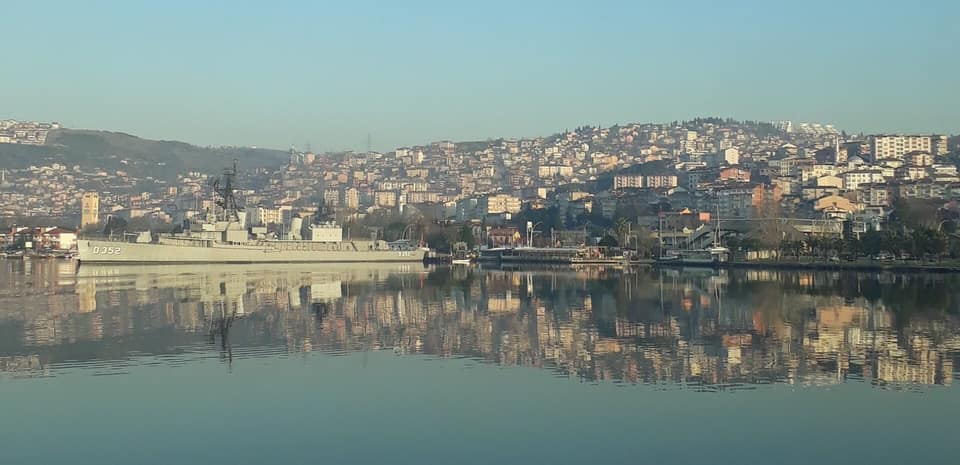
No building survives from the Ottoman shipyard; today the gulf's maritime past is told most concretely by two museum ships. The first is the TCG Gayret Museum on the İzmit shore. According to the Culture Portal, the ship was built in the United States in 1946, joined the Turkish navy in 1973 under the name TCG Gayret, and was decommissioned in 1995 after more than twenty years of service. Arranged through a museum ship project run jointly by the Governorship of Kocaeli, the Kocaeli Metropolitan Municipality and the Fleet Command, the ship opened as a museum in 1997. It lies on the shore next to the sailing club in the city centre and is easily added to a seafront walk.
The second ship is the Yarhisar Museum Ship on the southern shore of the gulf, on the Kavaklı seafront in Gölcük. The Culture Portal presents it as Turkey's first surface ship museum placed on land. Yarhisar, which served as a reconnaissance and patrol vessel, was built in the United States for the Turkish Naval Forces in 1964, raised the Turkish flag in 1965 and left service in 2005 after some forty years. Inside, the development of the Ottoman and Turkish navy is told through paintings, photographs, mannequins and various objects.
Suggested visit
It is possible to follow this story of the gulf in a single day. In the morning you can visit TCG Gayret on the İzmit shore and walk along the waterfront, looking towards the eastern end of the gulf and remembering that the old shipyard stood on the city's shore, near the palace. In the afternoon, crossing to the southern shore to see Yarhisar in Gölcük and ending the day on the Karamürsel seafront completes the line that runs from the galley to the museum ship. Since visiting days and hours of both museums may change, check the current information from official sources before setting out.
Sources
- TDV İslam Ansiklopedisi, İzmit (İdris Bostan), https://islamansiklopedisi.org.tr/izmit
- TDV İslam Ansiklopedisi, Tersane-i Amire (İdris Bostan), https://islamansiklopedisi.org.tr/tersane-i-amire
- TDV İslam Ansiklopedisi, Gemi (İdris Bostan), https://islamansiklopedisi.org.tr/gemi
- Kültür Portalı, TCG Gayret Müzesi, https://www.kulturportali.gov.tr/turkiye/kocaeli/gezilecekyer/tcg-gayret-muzesi---zmit
- Kültür Portalı, Yarhisar Müze Gemisi, https://www.kulturportali.gov.tr/turkiye/kocaeli/gezilecekyer/golcuk-belediyesi-yarhisar-muze-gemisi-kavakli-golcuk
- Çevre, Şehircilik ve İklim Değişikliği Bakanlığı Kocaeli İl Müdürlüğü, Gölcük imar planı açıklama raporu (2019), https://webdosya.csb.gov.tr/db/kocaeli/duyurular/ilan-ve-aski--8230-23225-20190722125205.pdf
Comments
Be the first to comment