

From Flamingos to Pygmy Cormorants, the Birds of the İzmit Bay Wetland
The reed bed of an industrial city At first glance, the eastern end of the Gulf of İzmit is not a place that comes to mind for birdwatching.
 Radar TürkiyeNovember 24, 2026
Sign in to like and rate
The reed bed of an industrial city
At first glance, the eastern end of the Gulf of İzmit is not a place that comes to mind for birdwatching. It looks like a strip squeezed between the shore road, factories and new housing. Yet where the gulf ends, on this shore where fresh water meets salt water, there are reed beds, mudflats and small islets. The 2023 Environmental Status Report prepared for Kocaeli by the Ministry of Environment, Urbanisation and Climate Change describes the İzmit Bay Wetland as the only and richest area near İstanbul where bird guides can show water and shore birds to foreign birdwatchers. For watchers who know how to observe birds without disturbing them, this quiet corner of the gulf opens an unexpected window in the middle of an industrial city.
A stop on a migration route
With its position as a passage between Europe and Asia and its gateway to Africa, Turkey is of great importance for birds. According to the same report, bird species that breed in different European countries head for the mild southern regions of Anatolia to winter, and a significant number of species pass through the Marmara Region, above all the İstanbul Strait, during migration. The İzmit Bay Wetland is one of the stops on this migration chain. The report stresses that the area is an important station meeting the feeding and shelter needs of migratory species and that it will become even more important for migratory birds in the future.
Dr. Duygu Öztekin Kanık's study, published in the journal Mimarlık ve Yaşam, draws attention to the same point. The area, most of which is reed bed, is one of the stops needed by migratory waterbirds that depend on wetlands. According to Kanık, two streams and a canal feed the area: the Sarı Dere, the Kiraz Deresi and the Kullar Canal. The alluvium carried by the streams over centuries allowed marshes and reed beds to form between the head of the gulf and the Kullar Plain.
A protected shore
According to the Environmental Status Report, the İzmit Bay Wetland was declared a wetland in 2006 and was given the status of a wetland of local importance in 2021. In the wetlands list of the Ministry of Agriculture and Forestry's General Directorate of Nature Conservation and National Parks, the area also appears as Kocaeli's wetland of local importance under the 1st Regional Directorate. As Kanık relates, the National Wetlands Commission approved its protection zones at its meeting of 27 March 2008, and special provisions for the area came into force in 2009. The report notes that besides this area, part of the Lake Sapanca Wetland also lies within the province.
The idea of protecting the area for birds goes back even further. According to Kanık's study, in 1994 some 400,000 square metres of natural fill and water surface west of the old Gölcük road, within the expansion area of the fairground of the time, were declared a bird protection and park area. The reason was the observation that this section, where the shores had remained in their natural state, was visited by migratory birds and that the birds stopped over here.
Which birds are seen
According to the Environmental Status Report, 171 bird species have been observed in the İzmit Bay Wetland so far; 100 of them are protected at national, European or global level. Many ducks and gulls feed and shelter on the shore section and islets where fresh and salt water mix. The report writes that the gulf is particularly important for two species: the white headed duck, on the IUCN Red List, and the pygmy cormorant, listed in Appendix II of the Bern Convention. Because it is an important post breeding stopover and feeding area for these two species, the gulf is a candidate Important Bird Area. Appendix II of the Bern Convention is the list of strictly protected species.
The report's list of protected species shows the richness of birds that may appear at the end of your binoculars on a day of watching. The list includes shore birds such as the flamingo, spoonbill, glossy ibis, avocet and black winged stilt. Among the herons it counts the great egret, little egret, purple heron, squacco heron and night heron. On the water you may see the mute swan, Bewick's swan, shelduck, ruddy shelduck, smew, goldeneye, great crested grebe and black necked grebe. Small migrants such as the dunlin, little stint, ringed plover and Kentish plover wander the mudflats. Among birds of prey the marsh harrier and the osprey, and among seabirds various terns, are also on the list. Small birds such as the kingfisher, great reed warbler and penduline tit are also recorded along the reed edges.
Looking at the province as a whole, the picture widens further. According to the same report, when field studies and literature records are considered together, the number of bird species occurring in Kocaeli is 262. Of the species found in the field, 145 are resident, 52 are summer visitors, 22 are winter visitors and 4 are passage migrants. The report notes that 60 per cent of the birds occurring across Turkey are also found in Kocaeli.
When to go
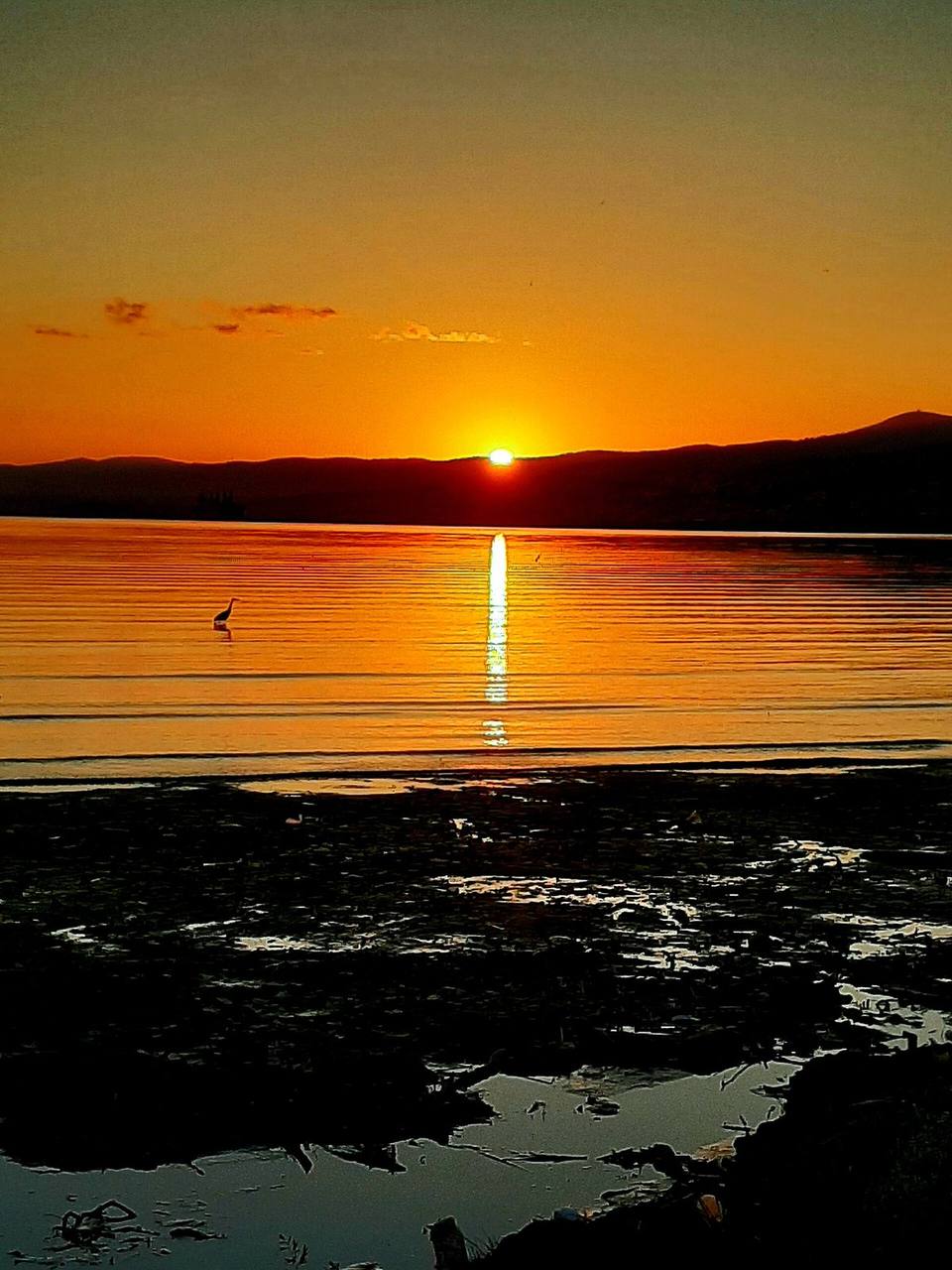
As Kanık relates, the species records for the area were gathered in the spring and autumn migration seasons. The migration periods are the busiest months, when different species stop by for a short time. The winter months are not empty either; the Environmental Status Report notes that 22 winter visiting species have been recorded in the province. In summer, during the breeding season, the reed beds should not be approached. Whatever season you go in, the early morning hours and the hours close to sunset are the times when birds are most active and the light is softest for photography. Evenings at the eastern end of the gulf, when the sun sets over the ridges of the Samanlı Mountains, make a good backdrop for the silhouettes of herons wading in the shallows.
Where the area begins
The Environmental Status Report describes the boundary of the area as follows: on the Gölcük coast road, starting in the west from the ferry pier road, it follows the shore eastwards, behind the fairground, to the concrete channel of the Sarı Dere. From there it follows the shore and continues southwards so as to include the marshland on both sides of the Gölcük road. The easiest starting point for watching is therefore the coast road on the south eastern shore of İzmit. As Kanık also mentions, works have been carried out to create a continuous green corridor along the shore; these shore paths make it possible to look over the water without entering the reeds.
Watching birds without disturbing them
Watching a wetland takes patience. Good binoculars or a telephoto lens are the only way to see birds without approaching them. Do not enter the reed beds and mudflats; these are both where birds feed and where species hide during the breeding season. Walking towards flocks or making noise to flush them is an unnecessary burden for birds trying to store energy on their migration route. Do not feed the birds, keep your dog on a lead and take your rubbish back with you. If you want to note your sightings, recording the species name, number, date and place is enough; these simple notes help in the long run to understand how the area changes.
The long story of the gulf
The Çatalca-Kocaeli Plateau rises to the north of the gulf and the Samanlı Mountains to the south. The narrow water between these two heights is a natural system that has survived for centuries right beside settlements, ports and industry. Kanık's study documents that, with the channelling of the streams and the growth of the city, the shoreline changed over time and the reed beds shrank. According to the study, the İzmit Analytical Surveys of the Bank of Provinces, dated 1970, record that a canal 5 kilometres long was built on the Kiraz Dere; Kanık states that this canal was opened to drain the marshes that stretched inland. In 1996 a wastewater treatment plant was set up to treat the industrial wastewater of some 35 factories in the east of the city and the domestic wastewater of the surrounding housing, and the channelling of the Sarı Dere and the Kiraz Deresi was completed. That is why every piece of reed bed left at the head of the gulf holds a special value for the birds that return here every year. On your next visit to İzmit, stopping for a few minutes on the coast road and looking towards the head of the gulf through binoculars is the easiest way to get to know these little known residents of the city.
Sources
- Çevre, Şehircilik ve İklim Değişikliği Bakanlığı, Kocaeli İli 2023 Yılı Çevre Durum Raporu, https://webdosya.csb.gov.tr/db/ced/icerikler/kocael-_2023-icdr-1-20250109073639.pdf
- Tarım ve Orman Bakanlığı Doğa Koruma ve Milli Parklar Genel Müdürlüğü, Sulak Alanlar, https://www.tarimorman.gov.tr/DKMP/Menu/31/Sulak-Alanlar
- Kanık, D. Ö., İzmit Kent Planlaması ve Sulak Alan Bölgesine İlişkin Plan Kararları, Mimarlık ve Yaşam 8(4), 2023, https://dergipark.org.tr/tr/pub/my/article/1233614
- Vikipedi, İzmit Körfezi, https://tr.wikipedia.org/wiki/%C4%B0zmit_K%C3%B6rfezi
Comments
Be the first to comment