

From Beykoz Glass to Yıldız Porcelain, the Palace Workshops of Istanbul
Producing for the palace In nineteenth-century Istanbul, the tables, halls and display cases of palaces and pavilions were furnished to a large extent with two materials: glass and porcelain.

Sign in to like and rate
Producing for the palace
In nineteenth-century Istanbul, the tables, halls and display cases of palaces and pavilions were furnished to a large extent with two materials: glass and porcelain. Some of these objects came from Europe, but some were produced in the city's own workshops. The glass workshops that rose in Beykoz on the Asian shore of the Bosphorus and the porcelain factory founded in the garden of Yıldız Palace represent the two ends of this production. Today it is possible to follow the traces of both in the same city, in places managed by the National Palaces.
The rise of glass in Beykoz
The glass entry of the TDV Encyclopedia of Islam states that the brilliant period of Ottoman glassmaking coincided with the rise of Bohemian glass. In the 19th century, workshops producing glassware with very different features were founded around Beykoz. According to the entry, the first workshop was opened in the reign of Selim III (1789-1807) by Mehmed Dede, who had learned the technique of making opal glass in Venice and returned to Istanbul. The newspaper Takvim-i Vekayi dated 9 January 1847 also mentions a crystal factory founded in İncirköy by Mustafa Nuri Pasha, the governor of Bursa. The management of the factory was later transferred to the Imperial Mint at the request of Mustafa Nuri Pasha.
According to the National Palaces, today's museum also takes its name from the Beykoz Imperial Factory of Glass and Crystal, founded in this district in the Ottoman period and the most important glass factory of its time. In the same period, many glass objects suited to Ottoman taste were also bought from Europe, above all from France and Bohemia. The TDV entry writes that this demand led to the development of glass forms known in Europe as "alla Turchesca" and "a la Turque". European glassmakers also worked in the Beykoz workshops, yet the works produced reflect Ottoman taste in all its refinement.
The types of Beykoz ware
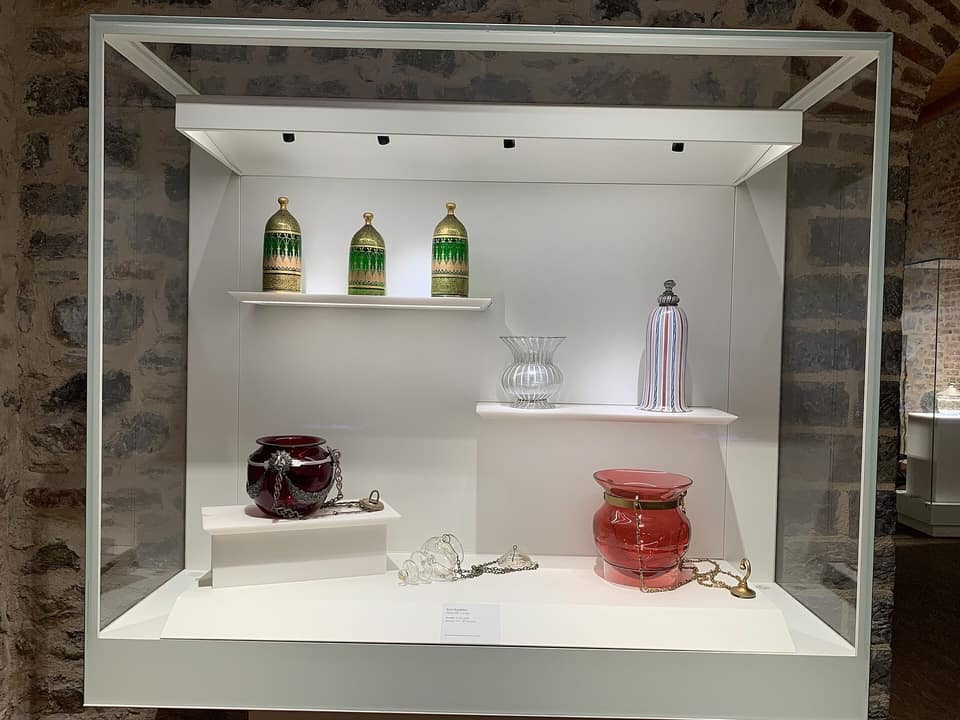
Beykoz ware is the name used for glassware made in Beykoz in the 19th century. The most common forms are rosewater sprinklers, ewers, vases, tulip vases, dipping vessels, bird figures, sugar bowls, bowls and plates. To recognize these forms in a museum case, looking at a few details is enough.
The best known of the colorless glasses is the type called "maydanozlu", meaning parsley-patterned. These are cut glass and are decorated in particular with gilding resembling parsley leaves. There are also enameled examples carrying various flower and plant motifs. Alongside the classic forms, this group includes basin and ewer sets, large bowls with plates and large bottles. The colored glasses are transparent, in tones such as cobalt blue, violet and dark blue; their decoration uses gilding alone or gilding together with enamel.
Opal glass makes up an important part of Beykoz ware. According to the TDV entry, this type of glass was widely produced in Venice in the 16th century, in Germany in the 17th century and throughout Europe in the 18th century, while in the Ottoman Empire it was made in the 19th century by masters who had learned the technique in the West and by Western masters working in local workshops. To make the glass opalescent, calcined bone ash and tin oxide were first added to the batch. Depending on the amount of the additive and the length of the process, degrees ranging from semi-transparent to fully matte are obtained. When held up to the light, opal glass gives a deep orange or red color. Red Beykoz glass, on the other hand, was obtained by staining colorless glass red.
Çeşmibülbül, the shimmer in a nightingale's eye
The best known type of Beykoz ware is çeşmibülbül. The TDV entry writes that the origin of this name is not known for certain, and that possible explanations are that the place where the factory stood bore this name, or that the parallel lines inside the glass were likened to the shimmer in a nightingale's eye. This type of striped glass first appeared in Venice in the 16th century, gradually spread across Europe, and gained importance in the Ottoman Empire in the 19th century.
The technique requires patience. The blowpipe is first dipped into molten glass and turned so that glass gathers at its tip. The glass taken out of the pot is shaped outside and brought down to the right temperature. Then the mass of glass at the tip of the pipe is inserted into a mold lined with colored glass rods and blown, so that the rods stick to the hot glass. The pipe is dipped into the pot again, glass is wrapped over the rods, and the piece is turned and blown once more. This two-layered structure is the secret of how the lines stay inside the glass. Similar glass was produced in Venice, Bohemia, France and other countries, but the TDV entry stresses that these differ from the Ottoman examples.
What to see at the Beykoz Glass and Crystal Museum
The best way to see all these types together is the Beykoz Glass and Crystal Museum. According to the National Palaces, the historic building of the museum was commissioned by Abraham Pasha, the agent of the Khedive İsmail Pasha of Egypt, who was raised to the rank of vizier by Sultan Abdülaziz. In the 19th century Abraham Pasha had pavilions, aviaries, pools, a theater building and a stable built on his land in Beykoz, and of these only the stable building has survived. The National Palaces restored this U-shaped stone building and turned it into a museum.
The museum displays 1,480 works, selected examples of glass art, in 12 thematic sections. Besides Turkish glass, the collection includes pieces produced in Europe for the Ottoman palaces, which makes it possible to compare Beykoz ware side by side with "a la Turque" glass from Europe. In the cases, try reading the forms first and then the decoration. Looking at the lid handle of a sugar bowl, the white and blue lines inside a carafe, or the color of an opal vase against the light is the way to confirm with your own eyes the techniques you read about in the entry.
The garden of the museum is also an important part of the visit. The land of about 360 decares holds 117 different species of trees. Abraham Pasha had plants and trees that did not exist in Ottoman lands at the time brought here and planted. For this reason the National Palaces states that the museum also has the character of a botanical museum. The institution's website states that the museum is closed on Mondays; check the other visiting information there.
The place of glass at the Mecidiye Pavilion
In the same district, the Beykoz Mecidiye Pavilion, standing at the place called Hünkar İskelesi, shows the place of glass in palace life from another angle. According to the National Palaces, construction of the pavilion was begun in 1845 by Kavalalı Mehmed Ali Pasha, the governor of Egypt, and after the Pasha's death it was completed in 1854 by his son Said Pasha and presented to Sultan Abdülmecid. The institution introduces the pavilion as the first masonry building on the Bosphorus built in the new style.
Photographs of the pavilion taken in the reign of Abdülhamid II show gilded furniture sets, upholstery and curtains of Hereke fabric, crystal vases and large crystal candelabra. This detail is a reminder that the palace's need for crystal and glass was met both by local workshops and by Europe. Used for many years as an orphanage, a hospital and a preventorium, the building opened to visitors as a museum on 11 April 2017 after restoration between 2010 and 2016. The pavilion is also stated to be closed on Mondays.
A porcelain factory on the Yıldız hill
On the opposite shore of the Bosphorus, inside Yıldız Park in Beşiktaş, the porcelain side of the story continues. According to the National Palaces, Sultan Abdülhamid II founded a porcelain factory named the Yıldız Imperial Tile Factory in the garden of Yıldız Palace in the early 1890s, with the aim of reviving the traditional art of tiles and porcelain. Heavily damaged in the earthquake of 1894, the factory was rebuilt in the same year by the Italian architect Raimondo D'Aronco.
The factory was founded as a unit attached to the palace, modeled on the porcelain works attached to European courts. Its aim was to meet the porcelain needs of palaces and pavilions and to introduce Ottoman identity to the world through the objects it produced. Its products ranged from large decorative vases to tableware, coffee sets and writing sets. Some special pieces were sent as gifts to foreign dynasties. All works produced in this factory bear the crescent and star mark, and directly beneath the mark the founding year of the factory and the year the piece was made. When you see Yıldız porcelain in a museum, turning the plate or vase over to look for the mark is the most direct way to read its date. Pieces in a naturalistic style depicting the architecture and landscaping of the period also have documentary value.
The later story of the factory is also full of interruptions. Production stopped in 1909, in 1910 the factory was attached to the Directorate of the Imperial Museum, and through the initiative of Osman Hamdi Bey it resumed production and worked until 1920. In 1959 it was transferred to Sümerbank and took the name Yıldız Porcelain Industry Establishment, and in 1995 it was attached to the National Palaces. Today it continues porcelain production with its identity as a museum factory, making wall plates, sugar bowls, vases and coffee sets inspired by traditional motifs.
How to visit today
Since it is hard to fit both sides into one day, giving Beykoz and Yıldız separate days makes for a more comfortable plan. On the Beykoz side, seeing the museum and the pavilion together lets you read the place of glass and crystal in palace life side by side. You can reach Beykoz by the ferry services on the Bosphorus or by road; check current timetable information on the operator's website. On the Yıldız side, the factory is on Palanga Street inside Yıldız Park and can be combined with a walk on the green slopes of the park.
A couple of small habits help while visiting. Look slightly from the side to avoid light reflected on the glass of the cases, since the color of opal and striped glass changes with the angle. Looking for the mark on porcelain, and for the place of gilding and enamel in the decoration of glass, makes it easier to compare the two materials with the same eye. Since visiting hours and prices can change, be sure to check the current pages of the National Palaces before you go.
Sources
- TDV İslam Ansiklopedisi, Cam, https://islamansiklopedisi.org.tr/cam
- TDV İslam Ansiklopedisi, Çeşmibülbül, https://islamansiklopedisi.org.tr/cesmibulbul
- Milli Saraylar, Beykoz Cam ve Billur Müzesi, https://www.millisaraylar.gov.tr/Lokasyon/12/beykoz-cam-ve-billur-muzesi
- Milli Saraylar, Beykoz Mecidiye Kasrı, https://www.millisaraylar.gov.tr/Lokasyon/8/beykoz-mecidiye-kasri
- Milli Saraylar, Yıldız Çini ve Porselen Fabrikası, https://www.millisaraylar.gov.tr/Lokasyon/18/yildiz-cini-ve-porselen-fabrikasi
Comments
Be the first to comment