

From Balık Gölü to the Reeds, Water and Birds in the Doğubayazıt Basin
Around Doğubayazıt, water is a story that travels from the mountain to the plain. There is a high mountain lake, a stream that leaves it, and a reed bed on the plain fed by that water; among them, there are birds.
 Radar TürkiyeNovember 6, 2026
Sign in to like and rate
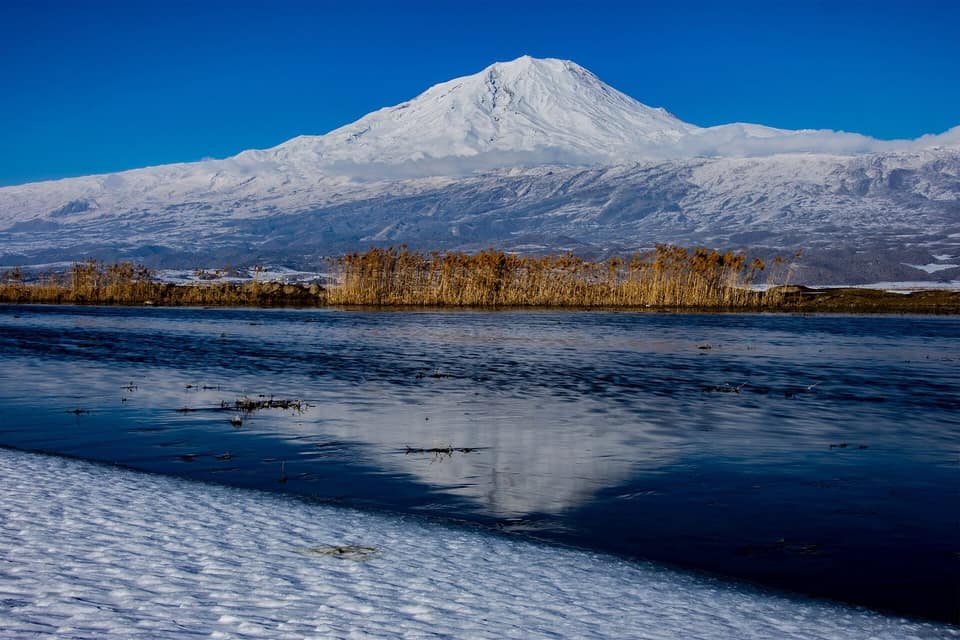
Around Doğubayazıt, water is a story that travels from the mountain to the plain. There is a high mountain lake, a stream that leaves it, and a reed bed on the plain fed by that water; among them, there are birds. This article combines that story with what scientific studies and official institutional pages say. Rather than introducing the places one by one, it looks at how the water flows, how the face of the plain has changed over forty years, and how birds have been affected. At the end it explains how to approach these areas as a respectful visitor.
The stream that lava blocked
The story begins with Balık Gölü. According to the wetlands page of the 13th Regional Directorate of the Ministry of Agriculture and Forestry, Balık Gölü is a lava-dam lake formed when lava flowing from Ağrı Dağı blocked a small stream. The lake is, in other words, water that has gathered behind a natural dam left by a volcano. In this article Ağrı Dağı appears only as scenery and a geological origin; its summit and its ascent are not the subject.
The lake is fed by small streams from the surrounding mountains, by springs along its shore and by groundwater. Its water is fresh and is used as drinking water. The Ağrı Provincial Directorate of Culture and Tourism also writes that the lake has the status of a drinking and utility water protection zone and supplies drinking water to nearby settlements. The same page gives the lake's altitude as 2241 metres above sea level and describes it as one of the highest lakes in Turkey. The directorate's page also notes that, since the lake is fed by streams, springs and groundwater, data on the pattern and continuity of its flow could not be determined.
A year on a high lake
At this altitude, the year is measured in ice. According to the 13th Regional Directorate page, the lake is generally covered with ice for five months of the year, although a small part in the north does not freeze thanks to strong springs. Its shores are muddy, and there are small reed beds in the south-east. The surroundings are covered with high mountain meadows and look like a typical alpine lake; the reed strips along the shore are thin and fragmented, and denser in the north and south where water enters and leaves.
The vegetation of this setting is remarkable too. The same page states that a plant species whose survival is threatened worldwide, Tripleurospermum corymbosum, lives in the whole world only around Balık Gölü. The hills around the lake are also said to be important for two other plants. This is a reminder that a visitor who comes for birdwatching should know what grows underfoot: it is best to stay on the path and avoid trampling grass and meadow.
The lake of the velvet scoter
The prominence of Balık Gölü as a bird area is stressed in official records as well. The velvet scoter population nesting on an island in the lake is given as the reason the area gained its status as an important bird area. A study published in the Journal of the Institute of Science of Yüzüncü Yıl University gives more detail. In field work carried out between April 2001 and September 2002, 83 species and 2 subspecies belonging to 31 families were observed in the area. Of the species observed, 50.5 percent were resident, 42.3 percent migrant, 4.7 percent winter visitors and 2.3 percent transit migrants. The researchers also established that Balık Gölü is a breeding area of the velvet scoter.
These figures need to be read correctly. The study was carried out more than twenty years ago, over a period of two years, and it does not give today's species numbers or counts. Even so, it is a good example of why a lake matters: the resident birds, about half of those recorded, depend on the lake's own ecosystem, while migrants use the area as a stopover in spring and autumn. The directorate's page also lists animals living around the lake such as eagles, hawks, partridges, wild hares, foxes, wolves, wild ducks, gulls, quails and woodcocks.
Water flowing from lake to plain
The second part of the story begins where the water leaves the lake. According to the 13th Regional Directorate, the stream that leaves the south-east of Balık Gölü feeds the Doğubayazıt reed beds. This sentence lets us think of the two places together: the ice and springs of the high lake are the beginning of a system that affects the wet meadows and reeds of the plain below. Thinking at basin level is meaningful for that reason, because a change at the water source upstream can be felt downstream in other forms. However, the source gives no detailed data on how continuous the flow is or how much water it carries in which seasons, and no guesses are made here.
Two lakes on the plain
An article published in Doğu Coğrafya Dergisi examines the land-cover change of the Doğubayazıt reeds. According to the article's abstract, two lakes hold an important place in the hydrography of the reeds, Saz Göl and Gölyüzü. Because of insufficient feeding, the depth and open-water surface area of these two lakes have shrunk. The article also notes that there is no marked increase in the drought trend, but that the frequency of extreme periods has risen in recent years.
The area called the reeds is not a single piece. The boundaries between open water, reed bed, wet meadow, pasture and settlement shift over time. It is therefore misleading to think of the reeds as having a single point, a car park or an observation tower as a fixed place to visit. It is more accurate to use basin language, that is, to speak of the area around Saz Göl.
A map of forty years
The most striking part of the article shows in figures how land cover has changed over the last forty years. According to the results of office and field work, pasture areas shrank by 12.02 percent, reed and vegetation areas by 5.18 percent and the lake surface by 4.74 percent. In the same period settlement areas grew by 15.28 percent, marsh areas by 1.68 percent and sand and bare ground by 4.98 percent. These values cannot be added together; each shows the change within a separate land class and should be read only as a percentage change.
The article's conclusion is also clear: the classes whose area shrank most are lake, pasture, and reed and vegetation areas. Lake water is giving way to reed and marsh, while pasture and vegetation areas have begun to be used as settlement. The authors write that the town of Doğubayazıt, to the south of the reeds, has grown almost fifteen-fold in the last forty years and that this has become a significant pressure on the reeds. Instead of building a language that blames the town, we do what the article does: we measure the change and note that wetlands should be considered in planning as a whole.
How birds experience the change
The article says that this change has also affected the bird species composition of the reeds. Depending on the shrinking open water, some shorebirds and ducks were observed not to use the reeds. This shows that waterbirds do not depend on a single point; they need different habitats, such as open water, shallow shores, reeds and meadow, to exist together. When open water narrows, the species that use it turn elsewhere.
The article also recalls the importance of wetlands: they provide habitat for living things, they form groundwater reserves and, to a limited extent, they help stabilise the climate of their region. The text recommends that these areas be treated with a protection-first approach. The article's bibliography includes a wetland management plan prepared for the Doğubayazıt reeds; but because sources differ on that plan and on the protection status of the area, this article states no status.
Being a respectful visitor to birds
In light of this information, a few principles follow for a visitor. Use binoculars to watch birds and keep your distance; approaching nests and resting areas can disrupt breeding. Do not enter the reeds; watch from the shore and the road. Do not make noise and do not call animals by feeding them or making sounds. Take your rubbish with you; the lakes are sources of drinking water and pollution directly affects people too. In winter most of Balık Gölü is covered with ice; going onto ice is dangerous and we encourage no visitor to do so.
Practical notes
According to the directorate's page, Balık Gölü is 60 kilometres from the district of Doğubayazıt and 26 kilometres from Taşlıçay, and lies within the boundaries of both districts. For that reason the district to which the lake belongs may be written differently in the sources; in our record we take Doğubayazıt as the basis. The 13th Regional Directorate page says there is a picnic area on the shore and that the area is attractive for day trips. You will need a vehicle; the sources contain no local public transport information, so check with the local administration before setting out.
For the Doğubayazıt reeds, visiting hours, entry conditions, observation points and permit information do not appear in the sources. Confirm these with the relevant local administration before you visit. The weather is harsh and changeable; nothing is required beyond warm clothing, binoculars and a camera. Early morning and late afternoon are generally more favourable for light, but that depends on your own observation; the sources give no recommended time.
Water, birds and people
The water line from Balık Gölü to the reeds is a whole that runs from a stream blocked by a mountain's lava to the wet meadows of a plain. Within this whole sit a species like the velvet scoter, a plant like Tripleurospermum corymbosum, settlements dependent on drinking water and a growing town. What the articles and official pages teach us is that the parts of this whole cannot be thought of separately. On your next visit to Doğubayazıt, look not only at a building or a view but also at the water that makes the view possible.
Sources
- Doğu Coğrafya Dergisi, Doğubayazıt sazlığının arazi örtüsü deseninde meydana gelen değişimlerin ekolojik sonuçları üzerine bir analiz, https://dergipark.org.tr/tr/pub/ataunidcd/article/1017835
- Yüzüncü Yıl Üniversitesi Fen Bilimleri Enstitüsü Dergisi, Balık Gölü ve Çevresinin Eko-Ornitofaunası Üzerine Bir Araştırma, https://dergipark.org.tr/tr/pub/yyufbed/article/734771
- Tarım ve Orman Bakanlığı 13. Bölge Müdürlüğü, Sulak Alanlar, https://bolge13.tarimorman.gov.tr/Menu/41/Sulak-Alanlar
- Ağrı İl Kültür ve Turizm Müdürlüğü, Balık Gölü, https://agri.ktb.gov.tr/TR-122248/balik-golu.html
Comments
Be the first to comment