

From Ankyra to Ankara, the Story of a City's Name
A city's name is its oldest monument. Stones fall, walls are repaired, streets are redrawn; but a name passes from mouth to mouth and lives for thousands of years, and every age adds its own colour to it.

Sign in to like and rate
A city's name is its oldest monument. Stones fall, walls are repaired, streets are redrawn; but a name passes from mouth to mouth and lives for thousands of years, and every age adds its own colour to it. The name of Ankara is such a monument. Its journey from a settlement debated as the Hittite Ankuwa to the legend of the Phrygians, from the Ankyra of the Galatians to the Ancyra of Rome, from the Engürü of the Seljuks and Ottomans to the Angora of Europe, and finally to the Ankara fixed in 1930, is at the same time a short summary of the city's history. This article follows that journey step by step and tells you on which stones in Ulus you can trace the name today.
The Ankuwa of the Hittites, perhaps
The origin of the name Ankara is not known for certain; the history published by the Governorship of Ankara says so plainly. The history of the settlement can be followed only from the Hittite period onward. The name Ankuwa, which appears frequently in the texts found in the excavations at Boğazköy within the borders of Çorum, that is the Hittite capital Hattuşa, is thought by some foreign historians to indicate the site of present-day Ankara. The TDV Encyclopaedia of Islam also records that the name may derive from Hittite Ankuwa or Ankuruwa, but this view is disputed and has not been proven. What is certain is that after the Hittites the Phrygians dominated the region. The Phrygians founded or enlarged the city in the eighth and seventh centuries BC; excavations in Ulus have shown for certain that the Phrygians lived here. Then come the Lydians, the Cimmerian invasion, the Persian king Cyrus and Alexander the Great, who passed through Anatolia in 333 BC. In other words, before the city's name was recorded as a Greek word there was already a settlement history of several centuries here.
The anchor legend, Midas and Pausanias
In the sources of antiquity the city's name is Ankyra in Greek and Ancyra in Latin, and in Greek ankyra means a ship's anchor. The legend explaining the name is related by the traveller Pausanias, who lived in the second century AD. According to him the Phrygian city of Ankyra was founded by Midas son of Gordios, and the anchor that Midas found was still kept in the temple of Zeus even in Pausanias's own time; nearby there was a spring known as the Spring of Midas. The authors of the ancient history site Livius regard this account as an origin legend invented later to explain the name; the thing called an anchor was most probably a large rock resembling the stones the ancients used as anchors, a standing stone kept in the temple. Pausanias himself notes that the city was far older than Midas. The Governorship of Ankara, on the other hand, writes that according to traditions not based on documents the name was given by the Galatians. Whichever is true, the anchor remained the city's emblem; that the name of a steppe town hundreds of kilometres from the sea should mean a ship's anchor is Ankara's oldest irony.
The Ankyra of the Galatians
At the beginning of the third century BC Celtic tribes coming from Europe, after wandering for a while in the Balkans and western Anatolia, settled between 280 and 274 BC in central Anatolia, in the region of Ankara, Çorum and Yozgat. This people, whom the Greeks called Galatians, was divided into three tribes: the Tectosages made Ankyra their centre, the Tolistobogii Pessinus and the Trocmi Tavium. Thus Ankara became for the first time in history the centre of a people; the history of the Governorship of Ankara names the city in this period as the capital of the Tectosages, and it is accepted that today's castle existed in the Galatian period. The Galatian tribal kingdoms kept their independence until the first century BC, then came under Roman control. The most surprising trace the Galatians left is language: there are indications that the Galatian language was spoken until the seventh century AD. Beneath the ruins that the guidebooks today call a Roman city, a Celtic-speaking people lived for nine hundred years.
The Ancyra of Rome
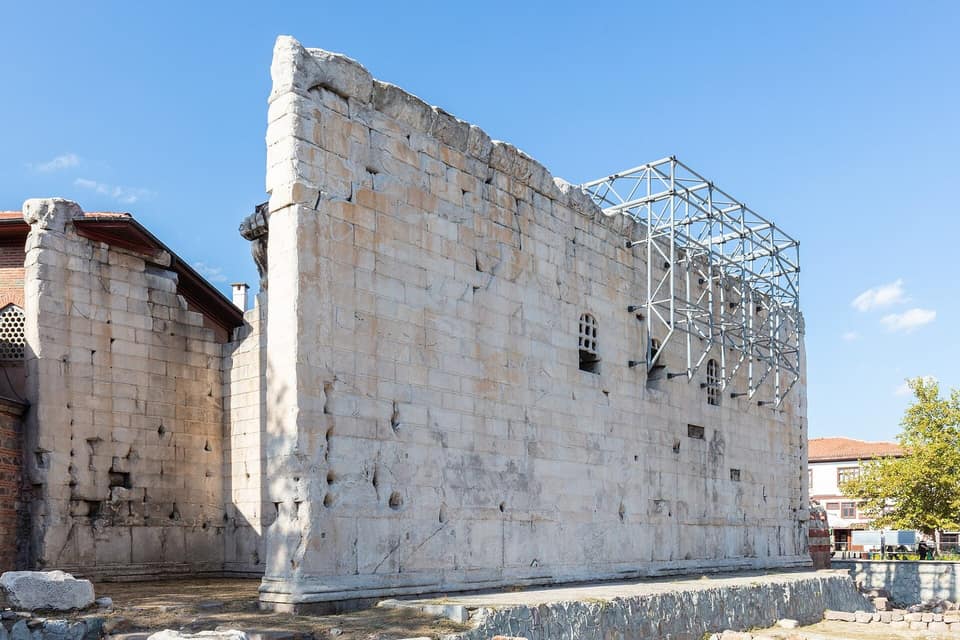
Rome had a say in the region from 189 BC; the real turning point came in 25 BC. The Emperor Augustus made Galatia a Roman province, gave Ankyra the status of a polis and declared the city the centre of the province. According to the authors of Livius the city was an important junction of the Roman road network, and a detachment of the Fifteenth Legion Apollinaris was stationed here. In the name of Augustus a temple rose between 25 and 20 BC over an area previously dedicated to the Phrygian goddess Cybele and to Men. On the walls of this building the Res Gestae Divi Augusti, the record of the deeds of Augustus, was carved in Latin and Greek. This is the only complete copy of the text surviving in the world today; the German historian Theodor Mommsen called it the queen of inscriptions. This temple, whose two side walls and ornate doorway still stand today right beside the Hacı Bayram Mosque in Ulus, is the most magnificent document of the name of Ankara carved in stone in its form Ancyra. The other great trace of the Roman period is the Roman Bath, thought to have been completed at the beginning of the third century in the time of the Emperor Caracalla; Caracalla also repaired the walls of the castle in 217. The city remained a provincial centre even when the emperors reorganised the provinces, in the time of Diocletian.
The Mamuriye of Byzantium and the Castle of Chains
According to the history of the Governorship of Ankara the city remained under Byzantine rule from 334 to 1073 and was an important centre of Anatolia during that time. The Temple of Augustus was converted into a church in the fifth century, with windows opened in its walls. After the Sasanian raids of the seventh century the Arabs held the city for a while, and in the period of the Arab-Byzantine conflicts Ankara was given new names: Mamuriye and Kal'at üs-Selasil, that is the Castle of Chains. The second name came from the great chains that closed the castle gate. These centuries were the period in which the castle saw the most repairs; the Byzantine emperors renewed the walls in 668, 740, 805 and 869 and built the marble blocks of the ruined Roman monuments into the walls. The name Ankyra went on living in this period too, but now there were names of Arabic and Byzantine origin beside it; the many-layered history of the city's name took shape in precisely these centuries.
Engürü, Engüriye and a story about grapes
After the victory at Manzikert in 1071 the Seljuks took the city in 1073, and Ankara passed into Turkish hands. According to the history of the Governorship of Ankara the city's most brilliant period was the time of Alaeddin Keykubat; the castle was fortified militarily and the city was built up with mosques and madrasas. In the Turkish period the name changed too: in Turkish speech Ankyra turned into the forms Engürü and Engüriye. The TDV Encyclopaedia of Islam writes that this change was not merely a sound shift, that the new owners reinterpreted the name through the Persian word engur, meaning grape; likening a foreign name to a familiar word is one of the best-known examples of folk etymology. During the Mongol invasion Sultan Gıyaseddin Keyhüsrev II took refuge in Ankara Castle; the city remained for a time under Ilkhanid governors and then under the sons of Eretna. In the 1350s the city joined the Ottoman realm; the Governorship dates this to 1354 and to Süleyman Pasha, son of Orhan Gazi. The loudest entry of Ankara's name into world history is 1402: the Battle of Ankara, fought on the Çubuk plain between Timur and Bayezid the Thunderbolt, ended with the Ottoman sultan taken prisoner and the state entering the Interregnum that lasted until 1413. When a provincial organisation was set up in Anatolia in the reign of Süleyman the Magnificent, Ankara became the centre of one of these provinces. The interesting thing is this: according to the Vikipedi article on the name, the Ottoman administrative records used the form Ankara from the sixteenth century onward, but in the speech of the people Engürü lived on for centuries. The pronunciation Angara, still heard in Anatolian dialects today, is the remnant of that long habit.
Angora, the name on the map of Europe
After the Seljuk conquest the languages of Europe began to call the city Angora, and that name was used in the West until 1930. What introduced Angora to Europe was not armies but cloth. According to the Ankara Development Agency's book on mohair, from the fifteenth century onward a strong weaving industry based on mohair developed in the city, and the Engürü sof, woven from pure mohair yarn, was sold in many European cities between the sixteenth and eighteenth centuries. In 1583 Queen Elizabeth I of England gave twelve English merchants licence to trade in sof; Dutch and Polish merchants came to the city as well. In the 1590s there were 621 sof looms in Ankara. The city that the European merchant wrote in his ledger as Angora thus became the name of a cloth, and then of a fibre: the goat that yields mohair was called the Angora goat, the long-haired white cat the Angora cat, and the rabbit whose wool is knitted into sweaters the Angora rabbit. That in almost every language of the world today the word angora evokes not a city but a softness is the result of this commercial journey of the name. The city itself remained an ordinary Ottoman provincial centre until the great fire of 1916, in which about one thousand nine hundred houses burned.
1930, the name takes its final form
The last step of the name was taken in the years when the city's fate changed. On 27 December 1919 Mustafa Kemal Pasha and the Representative Committee arrived in Ankara; on 23 April 1920 the Grand National Assembly of Turkey convened here, and by a law passed on 13 October 1923 Ankara became the capital of the Republic of Turkey. In the words of the Governorship's history, Ankara in those years was a small, poor and barren town with very few buildings. The name of the new capital was regulated anew as well. According to the Vikipedi article on the name, on 28 March 1930 the Republic of Turkey asked foreign countries to use the Turkish names for Turkish cities; after that date the postal administration did not deliver letters addressed to Angora and Constantinople to Ankara and Istanbul. The English Wikipedia also records that after 1930 the city was officially known in Western languages as Ankara. Thus the journey that began with Ankyra and passed through Ancyra, Mamuriye, Engürü and Angora settled on a single form. The name Angora, for its part, left the city and went on living on the goat, the cat and the rabbit.
Tracing the name, a walk in Ulus
The stones of this story are within walking distance of one another, and half a day is enough. Start at the Hacı Bayram square in Ulus; on the two surviving side walls of the Temple of Augustus look for the lines of the Res Gestae carved in Latin and Greek, and you will see that the letters read better in the morning light. The Rome that carved the name Ancyra into the stone of the temple meets you again at the Roman Bath down the road; this open-air museum on Çankırı Street reopened to visitors after a restoration completed in 2022. From there climb to the castle. At the gate of the outer castle imagine the great chains that once gave it the name Castle of Chains; in the walls of the inner castle find the Roman marbles buried by the Byzantine repairs, the upside-down inscriptions. The Museum of Anatolian Civilizations at the foot of the castle displays the works of the Hittite and Phrygian world, perhaps the oldest layer of the name; the material witnesses of the Ankuwa and Midas debate are there. End the walk in Ulus Square, in front of the cut-stone building of the Second Parliament; in the years when the decisions that fixed the name as Ankara were taken, the assembly met here. In a single afternoon you will have walked three thousand years. Knowing a city's name is another way of looking at its streets.
Sources
- TDV Encyclopaedia of Islam, Ankara, https://islamansiklopedisi.org.tr/ankara
- Governorship of Ankara, History, https://www.ankara.gov.tr/tarihce
- Livius.org, Ancyra (Ankara), https://www.livius.org/articles/place/ancyra-ankara/
- Ankara Development Agency, Ankara Keçisi, Tiftik ve Sof, https://www.kalkinmakutuphanesi.gov.tr/assets/upload/dosyalar/90.pdf
- Vikipedi, Ankara (isim), https://tr.wikipedia.org/wiki/Ankara_(isim)
- Vikipedi, Ankara, https://tr.wikipedia.org/wiki/Ankara
- Wikipedia, Ankara, https://en.wikipedia.org/wiki/Ankara
- Vikipedi, Augustus Tapınağı, https://tr.wikipedia.org/wiki/Augustus_Tap%C4%B1na%C4%9F%C4%B1
- Vikipedi, Galatlar, https://tr.wikipedia.org/wiki/Galatlar
- Vikipedi, Ankara Muharebesi, https://tr.wikipedia.org/wiki/Ankara_Muharebesi
- Vikipedi, Ankara Kalesi, https://tr.wikipedia.org/wiki/Ankara_Kalesi
Comments
Be the first to comment