

Fortress, Caravanserai and Madrasa on the Eğirdir Peninsula
Eğirdir stands on a small peninsula reaching toward the lakeshore in the east of Isparta.

Sign in to like and rate
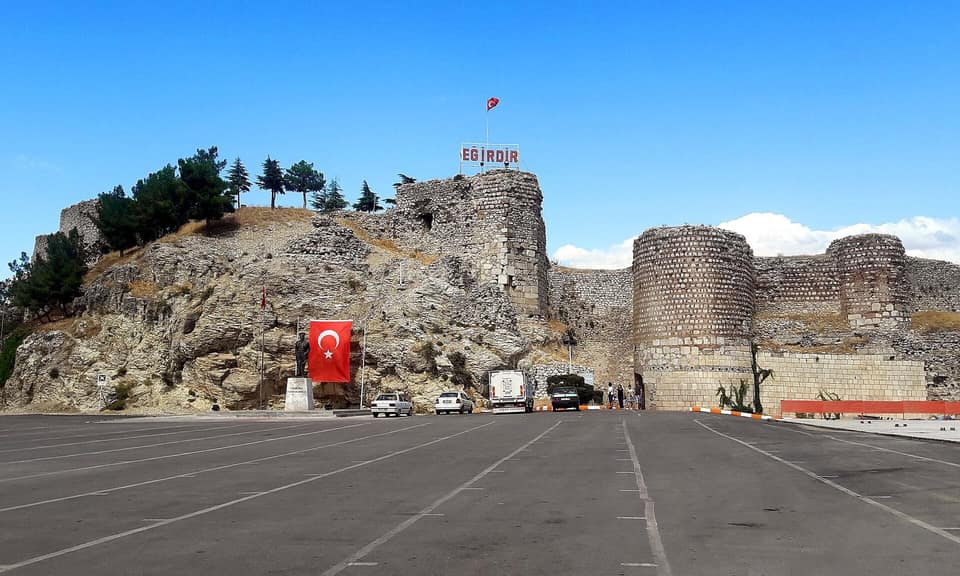
Eğirdir stands on a small peninsula reaching toward the lakeshore in the east of Isparta. According to the history page of the district governorate, the town lies on a small peninsula on the north of Lake Eğirdir, thirty-four kilometres from Isparta, at an altitude of 918 metres above sea level. The lake is presented as the fourth largest in Türkiye. This article reads the urban fabric of the peninsula through three historic structures: the fortress, the Keyhüsrev Caravanserai and the Dündar Bey Madrasa. All three tell the story of the road, trade and lodging that connected Antalya with central Anatolia in the Middle Ages.
A peninsula reaching into the lake
According to the Culture Portal, Eğirdir Fortress stands on the peninsula extending into Lake Eğirdir. There are houses on top of the walls that run along the peninsula in a north-south direction. Here the fortress does not stand as a monument apart from the houses; it is interwoven with daily life in the town. The page of the General Directorate of Promotion says that the structure, made up of an inner and an outer fortress, cuts across the peninsula in a north-south direction. The lake shapes both the defence and the view of this peninsula.
The lake itself is an important feature of the region. According to the General Directorate of Promotion page, with a surface area of 517 square kilometres it is the fourth largest lake in Türkiye. Its smaller northern part is called Lake Hoyran and the southern part Lake Eğirdir. The two parts are linked by the Hoyran Strait. The same page also says that, as water levels fell, two small islands that look like extensions of the peninsula became connected to Eğirdir.
The old core of the town
The history page of the district governorate says that Eğirdir and its surroundings have been inhabited since the period of the Arzawa Kingdom. In Hittite texts the name of the region appears as Pitassa. In the Phrygian, Lydian and Persian periods the region changed hands politically. The same page says it is thought that the town was founded by Croesus, the last ruler of Lydia, and that its name was Krozos, and that the inner fortress is thought to have been built in that period. After coming under the control of Alexander the Great, the region passed in later centuries to the Seleucids, the Kingdom of Pergamon and the Romans. In the Byzantine period the town appears under the names Akroterion and later Akrotiri.
Eğirdir and its surroundings passed to the Anatolian Seljuk State in 1204. According to the governorate page, the Seljuk sultans used this lovely lakeside town from time to time as a summer residence, cared for its development and repaired its walls. In the Middle Ages Eğirdir became an important lodging and trade centre on the road leading from the port of Antalya, which maintained trade with Egypt, to inner Anatolia. After the collapse of the Seljuk state, Dündar Bey founded the Hamidid Principality, and after Uluborlu the centre of the principality became Eğirdir in 1310. The founder gave the town the name Felekabad, after his own title. Eğirdir came under Ottoman rule in 1390.
Eğirdir Fortress
The fortress is the most visible witness of this long history. The Culture Portal writes that the construction date of the structure, made up of an inner and an outer fortress, is not known with certainty and that the present remains date from the Byzantine period. The walls, repaired at various times, were built in courses of brick and stone; the outer facing is stone and the interior is rubble fill. The fortress was damaged during Timur's invasion of Eğirdir and repaired in the Hamidid and Ottoman periods. The inscription of the fortress documents the repair of a structure in the year 707 of the Hijri calendar, that is 1307.
The sources do not agree on the age of the fortress. The Culture Portal speaks of a structure of unknown construction date and links the present remains to the Byzantine period. The governorate page says the inner fortress is thought to have been built in the Lydian period. The General Directorate of Promotion estimates that the fortress was built in the 4th century BC and says it underwent various repairs in the Roman and Byzantine periods. The same page adds that only the foundations of the outer fortress remain and that the inner fortress still stands today. For this reason, according to the sources, a wide range is given for the fortress's history; the common point is that the structure has many layers and was repaired many times.
Keyhüsrev Caravanserai, the Eğirdir Han
Rising in the Yeni Mahalle neighbourhood on the lakeshore, three kilometres south of the centre of Eğirdir, the han has the characteristics of classical Seljuk caravanserais according to the Culture Portal. The structure is described as one of the largest Anatolian Seljuk caravanserais. It lies on the Konya-Antalya caravan road and consists of two parts, a courtyard and an enclosed hall. Both parts have collapsed. The eastern wall of the courtyard has disappeared, and the facing of the surviving walls has been stripped, so the walls have become quite thin. Water seeping into the exposed rubble masonry causes further wear on the walls.
The han was built in 1237 by Gıyaseddin Keyhüsrev II. The Culture Portal and the governorate page write that it lost its function after a great fire a short time later. The Culture Portal gives this period as sixty-four years. The General Directorate of Promotion notes that today only the foundation traces of a few travellers' rooms remain in the courtyard. For this reason the han is visited less as a standing building than as a plan and a field of ruins. Even so, the thickness of the walls and the spread of the courtyard give an idea of the scale of the structure.
The 1993 excavation and the portal find
The most interesting part of the han's story is its link with a separate building. According to the Culture Portal, in the excavations carried out at the caravanserai in 1993 a stone fragment with geometric decoration was uncovered. This piece fitted exactly into the broken place in the frame border of the left niche of the portal of the Dündarbey Madrasa, and the composition was completed. Thus it became certain that during the construction of the madrasa in 1301 the portal was removed from the han and moved, and that the construction date of the han is 1237, as stated on the portal. This fragment binds the two buildings together.
The Dündar Bey Madrasa
For the Dündar Bey Madrasa, located inside the Eğirdir market, the page of the Eğirdir Tourism Information Office says that the building was built as a han in 1237 and converted into a madrasa in 1301 by the Hamidid Dündar Bey. The inscription above the entrance gate records its construction and its conversion. The building does not resemble Seljuk hans; it carries the features of the two-storey Seljuk madrasa plan.
The madrasa has a monumental entrance gate made of white marble. With its acanthus branches, volute corner colonnettes, geometric motifs and rich decoration, the gate is presented as one of the finest examples of Seljuk stone carving. The inscription surrounding the top and sides of the gate is written in celi sülüs script. The same page says that no other building in Seljuk architecture uses such a long and decorative inscription as a border. Partly damaged bird reliefs and plant motifs also draw attention. The pomegranate branches and leaves on the column capitals survive from earlier periods.
Ibn Battuta and the layout of the courtyard
According to the page, the Arab traveller Ibn Battuta came to Eğirdir in 1330 and stayed in this madrasa. The madrasa was used as a prison for a time, its upper floor was neglected during repairs, and as a result of poor repair it has come down to us as a single-storey building. The structure has a rectangular plan in a north-south direction and an open courtyard. Its eastern façade is a city wall, while the western façade is kept blind. When first built, the two-storey madrasa had thirty rooms. Today it has eleven rooms, six on the right of the courtyard and five on the left. Rubble stone, cut stone and reused material were all used in its construction, and white lime mortar is seen extensively.
There are also two different accounts of the madrasa's story. According to one, the main gate of the han was preserved and the other parts were altered and converted into a madrasa. According to the other, the facing stones of a Seljuk han three kilometres beyond Eğirdir were removed and brought here. The page says that no document has been found to show which of these is correct. What is certain is that the portal of the han was moved to the madrasa.
Walking through the fabric of the peninsula
When these three structures are read together, the story of the peninsula becomes clear. The fortress defends the narrow strip of land reaching into the lake; the houses on the walls show that daily life has become part of the structure. The madrasa stands inside the market, and its eastern façade is a city wall; that is, the building is integrated with the town's defensive line. The han lies outside the town, beside the road, on the lakeshore. The governorate page describes Eğirdir as a lodging and trade centre on the road from the port of Antalya to inner Anatolia; this trio is that tradition reflected in stone.
Walking in the narrow streets of the peninsula, looking at the courses of brick and stone in the fortress wall, at the marble work on the madrasa gate and then at the rubble walls of the han, is like following the stages of a journey. The governorate page also says that in the last half of the 12th century and in the 13th century Eğirdir was among the towns where scholarly and social movements were lively.
How to visit
The fortress and the madrasa are in the centre of the peninsula, within walking distance of each other. Since the madrasa is inside the market, it can be visited as part of a shopping walk. The han is three kilometres south of the centre; you can go there on foot or by vehicle. The suggested order is as follows: first look at the fortress walls, then move to the madrasa in the market, and then visit the han on the lakeshore. In this way the chronology of the article, first the fortress and then the han and madrasa, is reflected in the order of the visit.
Morning or late afternoon hours are better for light, both at the fortress and at the han on the lakeshore. Because the walls of the han are worn by water seepage, it is important not to climb the walls and to walk around without touching the ruins, so as not to damage the structure. Visiting conditions, opening hours and entry arrangements may change; for current information, check the pages of the Isparta Provincial Directorate of Culture and Tourism and kulturportali.gov.tr. The Eğirdir Tourism Information Office can also help on site.
Sources
- Culture Portal, Eğirdir Kalesi, https://www.kulturportali.gov.tr/turkiye/isparta/gezilecekyer/egirdir-kalesi
- Culture Portal, Keyhüsrev Kervansarayı / Eğirdir Hanı, https://www.kulturportali.gov.tr/turkiye/isparta/gezilecekyer/egirdir-keyhusrev-kervansarayi-egirdir-hani
- Eğirdir Tourism Information Office, Dündarbey Medresesi, https://egirdirturizmdanismaburosu.ktb.gov.tr/TR-178477/dundarbey-medresesi.html
- Eğirdir District Governorate, Eğirdir'in Tarihi, https://www.egirdir.gov.tr/egirdirin-tarihi
- Ministry of Culture and Tourism General Directorate of Promotion, Gezilecek Yerler, https://tanitma.ktb.gov.tr/TR-22623/gezilecek-yerler.html
Comments
Be the first to comment