

Flamingos of the Gediz Delta and the İzmir Bird Paradise
To the north-west of İzmir, where Karşıyaka ends, the city suddenly opens onto salt pans, reed beds and shallow waters full of pink birds.

Sign in to like and rate
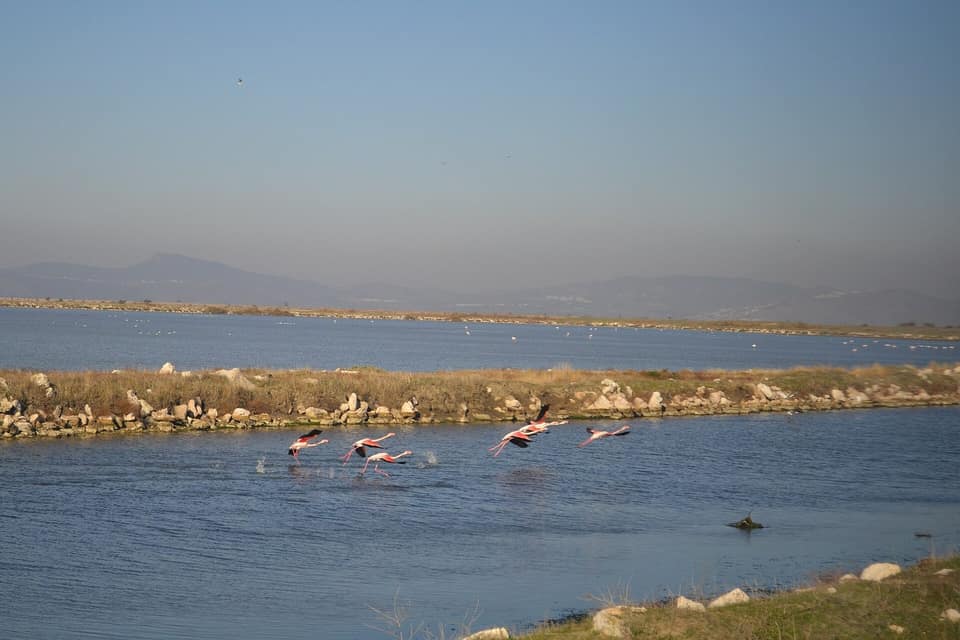
To the north-west of İzmir, where Karşıyaka ends, the city suddenly opens onto salt pans, reed beds and shallow waters full of pink birds. The Gediz Delta, home to one in every ten flamingos on earth, is one of the rare wetlands that survive inside a metropolis. This article explains what the delta is, why the flamingos chose it, what can be seen in which month of the year, where to watch the birds from and what to keep in mind while watching.
The delta on the city's doorstep
The Gediz is the second largest river of the Aegean Region after the Büyük Menderes; as it flows into the Gulf of İzmir it forms a delta of roughly 40,000 hectares between the districts of Çiğli, Menemen and Foça. According to the İzmir Bird Paradise Conservation and Development Union (İZKUŞ), the delta took two million years to form, and 20,400 hectares of it are wetland today. Three natural lagoons named Homa, Çilazmak and Kırdeniz, the salt pans of the Çamaltı Saltworks, reed beds, dunes and saline meadows interlock; fresh water gathers mostly in the old river channels, in irrigation canals and around Sazlıgöl in the Seyrek neighbourhood of Menemen. The river has shifted its bed throughout history. As Wikipedia relates, when at the end of the 19th century it was feared that the alluvium it carried would silt up the port of İzmir, its course was diverted with canals and embankments in the largest river project of the Ottoman era, a task that took twenty years. The remains of the ancient Ionian town of Leukai stand at the Üçtepeler locality of the delta, and salt is still produced today at the Çamaltı Saltworks on the shore. Glasswort, tamarisk, mastic and terebinth make up the vegetation; İZKUŞ counts 314 plant species from 61 families, while the 4th Regional Directorate of Nature Conservation and National Parks gives 316. Stretching from Mavişehir along the Sasalı shore to the hills of Foça, this area is considered a place with few equals in the world because it lies right at the foot of a city of millions.
Why there are so many flamingos
The greater flamingo, Phoenicopterus roseus by its scientific name, is a bird 120 to 140 centimetres long with pinkish-white plumage, red underwings and black flight feathers. Its bill is pink with a black tip and is used upside down: the bird dips its head into the water and works its bill like a sieve, picking out the tiny creatures that live in shallow salty water. According to İZKUŞ its staple food is the brine shrimp Artemia salina, and the red in its feathers is said to come from that food. The flamingo wants still, shallow, salty or soda water; salt pans and lagoons where other animals cannot survive are an ideal table for it. The Gediz Delta is exactly such a place. There are only two sites in Türkiye where flamingos breed, Tuz Gölü and the Gediz Delta; according to Doğa Derneği the delta hosts around ten percent of the world's flamingo population, and according to Wikipedia thirty percent of the greater flamingo population of Europe. In winter the numbers grow further: the Midwinter Waterbird Counts have found some 17,000 flamingos spending the winter in the delta. Ringing studies carried out since 2003 reveal an intriguing map: some of the chicks born in the delta have been seen in France, Italy, Greece, Spain, Tunisia and Israel, and birds ringed in those countries also turn up in the Gediz from time to time. In other words, part of the pink flock you watch from Mavişehir consists of guests from the far end of the Mediterranean.
Flamingo Island and a breeding year
The flamingo builds a small mound of mud and lays a single chalk-white egg on top of it; it breeds in colonies, and the chicks gather in a creche before they can fly. In the delta the breeding site is the salt pans inside the Çamaltı Saltworks and the islets there. When the natural islets proved insufficient, the General Directorate of Nature Conservation and National Parks, the İzmir Metropolitan Municipality, the Natural History Research Centre of Ege University and İZKUŞ launched an artificial breeding island project on 26 January 2012. According to İZKUŞ, an island of 550 square metres was enlarged to 6,440 square metres, creating a site where some 12,000 flamingos can breed, the largest flamingo island in the world after those in France and Spain. The result shows in the numbers: Doğa Derneği measures an annual average of 18,000 to 20,000 pairs of flamingos breeding in the delta. A breeding year runs like this. In the winter months the courtship dances begin; the flock turns its heads left and right in unison and opens and closes its wings. At the beginning of April the birds settle on the island to incubate, at the beginning of May the first chicks hatch, through the summer the grey-downed chicks grow up together in the creche, and at the end of summer they begin to fly. The nests can only be counted once the birds have left the island. In 2021 a year-long monitoring programme run by Doğa Derneği and the İzmir Metropolitan Municipality recorded the life cycles of 186 bird species and showed that 113 species breed in the delta and that more than a third of the birds breeding in Türkiye nest here.
Who else lives here besides the flamingo
The delta does not mean flamingos alone. İZKUŞ counts 289 bird species, the 4th Regional Directorate 295 and Doğa Derneği 301; in other words, close to 300 of the roughly 500 species recorded in Türkiye have been seen here. Foremost among them is the Dalmatian pelican, whose world population is around 15,000: the Gediz Delta is one of the five sites in Türkiye where the species breeds regularly, some 70 pairs incubate every year on the small islets of the Homa Lagoon, and between 200 and 700 Dalmatian pelicans stay in the delta over winter. Globally threatened species such as the pallid harrier, the red-breasted goose and the cinereous bunting are also among the delta's guests. Shorebirds make up the real crowd: the dunlin, the Kentish plover, the common redshank, the black-tailed godwit, the Eurasian curlew and the oystercatcher reach their highest wintering numbers in Türkiye here. Among the raptors, Bonelli's eagle, the osprey, the long-legged buzzard, the marsh harrier and the lesser kestrel are seen regularly; the bittern and the bearded reedling hide in the reeds, and the kingfisher and the bee-eater are the delta's colourful signatures. Beyond the birds, mammals such as the jackal, fox, wild boar, badger and marten, 28 reptile species and 71 fish species have been recorded; this is also one of the rare places where the Mediterranean monk seal and the loggerhead turtle can be seen together in the gulf.
A Ramsar site and its protection
The Gediz Delta was included in the Ramsar Convention on 15 April 1998 with an area of 14,900 hectares; it appears on the list of the General Directorate of Nature Conservation and National Parks as one of the 14 Ramsar sites in Türkiye and has been an Important Bird Area since 2000. Protection goes back further: an 8,000-hectare section was declared a wildlife protection area in 1982, a first-degree natural site registration followed in 1985, the İzmir Metropolitan Municipality declared the place a bird paradise in 1987, and a management plan came into force in 2007. The plan divides the area into absolute protection, wetland, ecological influence and buffer zones; according to the directorate the buffer area covers 32,385 hectares, the sensitive protection zone 3,561 and the sustainable use zone 3,820. In November 2019 the İzmir Metropolitan Municipality made an official application for the delta to become a UNESCO World Heritage site. The threats are considerable too: construction pressure, illegal hunting, pollution, drought and misguided water policies. A satellite-imagery study published in the Aegean Geographical Journal in 2022 shows that between 1987 and 2021 the reed swamps of the delta shrank while the shallow water surfaces expanded. According to Doğa Derneği the delta has so far been one of the better protected areas; even so, its survival depends on the people of İzmir not turning their backs on it.
What to see in which season
The delta shows a different face in every month of the year. Winter is the season of crowds: according to the 4th Regional Directorate the number of wintering waterbirds, ducks included, averages between 70,000 and 80,000, and the Midwinter Waterbird Count of 2023 recorded 57 species and 52,291 individuals. The flamingo flocks are at their densest in these months, the Dalmatian pelicans winter in the lagoon, and the kingfisher and the great egret wait along the banks of the canals. Spring and autumn are migration time; as songbirds and raptors pass through the delta it is diversity rather than numbers that rises, the bee-eater and the lesser kestrel arrive with the spring, and the bittern hides among the reeds. Summer is the breeding season: the flamingo colony on the island, the terns and the plovers raise their young; approaching the breeding island is forbidden in this period and observation is done from a distance. In autumn the light softens, and late afternoon on the edge of the salt pans is the best time for photographs. In short, winter and early spring to see the flamingos in numbers, late summer to watch the chicks, April and October to catch the migrants.
Where to watch from and how to get there
The delta can be approached through three doors. The first is Mavişehir: the coastal promenade at the western tip of Karşıyaka and the Mavişehir fishing harbour are the easiest place from which to look at the southern wing of the delta with a single pair of binoculars. The Flamingo Route boat tours of the İzmir Metropolitan Municipality and Doğa Derneği also depart from here and offer an hour and a half of birdwatching in the coastal marshes of the delta. The second is the Sasalı and Çiğli side: Sasalı, where the İzmir Natural Life Park stands, is the visitors' gateway to the İzmir Bird Paradise; İZKUŞ asks those planning individual or group visits to contact the İzmir Branch of the 4th Regional Directorate of the Ministry of Agriculture and Forestry. The information centre and the observation points in the delta lie on the roads reached from here; the section open to vehicles is limited, and the long stretches are covered on foot or by bicycle. The third is the bus tour: the Flamingo Route bus tour takes visitors through the Southern and Central Gediz Delta, from the reed beds to the salt pans, in the company of an expert. The birdwatching walks organised by the municipality start from the Kaklıç junction; binoculars and telescopes are provided by the team. Those using public transport reach Mavişehir by İZBAN and Sasalı by ESHOT buses. Tour days and times, permits to enter the saltworks and the opening days of the information centre change; check the latest information on the official websites of the İzmir Metropolitan Municipality and İZKUŞ.
Birdwatching etiquette
Birdwatching demands silence. Come to the delta early in the morning or in the late afternoon; the midday sun both hardens the light and drives the birds into the reeds. Bring binoculars, and a telescope if you can; instead of approaching the flamingo, find the distance that brings it to you. If the flock lifts its heads and looks towards you, you have come too close; take a step back. Never, under any circumstances, approach the breeding island, the incubating birds or the chick creche; a frightened colony may abandon its eggs. Do not fly drones, do not drive onto the embankments of the salt pans, do not bring your dog to the delta. Stay on the path; saline meadows die when they are trampled. Take your rubbish with you, do not feed the birds, do not talk loudly, do not use flash. The finest moment for a photograph is when the whole flock takes off at once and shows the red beneath its wings; waiting for it gives better frames than startling it. As İZKUŞ reminds us, the true owners of the delta are the birds that have lived here for thousands of years; we are only guests.
Sources
- İzmir Bird Paradise Conservation and Development Union (İZKUŞ), Gediz Delta, https://izmirkuscenneti.gov.tr/gediz-deltasi/
- İZKUŞ, home page and Flamingo Island, https://izmirkuscenneti.gov.tr/
- Ministry of Agriculture and Forestry, 4th Regional Directorate of Nature Conservation and National Parks, İzmir Gediz Delta (İzmir Bird Paradise), https://bolge4.tarimorman.gov.tr/Menu/41/Izmir-Gediz-Deltasi-_izmir-Kus-Cenneti_
- General Directorate of Nature Conservation and National Parks, list of wetlands, https://www.tarimorman.gov.tr/DKMP/Menu/31/Ramsar-Alanlari
- Doğa Derneği, Gediz Delta, https://dogadernegi.org/tr/calismalarimiz/ekosistemler/sulak-alanlar/gediz-deltasi/
- Doğa Derneği, İzmir's flamingo chicks have opened their eyes to the world (8 May 2021), https://dogadernegi.org/tr/izmirin-yavru-flamingolari-dunyaya-gozlerini-acti/
- Doğa Derneği, İzmir residents meet the birds on Flamingo Route tours (17 October 2023), https://dogadernegi.org/tr/izmirliler-flamingo-yolu-turlari-ile-kuslarla-bulusuyor/
- İzmir Metropolitan Municipality, news release on the Gediz Delta biodiversity research workshop (10 December 2021), https://www.izmir.bel.tr/tr/Haberler/soyer-izmir-de-dogan-her-cocuk-flamingolarla-birlikte-buyudugunu-bilmeli/45992/156
- Şermin Tağıl and Berkay Aytan, Changes in Ecosystem Service Value in response to Habitat Change in the Gediz Delta Conservation Area, Aegean Geographical Journal 31(2), 2022, https://dergipark.org.tr/tr/download/article-file/2653612
- Vikipedi, Gediz Deltası, https://tr.wikipedia.org/wiki/Gediz_Deltas%C4%B1
- Vikipedi, İzmir Kuş Cenneti, https://tr.wikipedia.org/wiki/%C4%B0zmir_Ku%C5%9F_Cenneti
- Wikipedia, Gediz Delta, https://en.wikipedia.org/wiki/Gediz_Delta
- Vikipedi, Büyük flamingo, https://tr.wikipedia.org/wiki/B%C3%BCy%C3%BCk_flamingo
Comments
Be the first to comment