

Fire in the Wooden City, Its Watchtowers and Its Tulumbacı Brigades
In old Istanbul the most dreaded news was news of a fire. For centuries the city was built of timber, its houses leaning into one another along narrow lanes.

Sign in to like and rate
In old Istanbul the most dreaded news was news of a fire. For centuries the city was built of timber, its houses leaning into one another along narrow lanes. A bakery chimney, a spark from a brazier or a carelessly dropped pipe of tobacco could turn an entire quarter to ash within hours on a windy summer day. The great fires have been described as "kıyamet-i suğra", a little apocalypse, and an old saying recorded by Osman Nuri Ergin names fire as Istanbul's scourge, just as plague was Anatolia's.
This article follows the marks that fear left on the city. It covers when and where the great fires broke out, the edicts and building codes that pushed Istanbul from timber to masonry, how the city was watched from the Beyazıt and Galata towers, and the story that began with Gerçek Davud's pump and continued with Széchenyi Pasha's fire regiment. At the end you will find where this history can still be seen today and how to plan a day around it.
The Fate of a Timber City
According to historian Kenan Yıldız, writing for the History of Istanbul project, the threat of fire occupied the minds of both the state and ordinary people until the middle of the 20th century. Most Western travellers who wrote about Istanbul devoted separate pages to its fires. James Dallaway, describing the city at the end of the 18th century, noted that hardly a few months went by without one. The 16th-century chronicler Selaniki recorded 17 fires in the 37 years between 1563 and 1600.
The sources are clear about why the fires were so frequent and so destructive. After the conquest the population concentrated inside the walls, in Galata and in Eyüp, creating crowded quarters of tightly packed wooden houses. The northeasterly wind drove any fire that started on the shores of the Golden Horn southwest, deep into the peninsula. Timber yards along the Golden Horn, shops selling pitch and tar, gunpowder stores inside the city and rainless summers completed the picture.
Why did the move to stone take so long? The sources give several reasons: stone was expensive to quarry and transport, people had to rebuild quickly after each disaster, and a wooden house was easy to heat, repair and alter. So although the first edict ordering a shift from timber to stone was issued in the 17th century, real results only came in the 19th. After every great fire the fabric of the city changed a little.
The Great Fires in the Record
Ottoman chronicles gave the largest fires names such as "ihrak-ı azim", "harik-i kebir" or "harik-i ekber". These are some of the fires that genuinely reshaped the city.
- 1569: Thought to have started in a bakery in a crowded quarter, this fire swept through a city that had seen no rain for five months. Hammer, drawing on European ambassadors' reports, wrote that 36,000 houses burned. Afterwards every household was required to keep a ladder and a large barrel of water in the attic.
- 1633, Cibali: Driven by a strong north wind, it burned for three days and, according to Katip Çelebi, destroyed a fifth of the city. Told that the fire had been caused by smoking, Murad IV closed the coffeehouses and banned tobacco.
- 1718, Cibali: Starting on 17 July and lasting 27 hours, it spread through Unkapanı, Zeyrek, Vefa, Süleymaniye, Aksaray, Fatih and as far as Kumkapı. Records list 51,000 houses, 2,283 shops and 171 mosques lost.
- 1782, Cibali: Three major fires struck that year. The largest began on the night of 22 August in Cibali and took 65 hours to put out completely; a water shortage lasting since March made fighting it almost impossible. Cevdet Pasha put the number of houses burned at 20,000, the Dutch envoy at 80,000. Some of the homeless were resettled in towns such as Silivri, Çorlu, Edirne, İzmit, Kartal and Şile.
- 1826, Hocapaşa: Breaking out on 2 August, just after the abolition of the Janissary Corps and its fire brigade, it made a new fire organisation unavoidable.
- 1833, Cibali: Starting on 31 August and splitting into several branches in the wind, it burned half the city.
- 1856 Aksaray and 1865 Hocapaşa: Both destroyed large areas and changed the direction of urban planning; they are covered separately below.
Harik-i Kebir, the Summer of 1660
Istanbul's largest known fire began on the afternoon of 24 July 1660 in a chest maker's shop near the Ahi Çelebi Mosque, between Odunkapısı and Ayazmakapısı. The sources blame a careless smoker. From the timber yards of Unkapanı the flames leapt in every direction, reaching Süleymaniye, the Old Palace, Beyazıt, Fatih, the Grand Bazaar, Mahmutpaşa, Hocapaşa, the Hippodrome, Kadırga, Kumkapı and Samatya. It burned for 49 hours and reduced two thirds of the city to ash.
Kenan Yıldız reports that between 2,700 and 4,000 people died, and that 120 palaces and mansions, 40 baths, 360 mosques and prayer rooms and more than a hundred storehouses were lost. The eyewitness Eremya Çelebi wrote that 13 of the city's 18 markets were destroyed. July dryness, a strong north wind and timber yards right next to the point of origin combined to make the disaster worse; the heat made nails shoot out of burning houses into neighbouring buildings, spreading the fire further. People fled to the shore, the piers and the vegetable gardens of Langa. The head gardener of the palace, who let fleeing residents into the royal Hasbahçe gardens of Topkapı without waiting for the sultan's permission, was rewarded with the rank of vizier.
The most visible mark the fire left on the city is in Eminönü. The Yeni Valide Mosque, which had stood unfinished for years, was taken up again after the fire on the decision of Hatice Turhan Sultan, and the complex was completed. The Yeni Cami that fills the front row of the skyline as your ferry approaches Eminönü is part of the city's rebuilding after this catastrophe. The sources note that the make-up of the neighbourhood's population also changed in the process.
From Edicts to Building Codes, From Timber to Masonry
For centuries the state issued rules to prevent fires, but most of them struggled in practice. The Istanbul Fire Department cites an edict of Murad III dated 12 March 1579 as the first written fire regulation: every house was to keep a large barrel of water and a ladder. An edict issued after the Galata fire of 1696 went much further, ordering that burned areas be rebuilt "with stone, lime and mud" as in Aleppo and Damascus. After the Grand Bazaar fire of 1701 it was decided that the bazaar's shops should be rebuilt in stone or brick.
The real turning point came in the 19th century. According to a study published in the journal Kent Akademisi, an 1839 memorandum called for new buildings to be of masonry, streets to be graded into four widths and dead-end streets to be banned. Those who could not afford masonry could build in timber only if they raised stone walls between houses. The proposal was not carried out at the time, but it paved the way for the regulations that followed: the building codes of 1848 and 1849, the street regulation of 1858, the 1863 Roads and Buildings Regulation, the regulation of 1875, the municipal law of 1877 and the Building Law of 1882. These texts kept timber buildings lower than masonry ones, defined street widths and required firewalls for wooden houses. The fact that the same clauses were repeated in each new text shows how hard people found it to comply and how often the authorities made concessions.
It was the fires themselves that brought the rules down to street level. After the Aksaray fire of 1856, Storari, who was commissioned to map the burned districts, replaced the old winding fabric with a grid of streets and carried out street improvements elsewhere in the city until 1863. The scale of the 1865 Hocapaşa fire led to the creation of the Road Improvement Commission (İslahat-ı Turuk Komisyonu). The commission demolished buildings on both sides of Divanyolu to widen it, cleared space around major monuments and, until it was dissolved in 1869, regulated many streets both in burned areas and elsewhere. Karagümrük, Ayvansaray, Balat, Fener, Unkapanı, Kadırga, Langa, Samatya and Yedikule were among the areas reorganised in this period. The result was a two-faced city in which old and new fabric stood side by side, and the timber fabric of the historic peninsula began to dissolve.
Beyoğlu 1870 and the Rebuilding of Pera
At one in the afternoon on Sunday 5 June 1870, a fire broke out in a house on Feridiye Street and split into five or six branches in the wind. The flames advanced from Tarlabaşı to Taksim; one branch reached the Cadde-i Kebir, today's İstiklal Avenue, opposite Galatasaray High School, while another ran down to Kalyoncukulluğu. According to the report of the Sixth Municipal District cited by Prof. Abdurrahman Kılıç, around 8,000 buildings in 65 streets and 163 neighbourhoods were destroyed. By the evening of the third day 104 bodies had been recovered, and relief lists show that 28,689 people were affected.
One of the bitterest lessons of this fire was misplaced trust in masonry. People living in stone houses closed the iron shutters on their windows and took refuge in cellars; when roofs and eaves caught fire, many suffocated in the smoke. The Artillery Barracks at Taksim was emptied for the victims and more than two thousand tents were pitched on the parade ground opposite. Hotels, theatres and embassy buildings were among the losses.
Beyoğlu owes much of its present appearance to the rebuilding that followed. Better stone and cast iron were used, and apartment blocks of several storeys replaced two and three storey houses. On the site of the Naum Theatre, lost in the fire, the Cité de Péra building was completed in 1876; it is the building known today as Çiçek Pasajı. After the fire foreign insurance companies opened branches in Istanbul, maps showing fire risk began to be drawn, and wealthy families spread out towards Şişli and Nişantaşı. Most importantly, the disaster made a regular fire service inevitable.
Watching the City From the Towers
The first requirement for fighting a fire was to see it early. By the middle of the 18th century there were fire watchtowers at Beyazıt, at Galata and at İcadiye on the Asian shore. The lookout on duty was called the "dideban". When he spotted a fire, messengers known as "köşklü" carried the news to the neighbourhood watchmen.
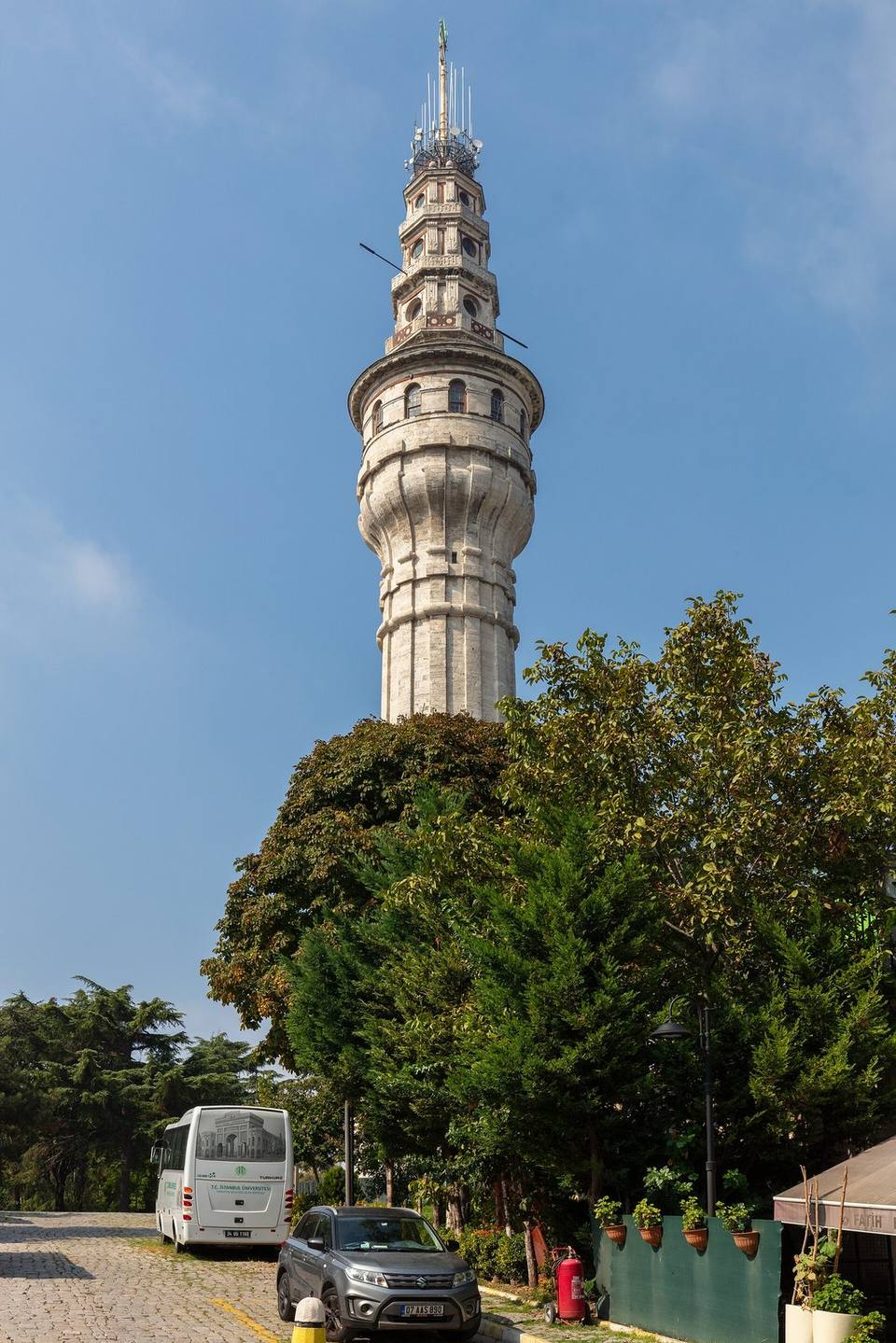
The first tower at Beyazıt was built of timber in 1749 in the garden of the Ağakapısı, which had been damaged in the Küçükpazar fire. The sources say this wooden tower burned in one of the Cibali fires and was replaced by another wooden one. When the Janissary Corps was abolished in 1826 the tower was pulled down; a fire two days later showed how necessary it was, and a new wooden tower was erected on the present site, in the courtyard of the Ministry of War. That tower was soon set on fire as well. Mahmud II then commissioned the architect Senekerim Balyan to build the masonry tower you see today, completed in 1828. In 1849 three storeys with round windows were added to the top, and in 1889 a flagpole was fitted.
The signalling system was simple but effective. By day baskets were lowered from the tower, by night lamps were lit; the number of baskets, or the number and colour of the lamps, showed which district was burning. According to the sources, the İcadiye tower on the Asian side then fired cannon to alert the public. From the Beyazıt Tower the view stretched from Yedikule to Topkapı, from Fener and Balat to Beşiktaş and Ortaköy, and from Üsküdar and Kadıköy to the Princes' Islands. Until 1923 twenty firefighters were stationed in the tower.
The Galata Tower did the same job. Built by the Genoese in the 14th century, it was used from the 18th century onwards as a fire tower by the Ottoman military band corps and fire lookouts. In the repairs after a fire in 1794 its top floor was remodelled and a large drum, the kös, was installed to announce fires. The tower was damaged again in the fire of 1831 and its upper section was restored close to its present appearance. When a storm toppled its roof in 1875, two octagonal storeys and a terrace were added, and this became the fire alarm centre of the fire service founded in 1874.
Gerçek Davud and the Fire Brigade Corps
Before the pump, the strongest weapon against fire was human hands: water carried in buckets from cisterns, and houses pulled down with axes and hooks. Kenan Yıldız writes that the custom of making the Janissary aghas responsible for watching for and extinguishing fires took hold after a disaster in 1501, when lightning struck a gunpowder shop in Galata. The sources also frequently mention Janissaries looting instead of fighting the flames.
Change came with a French-born engineer. According to the TDV Encyclopedia of Islam, this engineer, named Davud (David), took part in the Venice campaign of 1715, became a Muslim on his return and was known by the nickname "Gerçek", meaning genuine; some sources call him Davud-u Hakiki. The tulumba, a word derived from the Italian "tromba", meaning pipe, was a simple hand-operated water pump. When Davud's pump proved its worth in the Tüfenkhane and Tophane fires of 1718, Grand Vizier Nevşehirli Damat İbrahim Pasha placed him at the head of the Fire Brigade Corps founded in 1720.
The sources differ on the date. The Istanbul Fire Department traces its own foundation to 1714 and displays Gerçek Davud's canopied pump of 1714 in its museum. The TDV Encyclopedia of Islam and the History of Istanbul, on the other hand, state that the corps was formally established in 1720. Both dates tell the same story: in the first quarter of the 18th century, Istanbul set up its first regular unit against fire.
The corps was housed in the barracks of the novice Janissaries at Şehzadebaşı. It started with six officers and fifty men, reaching 150 men in 1724 and 461 in 1755. The firemen's everyday dress was a large turban, a red cloak called "kartal kanat" (eagle's wing) and red slippers, with bare calves. When they went into a fire they wore a copper helmet known as the "yangın tası". Even so, the pump worked no miracles. As Osman Nuri Ergin observed, fires did not decrease after its arrival, and some of the largest broke out in exactly this period.
The Neighbourhood Tulumbacıs
When the Janissary Corps was abolished in 1826, its fire brigade went with it. The Hocapaşa fire, which broke out 48 days later, showed the cost of the gap, and a new organisation was soon set up; the word "yangıncı", fire-fighter, began to replace "tulumbacı". The fire battalions were attached first to the new army, then to the police in 1846 and to the city administration founded in 1855.
In the same period an imperial edict required every neighbourhood to acquire its own pump, and volunteer neighbourhood fire brigades were born. The pump chest was regarded as the honour of the neighbourhood. At the head of each team stood a first chief chosen by the neighbourhood council, carrying a leather whip. A second chief assisted him, a lantern bearer lit the way, a nozzle man held the pipe that shot out the water and another member handled the hose. The four men who carried the chest on their shoulders with poles called each other "omuzdaş", shoulder mates.
The firemen ran to fires with cries beginning "haaayt" and with rhyming songs, and they spoke a slang of their own known as "tulumbacı ağzı". Service was voluntary; in return they were exempted from some taxes and given the right to work as street vendors in their district or to collect tips. Over time they were also portrayed as brawlers and toughs. The painters Amedeo Preziosi and Fausto Zonaro depicted them, and Nabizade Nazım's novel Zehra and Sermet Muhtar Alus's Onikiler brought their world into literature. Neighbourhood fire brigades were banned in August 1924 and passed into history.
Széchenyi Pasha and the Modern Fire Service
The Beyoğlu fire of 1870 laid bare the shortcomings of the existing system for all to see. Summoned to Istanbul on the orders of Sultan Abdülaziz, the Hungarian count Ödön Széchenyi founded, according to the Istanbul Fire Department's history, a Fire Regiment run on military discipline on 26 September 1874. The regiment worked with animal-drawn vehicles, standard protective clothing and regular training. Its success earned Széchenyi the title of pasha and the task of setting up new battalions; in the 1880s a naval fire battalion was also formed to fight fires from the water. The sources give different founding years for this battalion.
Reform did not stop there. An 1890 regulation laid down chimney inspections, building rules and penalties for breaches of fire safety. On 25 September 1923 the fire service, a military organisation for 49 years, was handed over to the Istanbul Municipality, and in 1937 a modern fire school opened at Saraçhane. Széchenyi ran the city's fire service for 48 years, died in 1922 and, at his own request, was buried in the Feriköy Latin Cemetery. Today the Istanbul Fire Department, headquartered in Fatih, is the largest fire service in Turkey.
Where to See This History Today
The most visible monuments to the city's fire history are the two towers, but the traces are not limited to them. They also survive in the lines of certain streets, in the materials of certain buildings and in the halls of a museum.
- Beyazıt Tower: It rises in the courtyard of Istanbul University's main campus. The sources state that special permission is needed to enter, so the best way to see it is from Beyazıt Square and the streets around the campus. Look for the inscription bearing the monogram of Mahmud II on the side facing the square. For a long time the tower announced the next day's weather with coloured lights at night: blue meant clear skies, green rain, yellow fog and red snow. The practice stopped in 1995 and was revived in 2010 on the initiative of the Istanbul Metropolitan Municipality.
- Galata Tower: It is now a museum. The inscription above the entrance commemorates the repairs of 1831-32; the monogram of Mahmud II on it was later scraped away. On the seventh floor there is a model of part of the city and viewing binoculars at the windows, and the eighth floor is a viewing terrace. As you look out, remember that from 1875 the top of the tower was used for exactly this purpose, scanning the city and raising the alarm, and try to find the Beyazıt Tower on the far side of the Golden Horn.
- Fire Department Museum: The Istanbul Count Szechenyi Fire Department Museum was first founded in 1931 and reorganised in 1998. When its original building in Fatih went into restoration in 2008, it moved to the historic Kılıç Ali Paşa water cistern on Horoz Sokak, off Çitlembik Yokuşu in the Yıldız neighbourhood of Beşiktaş. On display are canopied pumps, neighbourhood pumps, steam pumps, a horse-drawn pump carriage, the first motor pump, uniforms from the military period, fire axes, leather buckets, candle lanterns, photographs of fires and dioramas.
- Fatih Fire Station: It stands on Macar Kardeşler Caddesi; the bus stop on the street is also named Fatih İtfaiye, and the area goes by that name. The street's name has nothing to do with Széchenyi: it was given during the First World War as a gesture to Hungary, an ally at the time. It can be combined with nearby Kadınlar Pazarı on the same walk.
- The Grand Bazaar and Divanyolu: The Grand Bazaar's masonry shops are the legacy of the decision to build in stone after the fire of 1701; even so, the bazaar suffered major fires in 1943 and 1954. The present width of Divanyolu comes from the improvements made after the Hocapaşa fire of 1865.
- Grid streets: The straight, intersecting streets in parts of Aksaray and Samatya are traces of 19th-century plans drawn up after fires. When walking in Samatya, watch for the points where the regular streets meet the older winding fabric.
- İstiklal Avenue: The masonry apartment blocks that rose after 1870 and the Cité de Péra building on the site of the Naum Theatre are the traces of the Beyoğlu fire along the avenue.
A Half-Day Walk Through Fire History
If you want to read this history in a single day, you can build a walk that starts on the historic peninsula and ends in Galata. Take the tram to Beyazıt and look at the tower from the square, around the campus gate. From there enter the Grand Bazaar and walk between its rows of masonry shops. When you come out, follow Divanyolu down towards Sultanahmet and picture the line of the avenue widened after 1865. Then walk through the streets of Sirkeci and Hocapaşa to Eminönü, pass in front of the Yeni Cami completed after the fire of 1660 and cross the Galata Bridge on foot. Finish the day by climbing the Galata Tower; from the terrace you will see most of the route you walked in the morning.
If you can spare a second day, spend the morning in Fatih: pass the fire station on Macar Kardeşler Caddesi and explore the older streets around it. In the afternoon head to the Fire Department Museum in Beşiktaş; once you have seen the pumps, the chests and the copper helmet, the accounts of the firemen's cries will feel far more vivid. In the late afternoon walk along İstiklal Avenue around Galatasaray, tracing in your mind the branches of the fire of 1870.
Practical Notes
- The Beyazıt Tower stands inside a university campus and access rules may change. The square and the surrounding streets are enough to see the tower.
- Check current opening hours and ticket information for the Galata Tower on the Ministry of Culture and Tourism's museum website (muze.gov.tr).
- The Fire Department Museum's opening days and hours are given differently in different sources; check the Istanbul Fire Department's official website before you go. The official page states that entry is free.
- The walking route is hilly and cobbled in places; wear comfortable shoes and carry water on summer days.
- When taking photographs in front of fire stations, do not block the vehicle exits; these are working units that still respond to emergencies.
Sources
- Kenan Yıldız, Istanbul Fires During the Ottoman Period and Their Effect on the City's Topography, History of Istanbul, https://istanbultarihi.ist/393-istanbul-fires-during-the-ottoman-period-and-their-effect-on-the-citys-topography
- Kenan Yıldız, The Great Istanbul Fire of 1660, History of Istanbul, https://istanbultarihi.ist/394-the-great-istanbul-fire-of-1660
- TDV Encyclopedia of Islam, Tulumbacı entry, https://islamansiklopedisi.org.tr/tulumbaci
- TDV Encyclopedia of Islam, Beyazıt Yangın Kulesi entry, https://islamansiklopedisi.org.tr/beyazit-yangin-kulesi
- Istanbul Fire Department, History, https://itfaiye.ibb.gov.tr/tr/tarihce.html
- Istanbul Fire Department, Fire Department Museum, https://itfaiye.ibb.gov.tr/tr/itfaiye-muzesi.html
- Turkish Museums, Istanbul Count Szechenyi Fire Department Museum, https://www.turkishmuseums.com/museum/detail/12313-istanbul-kont-szechenyi-itfaiye-muzesi/12313/1
- Abdurrahman Kılıç, Büyük Beyoğlu Yangını, https://yangin.org/dosyalar/buyuk_beyoglu_yangini.pdf
- Güneş Yörüten and Cenk Hamamcıoğlu, Ayvansaray and Samatya Fire Areas Reorganised in the 19th Century, Kent Akademisi, 2018, https://dergipark.org.tr/tr/download/article-file/451683
- Wikipedia (Turkish), Beyazıt Kulesi, https://tr.wikipedia.org/wiki/Beyazıt_Kulesi
- Wikipedia, Beyazıt Tower, https://en.wikipedia.org/wiki/Beyazıt_Tower
- Wikipedia (Turkish), Galata Kulesi, https://tr.wikipedia.org/wiki/Galata_Kulesi
- Wikipedia (Turkish), Tulumbacılar, https://tr.wikipedia.org/wiki/Tulumbacılar
- Wikipedia (Turkish), 1782 İstanbul yangınları, https://tr.wikipedia.org/wiki/1782_İstanbul_yangınları
- Wikipedia (Turkish), Harik Köşkü, https://tr.wikipedia.org/wiki/Harik_Köşkü
- Wikipedia (Turkish), Macar Kardeşler Caddesi, https://tr.wikipedia.org/wiki/Macar_Kardeşler_Caddesi
- Wikipedia (Turkish), İstanbul İtfaiyesi, https://tr.wikipedia.org/wiki/İstanbul_İtfaiyesi
Comments
Be the first to comment