

Eskişehir's Nature, from the Sündiken Forests to the Reedbeds of Balıkdamı
Between steppe and forest Eskişehir first brings to mind a plain and the steppe.
 Radar TürkiyeNovember 24, 2026
Sign in to like and rate
Between steppe and forest
Eskişehir first brings to mind a plain and the steppe. Yet the province has a surprisingly varied natural landscape, with pine forests in the north, steppe in the south and wetlands along the Sakarya. The Eskişehir Provincial Directorate of Culture and Tourism writes that the province's vegetation forms where the steppes of Central Anatolia meet the forests of Northern and Western Anatolia. According to the directorate, more than 26 per cent of the province is covered by forest. Seventy-eight per cent of the high forest is black pine, followed by Scots pine and Turkish red pine. A nature journey can stretch from the Sündiken Mountains north of the city to Türkmen Mountain in the west, and on to the Balıkdamı reedbeds left by the Sakarya south of Sivrihisar.
The Sündiken Mountains and the pine belt
The north of the city is enclosed by Bozdağ and the Sündiken Mountains. The provincial directorate gives the height of the Sündiken Mountains, which extend within the boundaries of the Mihalıççık, Alpu, Sarıcakaya, Mihalgazi and central districts, as 1,325 metres, and the highest point of Bozdağ as 1,534 metres. According to the directorate's vegetation page, on the southern slopes of the Sündiken facing the Porsuk Valley, oak scrub and dwarf oaks begin above a thousand metres. Above 1,300 metres black pines appear here and there. The face of the mountains looking towards the Sakarya Valley is covered with dense black pine forest, with Turkish red pines among them. Towards Taştepe and Mihalıççık, Scots pines become more common. On the plateaus south of the city and on the Çifteler Plain there is no forest; characteristic steppe plants grow there instead. The vegetation of the Sarısu and Porsuk valleys consists of fescue, wormwood and thyme. The banks of the Porsuk and Keskin streams are lined with willow, poplar and elm. For those who know Eskişehir only as a steppe city, these belts are a great surprise.
Hekimdağ, also called Bozdağ, in the eastern part of the Sündiken belt, has also attracted the attention of scientists. A flora study by Murat Ardıç, Onur Koyuncu and Süleyman Tokur of Anadolu University, published in 2011, recorded 467 species and subspecies taxa belonging to 59 families here. Of these, 43 are endemic, meaning they grow only in Turkey. The study states that the area consists of forest, degraded forest and meadow vegetation, and that the largest numbers of species belong to the daisy and legume families. According to the provincial directorate, close to 2,000 plant species grow naturally across the province. More than 220 of them are unique to Turkey, and 14 are known nowhere in the world except Eskişehir. The directorate stresses that these species are concentrated especially in the Sündiken and Türkmen mountains.
Çatacık and the red deer
The best-known corner of the Sündiken forests is Çatacık in the Mihalıççık district. The provincial directorate describes the Çatacık forests, at an altitude of 1,350 metres, as the province's most important fauna area for mammals. According to the directorate, one of the two red deer breeding stations in Turkey is located here. In the wildlife development area, which is completely closed to hunting, bears, wild boar, wolves, hares and squirrels live alongside the red deer, and partridges, falcons, eagles and hawks are among the area's birds. The directorate writes that the Çatacık Forest Recreation Area was established in 1967 and is a four-hectare day-use site. The Scots pine forest and the deer of the adjoining breeding station are, in the directorate's words, a beauty worth seeing. The area is 85 kilometres from the provincial centre and 40 kilometres from Mihalıççık and Alpu. The directorate's list of protected areas also includes a large Mihalıççık, Alpu and Sarıcakaya wildlife protection area that follows the southern bank of the Sakarya River.
Monumental trees and rivers
The provincial directorate writes that there are eight natural monuments within the province, one of which is the Çatacık Deer Area. The other monuments on the list are individual trees: a Turkish hazel, three stinking junipers, a rock juniper, the Turkey oak at Kepez and the Piribaba oak. According to the directorate, there is no national park within the province. Rivers are also an important part of the landscape. Freshwater fish such as carp, wels catfish and the fish known locally as karagöz live in the Porsuk, the Seydisuyu and the Sakarya and in the Sarıyar and Porsuk dams. In the high streams inside the forests, trout occur naturally.
Green stops close to the city
You do not have to travel far to see forest. According to the directorate's list of recreation areas, the Forest Nursery, seven kilometres from the city centre, was established in 1962 and is a twelve-hectare wooded area on the bank of the Porsuk. The ruins of Karacaşehir Castle can be seen on the upper part of the slope south of the nursery, and the area can be reached by public transport. Bademlik, above Odunpazarı, takes its name from its almond trees and is a viewpoint looking over the whole Eskişehir Plain. The Şelale (Kalabak) Forest Recreation Area, 42 kilometres from the provincial centre, is known for the waterfall that gives it its name and for its rich vegetation of black pine, juniper, plane, maple, hazel and oak. Kalabak Başı, at the foot of Türkmen Mountain, is a wooded picnic area where the city's drinking water springs are found. The provincial directorate states that the highest point of the mountainous zone enclosing the province from the west and south is the summit of Türkmen Mountain at 1,825 metres.
Balıkdamı, the last reedbed of the Sakarya
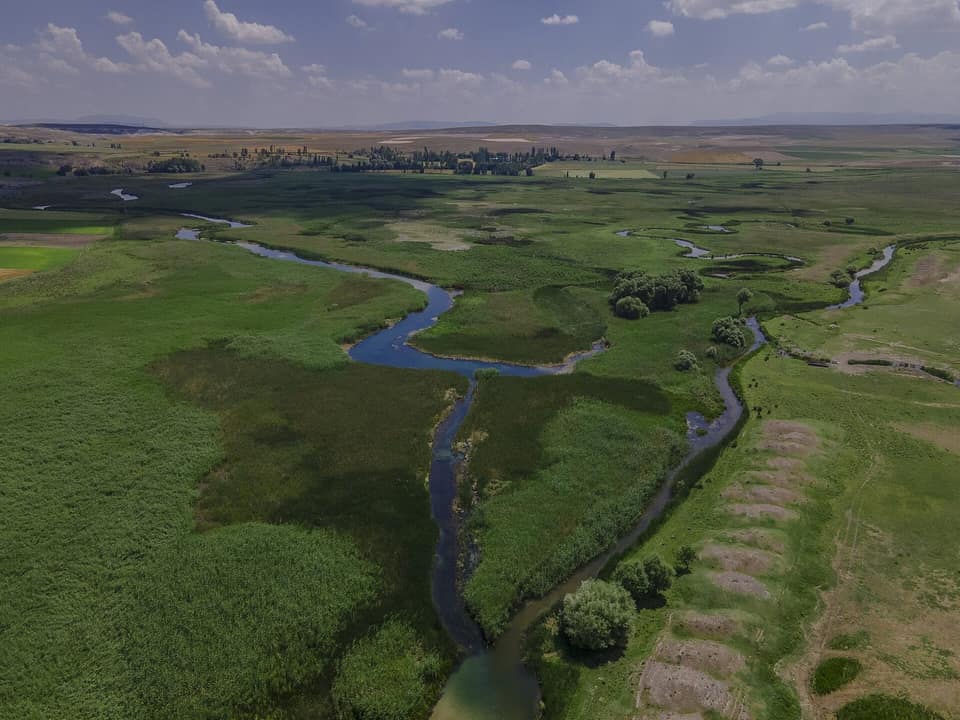
In the south-east of the province nature takes on an entirely different face. Balıkdamı, about 25 kilometres south of the district centre of Sivrihisar, is the most important example of the Sakarya River's floodplains to have survived to the present day without being drained. This description comes from a study by Nuri Kaan Özkazanç, Emir Özay and Ali Uğur Özcan, published in the Turkish Journal of Forestry in 2019. Between 2017 and 2019 the researchers used point counts and line transects to record 210 bird species belonging to 18 orders and 47 families in the area. Of these species, 103 are resident, 78 are summer migrants, 24 are winter migrants and 5 are passage migrants. The list includes species such as the great white pelican, the flamingo, the ruddy shelduck and the ferruginous duck. According to the study, one of the species recorded is globally endangered, two are vulnerable and seven are near threatened. The authors state that in spring the number of birds in the area can reach 18,000, and that the reedbeds and flooded willow stands are of great importance for breeding birds. The provincial directorate also writes that Balıkdamı hosts some 140 bird species during the migration season. According to the directorate, the Doğancı pond in Alpu, the Emineken pond in Çifteler and the Yörükkırka pond in the central district are also important for birdwatching as stopping places for migratory birds.
Balıkdamı is a home not only for birds but for other creatures as well. The researchers also observed otters, jungle cats, jackals, foxes and wild cats in the area. The same study stresses that the area is in great danger because of intensive human use, environmental pollution, habitat degradation and poaching. The authors recommend preventing pollution, regulating agricultural activity and bringing illegal hunting under control.
Practical notes for a trip
Eskişehir's nature changes greatly with the seasons. The provincial directorate states that the province has a harsh continental climate, with hot, dry summers and severe, wet winters, and a large temperature difference between night and day. For this reason, take a warm layer with you when you go to the forest, even in summer. The most rewarding time for birdwatching at Balıkdamı is spring, when migratory birds use the area intensively. There is no public transport to most of these areas; go by car and take water, a hat and binoculars. In wildlife areas do not leave the paths, do not approach the animals and do not feed them. Follow the rules on lighting fires in the forest, because in the dry summer months even a small spark can do great damage. The ground at the edge of the reedbeds can be soft; approach the water with care and do not disturb the birds during the breeding season. Find out the conditions of use and any fees for the forest recreation areas from the relevant institutions before you go.
A green ring around the plain
Eskişehir's nature can be thought of as a ring around the city. In the north the pine forests of the Sündiken and the deer of Çatacık, in the west the springs and endemic plants of Türkmen Mountain, and in the south-east the reedbeds and migratory birds of the Sakarya form this ring. An interest in nature that begins in the city's parks and on the banks of the Porsuk can easily deepen at any point on this ring.
Sources
- Eskişehir İl Kültür ve Turizm Müdürlüğü, İklim ve Bitki Örtüsü, https://eskisehir.ktb.gov.tr/TR-111593/iklim-ve-bitki-ortusu.html
- Eskişehir İl Kültür ve Turizm Müdürlüğü, Yeryüzü Şekilleri, https://eskisehir.ktb.gov.tr/TR-149994/yeryuzu-sekilleri.html
- Eskişehir İl Kültür ve Turizm Müdürlüğü, Mesire Yerleri, https://eskisehir.ktb.gov.tr/TR-70884/mesire-yerleri.html
- Eskişehir İl Kültür ve Turizm Müdürlüğü, Bitki İnceleme, https://eskisehir.ktb.gov.tr/TR-159733/bitki-inceleme.html
- Eskişehir İl Kültür ve Turizm Müdürlüğü, Yaban Hayatı, https://eskisehir.ktb.gov.tr/TR-70885/yaban-hayati.html
- Eskişehir İl Kültür ve Turizm Müdürlüğü, Korunan Alanlar, https://eskisehir.ktb.gov.tr/TR-70880/korunan-alanlar.html
- Özkazanç, Özay ve Özcan, Balıkdamı Yaban Hayatı Geliştirme Sahası Kuş Türleri, Türkiye Ormancılık Dergisi 20(4), 2019, https://dergipark.org.tr/en/pub/tjf/article/570107
- Ardıç, Koyuncu ve Tokur, Hekimdağ (Bozdağ) Florası, Eskişehir, Anadolu Üniversitesi Bilim ve Teknoloji Dergisi C 1(1), 2011, https://dergipark.org.tr/tr/download/article-file/35729
Comments
Be the first to comment