

Eskişehir's Industrial Heritage, from the Railway Workshop to the Sugar Factory
A city brought by the rails Today Eskişehir is known as a university and cultural city, but for most of the twentieth century it was one of the country's leading industrial cities.
 Radar TürkiyeNovember 24, 2026
Sign in to like and rate
A city brought by the rails
Today Eskişehir is known as a university and cultural city, but for most of the twentieth century it was one of the country's leading industrial cities. At the start of this transformation stands the railway. The corporate history of TÜRASAŞ writes that the line planned to link Istanbul with Baghdad passed through Eskişehir in 1892 and that this was the main driving force of industrialisation in the region. According to that history, construction of the section from Eskişehir to Konya began on 31 August 1893 and reached Konya on 29 July 1896. The Eskişehir entry of the TDV Encyclopaedia of Islam also states that the railway played an important role in the city's growth at the end of the nineteenth century, and that in the same period immigrants from the Balkans founded new neighbourhoods on the plain. A study of the city's history by Gaye Ertin of Istanbul University reads these two developments together. According to Ertin, the migrations of 1877-1878 and the arrival of the railway turned Eskişehir, long described by travellers as a small town, into a lively city.
From a small repair shop to a locomotive factory
The backbone of the city's industrial history is the railway workshop. According to the TÜRASAŞ history, in 1894, while the line was being built, a small workshop called the Anadolu-Osmanlı Kumpanyası was founded to repair steam locomotives and wagons. In those years only small-scale repairs were carried out here, locomotive boilers were sent to Germany for repair and all spare parts came from abroad. In 1920 the workshop took the name Eskişehir Cer Atölyesi, the Eskişehir Traction Workshop. Its covered area reached 800 square metres in 1923, and between 1925 and 1928 a boiler shop, a wheel shop, a carpentry shop and units producing railway points, weighbridges and track safety materials were added. As a result, the repair of three or four locomotives and some thirty passenger and freight wagons a year became possible. A 2016 study by Gamze Şensoy and Berna Üstün also stresses that the railway maintenance workshop formed the foundation of industry in the city.
The years of the Second World War turned the workshop into a school. According to the history, new workers were trained in six-month courses to replace those called up for military service, and day and boarding apprentice schools were opened. The Welding House set up in the workshop became a centre that trained skilled welders for the country. After 1946 the workshop began to operate like a factory, even though it was still called a workshop. The power station built to meet its growing energy needs also supplied electricity to parts of the city. In 1951 the first mechanical weighbridge in Turkey was produced here without any licence or outside know-how. In 1957 two small steam locomotives named Mehmetçik and Efe were built for Ankara's Gençlik Park. The history also describes the workshop's sports clubs, with football, wrestling, skiing and shooting sections, and the films shown several evenings a week in its guest halls; the factory was also a centre of social life.
Karakurt, Devrim and the DE 24000
The organisation, renamed Eskişehir Railway Factory in 1958, set itself a new goal: to build a domestic locomotive. According to the TÜRASAŞ history, this goal was reached in 1961. Karakurt, rated at 1915 horsepower, weighing 97 tonnes and capable of 70 kilometres per hour, was the first Turkish steam locomotive. In the same year a project carried out in the factory's disused foundry building produced the first domestic cars, named Devrim. The history relates that some twenty engineers from the railway factories designed and built these cars in a short time of four and a half months. The engine blocks were cast in Sivas and machined in Ankara, while the pistons, piston rings and front suspension were made in Eskişehir. Of the four cars produced, only one has survived. This car is preserved in working order in a glass garage in the garden of the TÜRASAŞ Devrim Cars Museum.
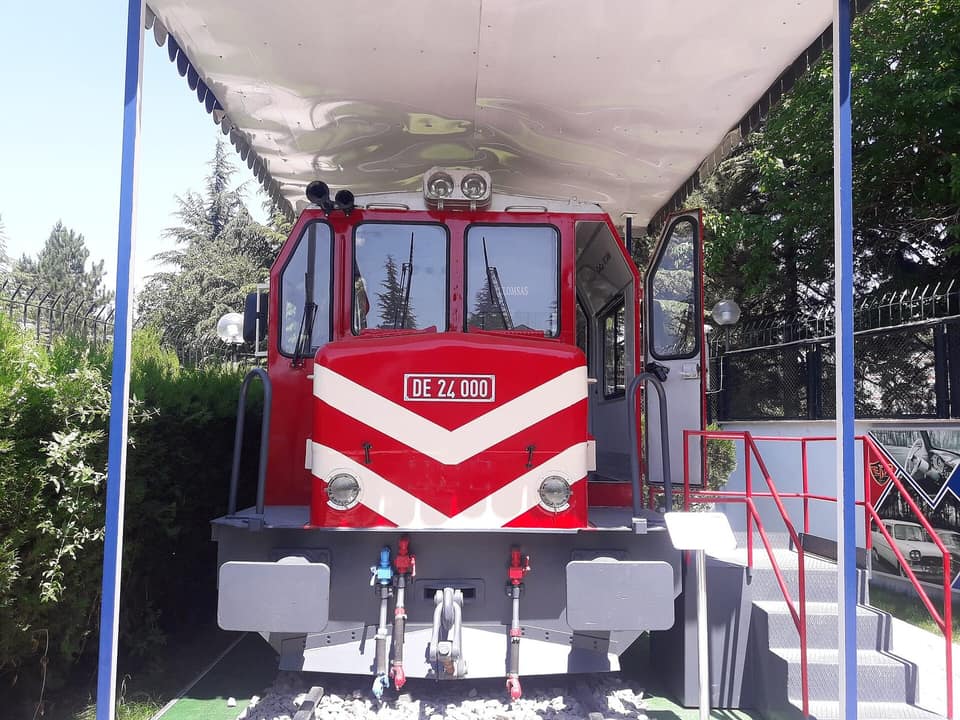
In 1970 the factory took the name Eskişehir Locomotive and Engine Industry Establishment. In 1971, under licence agreements made with French firms, the first 2400-horsepower diesel-electric mainline locomotive entered service with a ceremony. According to the history, 431 locomotives of this DE 24000 type were built up to 1985. In 1986 the organisation took the name TÜLOMSAŞ and in the following years produced many types of locomotive, both under licence and to its own designs. In 2020 it was brought under the umbrella of TÜRASAŞ and became its Eskişehir Regional Directorate. According to the history, it continues today as an integrated plant of seven factories that builds and repairs locomotives, wagons and track maintenance vehicles.
The beet of the plain, the sugar of the city
The railway's second major contribution to the city was agriculture-based industry. A 2019 article by Selahattin Önder and Necmettin Oğur of Eskişehir Osmangazi University explains that the Eskişehir Sugar Factory was founded as the country's third sugar factory, after those of Uşak and Alpullu. According to the article, the factory's foundation was laid on 1 February 1933, trial operations began in the autumn of the same year and the factory officially opened on 5 December 1933. All the machinery and equipment, including the iron structure of the buildings, was brought from Germany. Around a hundred German fitters came for the assembly, and Hungarian and Czech sugar masters were engaged for the campaign. The factory was built on the bank of the Porsuk Stream and linked to Eskişehir station by its own branch line. According to the article, 83,157 tonnes of beet were processed in the first campaign, producing 12,124 tonnes of sugar. The factory, built to process 1,500 tonnes of beet a day, had its capacity raised to 1,800 tonnes a year later.
The factory did not produce only sugar. The article explains that its workshops, made up of a foundry, a carpentry shop, a smithy and a repair shop, over time reached a level where they could build the machinery of new sugar factories. A large part of the machinery and installations of the Ankara and Kastamonu sugar factories, founded in 1962 and 1963, was made in these workshops. Around the factory there were staff housing, a twenty-bed infirmary opened in 1947, a school, a cinema, sports sections and a library. A cultural association organised plays, concerts of Western music and language courses. In 1998 the factory was named after Kazım Taşkent, the first general manager of the Turkish Sugar Factories company.
Tile kilns and the factory district
The area north of the railway, in the north-west of the city, was long known as the factory district. According to Şensoy and Üstün, the quality of Eskişehir's soil led to the founding of many roof tile and brick factories here from the first years of the Republic onwards. These factories began to produce the Marseille-type tile that had been imported until 1927. From 1928 to the end of the 1960s new tile, brick and flour factories were added to the district. According to the authors, the Traction Workshop and the flour and tile factories chose sites in the north-west of the city linked to the railway, while the Sugar Factory was built in the north-east. Today some of these buildings have been demolished and others are in ruins. The study finds that buildings left without a function deteriorate quickly, while those given new uses remain sound, and it proposes that the district be treated as industrial heritage. The authors also recall that company cinemas had a place in the city's cultural life, with film screenings held in the Sugar Factory and State Railways compounds.
Where to see the industrial heritage today
The best starting point for seeing Eskişehir's industrial history is the historic railway station. The railway buildings around the station show this side of the city most clearly. The TÜRASAŞ compound also extends in the north-west of the city, linked to the railway line. If you would like to visit the museum where the Devrim car is kept, find out the admission conditions from the organisation in advance, because the museum lies inside a working industrial plant. The Sugar Factory is also an active production site; you can only view it from outside, by walking the streets around it. In the factory district the brick bodies of old tile factories can still be picked out among the new buildings. Most of these buildings are privately owned; do not enter the property when taking photographs and keep away from ruined buildings. If you end your tour on the banks of the Porsuk, you will also see on the same day how the industrial city has turned into a city of students and culture.
The memory of an industrial city
Eskişehir's industrial heritage is one of the strongest examples of how a railway transformed a plain. A small repair shop became a locomotive factory, the beet of the plain became a sugar factory, and the city's soil became dozens of tile kilns. These buildings were not only places of production; with their apprentice schools, cinemas and sports clubs they were also part of the city's daily life. Keeping this layer in mind while touring Eskişehir today makes it easier to understand why the city is known as both hard-working and young.
Sources
- TÜRASAŞ, Eskişehir Bölge Müdürlüğü Tarihçesi, https://www.turasas.gov.tr/tarihcedetay/eskisehir-bolge-mudurlugu-tarihcesi
- Önder ve Oğur, Eskişehir Şeker Fabrikası, ESOGÜ Tarih Dergisi 2(2), 2019, https://dergipark.org.tr/tr/download/article-file/866559
- Şensoy ve Üstün, Eskişehir Fabrikalar Bölgesi, BAUN Fen Bilimleri Enstitüsü Dergisi 18(1), 2016, https://dergipark.org.tr/tr/download/article-file/259568
- Ertin, Eskişehir Kentinin Eski Sit Alanları ve Fonksiyonel Özellikleri, Art-Sanat 9, 2018, https://dergipark.org.tr/en/download/article-file/783515
- TDV İslam Ansiklopedisi, Eskişehir, https://islamansiklopedisi.org.tr/eskisehir
Comments
Be the first to comment