

Eskişehir, City of Hot Springs, from Hamamyolu to Sakarıılıca
A warm city underground Most visitors know Eskişehir by the banks of the Porsuk, the colourful houses of Odunpazarı and its trams. Yet in the city's story water also has a hidden face, one that rises from underground.
 Radar TürkiyeNovember 24, 2026
Sign in to like and rate
A warm city underground
Most visitors know Eskişehir by the banks of the Porsuk, the colourful houses of Odunpazarı and its trams. Yet in the city's story water also has a hidden face, one that rises from underground. The Eskişehir Provincial Directorate of Culture and Tourism writes that the province is very rich in groundwater and that thermal water has been used by many civilisations throughout history. According to the directorate, hot water is found not only in the city centre but across almost the whole province. The trail of this hot water can be followed from Hamamyolu in the city centre to the spas in the outlying districts. That trail also shows how water shaped the city and where it can be seen today.
Water from deep below
Geologists try to answer the question of where the hot water comes from. A study presented by Serkan Kahraman and Emrah Pekkan of Anadolu University at the 2014 Geological Congress of Turkey compares the hot springs of the city centre and of Kızılinler using chemical and isotope methods. According to the study, the temperature of the springs ranges between 38 and 50 degrees. In the city centre the water reaches the surface along a buried fault thought to belong to the Eskişehir Fault System. At Kızılinler the outflow lies on the Kızılinler Reverse Fault. The water of the two areas is fed by different rocks. The central waters are thought to come from a dolomitic reservoir, most probably Jurassic limestones; they show the character of a shallow-circulating calcium bicarbonate groundwater. The Kızılinler water, by contrast, is richer in sodium, circulates deeper and points to a volcanic reservoir. The researchers found no tritium isotope in the samples, which shows that the reservoirs are not fed by recent rainfall. Oxygen and hydrogen isotopes suggest that the water originates as precipitation, in other words that rain and snow return to the surface warmed after a long journey underground.
The hot springs of Dorylaion
The hot springs also lie at the heart of the debate about the city's founding. The provincial directorate notes that the hot springs area in the centre is pointed to as the founding site of the ancient city of Dorylaion. An article by Gaye Ertin of Istanbul University, published in 2018, discusses this debate in detail. According to Ertin, some researchers look for the city's first site at Şarhöyük and others at Karacaşehir, while travellers and scholars such as Leake and Ramsay place the first settlement around the hot and cold springs near today's market district. Ertin relates that ancient sources describe Dorylaion as a city known for its baths and standing at a junction of important roads. According to the same article, in the Byzantine period the city became a place of rest and summer retreat thanks to its pleasant climate and hot springs. The provincial directorate also writes that Eskişehir was one of the important settlements of the region known as Phrygia Salutaris, meaning Healing Phrygia. According to the directorate, in the Roman period the baths and spas in the Köprübaşı and Sıcak Sular quarters made the city a favoured place to settle. As Ertin relates, the Byzantine historian Kinnamos also describes the city's climate, fertile land and baths in the twelfth century.
The spas seen by travellers
In the Ottoman period, too, hot water was closely bound to the commercial side of the city. The Eskişehir entry of the TDV Encyclopaedia of Islam notes that in Matrakçı Nasuh's miniature of Eskişehir, painted for the campaign of 1534, the spas lie a little beyond the Porsuk Stream. Hans Dernschwam, who passed through in 1555, also noted that there was a spa near the town. According to the same entry, the Cihannüma states that in the seventeenth century the quarter of inns and markets lay on the plain near the hot spring, and Evliya Çelebi also mentions the city's spas. The provincial directorate relates that the poet Nabi, on his journey of 1679, praised this bath as water warmed without fire and shook off the fatigue of the road here. In the nineteenth century Charles Texier wrote that the city consisted of two quarters, one with houses and the other with the market and the baths. As Ertin relates, Texier noted that Eskişehir's hot springs were still famous in his day. This picture shows that the city long lived between two poles: the houses of Odunpazarı on the slope, and on the plain the market surrounded by hot water, inns and baths.
Hamamyolu, the street of water
Today the most familiar trace of this old market and bath quarter is Hamamyolu. According to a 2016 study by Berna Üstün and Cemile Özkan of Anadolu University, the street, also known as Yunak, takes its name from the baths in the area of the hot springs. The authors state that in this part of the city, rich in hot springs, the baths were built directly over the springs, and that the number of baths serving the city increased from the beginning of the twentieth century. Hamamyolu was the axis not only of the baths but also of trade and daily life. The Akar Stream, a branch of the Porsuk, flowed beside the street for a long time; part of it was covered in the 1970s and the rest in the mid-1980s. The study stresses that the street has kept its role as a centre since the founding of the city and that it remains a public space with heavy pedestrian use today.
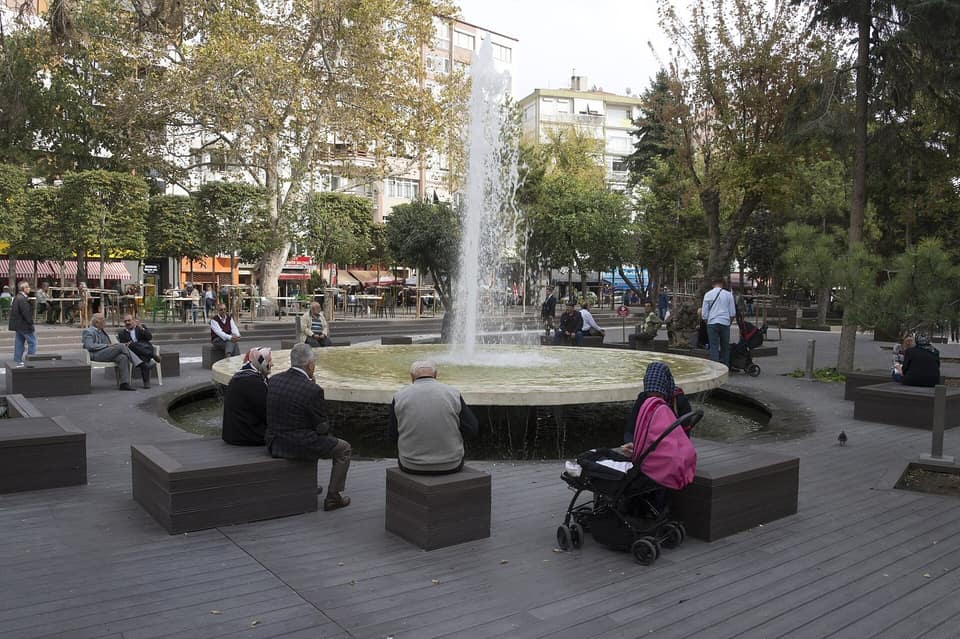
According to the provincial directorate, the baths of the city centre are clustered in the Hamamyolu and Sıcak Sular areas and keep alive a long-standing bathing tradition that draws its strength from natural geothermal springs. Because these baths are run by different businesses, opening hours and prices may change; check directly with the business before you go. As you walk along Hamamyolu, look at the pools, fountains and seating areas under the trees in the middle of the street. You will notice that water is still the main organising element of this street.
Spas beyond the city
The provincial directorate states that the Kızılinler and Sakarıılıca areas were declared thermal tourism centres by a decision of the Council of Ministers. Sakarıılıca lies about thirty kilometres north of the city in a narrow valley surrounded by pine forests. The directorate gives the temperature of the spa water as between 43 and 48 degrees; it writes that the water reaches the baths from a covered catchment well through a closed channel, and that there is also a cooler spring with the character of mineral water in the same area. The area was declared a thermal tourism centre in 1993 and its boundaries were extended in 2006. The English-language promotional page of the Ministry of Culture and Tourism also describes the water of the Sarıcakaya-Sakar spa as a hyperthermal mineral water containing bicarbonate and sulphate, and states that the spa lies on a road branching off the road to Mihalgazi. As there are also camping areas in the forest, Sakarıılıca is as much a stop for picnics and walks as it is a spa.
Kızılinler is a village about fifteen kilometres south-west of the city centre. The directorate writes that a small guesthouse-style spa operates in the village and that the water is 38 degrees; the area was declared a thermal tourism centre in 2006. Further away, on the road that branches off the Sivrihisar-Polatlı road towards Günyüzü, the water of the Çardak (Hamamkarahisar) Spa is, according to the provincial directorate, among the first-degree important and priority mineral waters of Turkey. The spa has two baths of historic value, with two pools inside them, one for women and one for men. The Hasırca spring, together with Sakarıılıca, is counted among the country's third-degree important sources. The Yarıkçı Bath near Mihalıççık is known to date from the Seljuk period; its building, which collapsed over time, has been rebuilt. Its sulphurous water deposits calcium carbonate and forms small petrified cascades in the valley. Uyuzhamam near Alpu, the bath at the source of the Sakarya in Çifteler, and the Lower and Upper Ilıca towards Seyitgazi are simpler springs within villages.
Tips for a visit
The easiest way to begin a hot-water tour is in the city centre. Hamamyolu is within walking distance of the tram lines and the bank of the Porsuk; you can walk from one end of the street to the other and continue down to the area of the old market. You will need a car for the spas outside the city; Sakarıılıca and Kızılinler suit a half-day trip, while Çardak and Yarıkçı require a longer journey. The provincial directorate's pages list the conditions each spring is said to be good for, but consult your doctor before going to a spa for treatment. People with heart, blood pressure or circulation problems should not stay long in a hot pool. As some of the rural springs have no facilities, taking water, a towel and spare clothes will make things easier. In winter the road into the Sakarıılıca valley can be snowy and icy; check the weather before you set off. Follow the rules on hygiene and clothing in the baths and spas, and do not use soap or shampoo in shared pools.
What hot water gives the city
In Eskişehir hot water is not only a matter of spas; it is a natural phenomenon that has shaped the city's layout, its market and its daily habits. From Dorylaion's first settlement on the plain to the Ottoman market and today's pedestrian street of Hamamyolu, the city has always gathered around this warm water. When the coolness of the Porsuk and the warmth rising from underground are considered together, it becomes easier to understand why Eskişehir describes itself as a city of water.
Sources
- Eskişehir İl Kültür ve Turizm Müdürlüğü, Termal Turizm, https://eskisehir.ktb.gov.tr/TR-158566/termal-turizm.html
- Eskişehir İl Kültür ve Turizm Müdürlüğü, Eskişehir Hamamları, https://eskisehir.ktb.gov.tr/TR-158578/eskisehir-hamamlari.html
- Eskişehir İl Kültür ve Turizm Müdürlüğü, Sakarıılıca Kaplıcaları, https://eskisehir.ktb.gov.tr/TR-158580/sakariilica-kaplicalari.html
- Eskişehir İl Kültür ve Turizm Müdürlüğü, Kızılinler Kaplıcası, https://eskisehir.ktb.gov.tr/TR-158582/kizilinler-kaplicasi.html
- Eskişehir İl Kültür ve Turizm Müdürlüğü, Çardak (Hamamkarahisar) Kaplıcası, https://eskisehir.ktb.gov.tr/TR-158603/cardak-hamamkarahisar-kaplicasi.html
- Eskişehir İl Kültür ve Turizm Müdürlüğü, Yarıkçı Hamamı, https://eskisehir.ktb.gov.tr/TR-158584/yarikci-hamami.html
- Kültür ve Turizm Bakanlığı, Eskişehir (Sarıcakaya-Sakar Thermal Resort), https://www.ktb.gov.tr/EN-99311/eskisehir.html
- Kahraman ve Pekkan, Eskişehir Merkez ve Kızılinler Sıcak Su Kaynaklarının Hidrojeokimyasal ve İzotopik İncelenmesi, 67. Türkiye Jeoloji Kurultayı, 2014, https://www.jmo.org.tr/resimler/ekler/31b2d326b55bb8a_ek.pdf
- Ertin, Eskişehir Kentinin Eski Sit Alanları ve Fonksiyonel Özellikleri, Art-Sanat 9, 2018, https://dergipark.org.tr/en/download/article-file/783515
- Üstün ve Özkan, Eskişehir Hamamyolu Caddesi'nin Cumhuriyet Döneminden Günümüze Mekansal Değişimi, BAUN Fen Bilimleri Enstitüsü Dergisi 18(2), 2016, https://dergipark.org.tr/tr/download/article-file/261990
- TDV İslam Ansiklopedisi, Eskişehir, https://islamansiklopedisi.org.tr/eskisehir
Comments
Be the first to comment