

Erzurum Station, the Cut Stone Terminal Reached by Rail in 1939
Years without a train For centuries Erzurum stood on important transit routes, yet the railway reached the city very late.
 Radar TürkiyeNovember 24, 2026
Sign in to like and rate
Years without a train
For centuries Erzurum stood on important transit routes, yet the railway reached the city very late. A study by Firdes Temizgüney, published in the Journal of Turkish Researches Institute, explains that from the middle of the 19th century many railway projects that included Erzurum were put forward, but none of them was realised because of financial and technical shortcomings and the climate and natural conditions. The narrow and steep gorges, valleys, sheer slopes and torrential waters of the region made railway building difficult. Letters written from Trabzon and Erzurum between 1909 and 1916 show that the people and merchants of the region wanted a line that would at least connect Erzurum to the Black Sea coast.
According to the same study, Erzurum's goods moved very slowly before the railway. The city's economy rested on farming and livestock, and herds could reach the Istanbul market only in about 75 days, suffering losses on the long walk. Once the railway arrived, the same animals could be taken by train to Haydarpaşa in three days. This difference explains why the station carried such great expectations for the city.
A steep route
Construction of the line from Sivas to Erzurum began in 1933. According to Temizgüney, the contract for the line was awarded on 12 June 1933, and work started from Sivas on 4 September 1933. The line was built entirely with domestic engineers, workers and capital, and in this respect it was regarded as a first in the country's railway history.
The route was not easy. The study by Murat Küçükuğurlu and Gürkan Fırat Saylan states that the Sivas to Erzurum line, together with the Çetinkaya to Malatya connecting line, reached a total of 690 kilometres and was the longest line laid in a single campaign. The Pingan, Atma, Cürek, Çaltı, Sansa and Saptıran gorges along the route were the hardest parts of the construction. According to the same study, 138 tunnels were dug on the Sivas to Erzurum line alone, with a combined length of more than 22 kilometres. Despite the hard conditions, an average of 1500 metres of track was laid per day, a record in the Turkey of the time. In steep places materials were carried by mules, and across rivers by suspension bridges.
While the line advanced, Erzurum was also getting ready. To bring materials to the city, the 46 kilometre narrow gauge line between Erzurum and Karabıyık was repaired and reopened in July 1937. This narrow line was also expected to carry the many passengers heading to the hot springs at Ilıca in summer.
The day the train entered the city
The rails reached Erzincan in October 1938, Aşkale on 28 July 1939, Ilıca on 27 August and Erzurum on 6 September 1939. The official opening ceremony of Erzurum Station was held on 20 October 1939. As Temizgüney relates, the city was decorated with flags from end to end, and from early morning people filled the roads leading to the station. On the same day new buildings in the city, such as a hospital, a maternity and childcare home and the Aviation Society building, were also opened.
Küçükuğurlu and Saylan also describe the programme of the opening day. In the evening, folk dances were performed at Lalapaşa Garden, Çifte Minareler, Gürcü Kapısı, Gölbaşı, Mahallebaşı and Erzincan Kapısı. Right after the opening, services with sleeping and dining cars began between Istanbul and Erzurum. According to the head of the railway construction department, who spoke at the ceremony, it would now be possible to travel from Erzurum to Ankara in 30 hours and to Istanbul in 45 hours.
A two storey building of cut stone
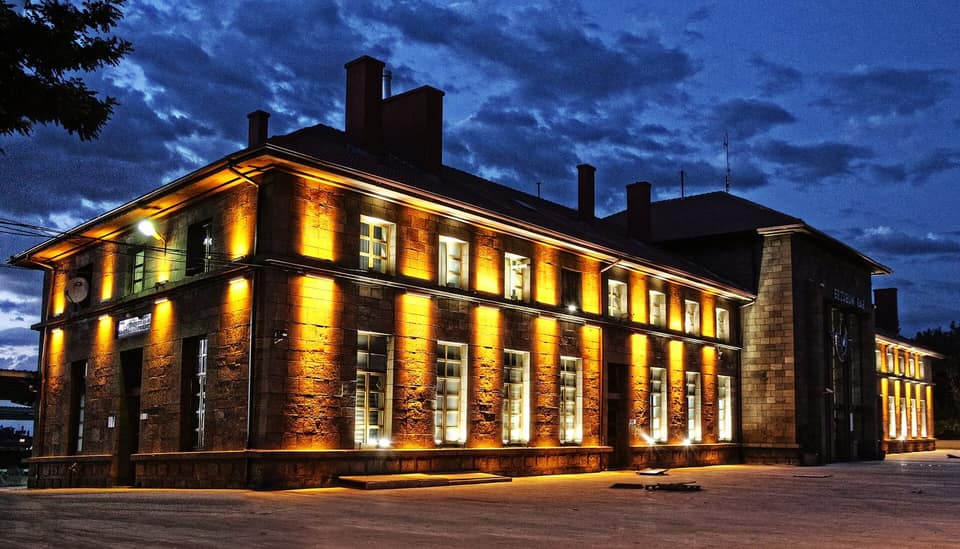
The foundation of the station building was laid on 20 July 1937, two years before the line reached the city. According to İsmail Eyyupoğlu's study, published in Atatürk Dergisi, the building was completed on 20 August 1939 and was built of cut stone in a neoclassical style. Eyyupoğlu writes that Erzurum station bears a strong resemblance to Erzincan Station: both are two storey, symmetrically planned stations whose central section projects forward. The same study also points out that traditional motifs were used in the interiors of railway buildings of the period.
Temizgüney, for her part, notes that in the places the railway passed through, station buildings were often built with more carefully cut stone and greater care than government buildings, and that these structures brought a new understanding of building to the region. The guide of the Erzurum Provincial Directorate of Culture and Tourism likewise presents the historic station as a transport building in the city centre, opened in 1939 and standing out for its stonework and architecture.
Designing a neighbourhood around the station
Soon after the station opened, a new living area began to take shape around it. According to Eyyupoğlu, a decision issued on 11 August 1942 provided for six staff houses, a district engineering building and a store building to be built around the station. In 1945 the State Railways then opened a design competition for a complex around the station made up of an operations building, a meeting house, a hotel and houses.
Only qualified architects and engineers could take part in the competition, and 22 projects were submitted. The jury was chaired by Prof. P. Bonatz. First prize went to the joint project of Ali Mukbil Gökdoğan and Eyüp Asım Kömürcüoğlu. In its assessments the jury paid particular attention to placing the buildings in the right orientation, using light correctly, respecting the natural and cultural character of Erzurum and not leaving more space between buildings than necessary; separate detached houses were considered a flawed choice for a cold city. According to Eyyupoğlu's article, the operations building, hotel and meeting house of the winning project were never built. Only the terraced houses with gardens were realised, and at the time the article was written they were in use as staff housing.
Change that came with the rails
The railway also changed the direction of Erzurum's trade. According to the study by Vedat Karadeniz and Deniz Akpınar, once the line opened, the Erzurum to Haydarpaşa railway replaced the journey between Erzurum and Trabzon, and the city gained an important advantage on its way to becoming the trading centre of the east. The same study shows that settlements on the line grew thanks to their stations, while some towns left off the route declined. Aşkale, once a small subdistrict centre, became a district centre in 1937, largely because it lay on the route. Çat, formerly a district, fell behind administratively and economically because it was left off the line.
Temizgüney also describes the effect of the railway on education, the press and cultural life. Newspapers and magazines began to reach the city regularly, and teachers from other regions could come to the city more easily. During the construction of the line, local people learned new trades such as carpentry, plastering, stonemasonry, blacksmithing and engine driving. With travel made easier, a university week was held in the city in 1940; a group of professors from Istanbul University gave lectures for seven days on subjects such as economics and medicine, and the public showed great interest in the event. Temizgüney writes that the improved transport links also paved the way for the founding of Atatürk University in 1957.
The place of the station in city life was also reflected in the decisions of the municipality. As Temizgüney relates on the basis of municipal records, in 1939, while the city was suffering from a shortage of electricity, the municipality gave priority to supplying power to the area around the station; it did not want passengers arriving at the station to be met by darkness.
Visiting the station today
The station building stands in the city centre, in the Yakutiye district, and still serves passenger trains today. According to the guide of the Provincial Directorate of Culture and Tourism, the station is one of the key stops of the Eastern Express. Since train days and times change with the season, check the current information on the railway operator's official ticketing system if you are planning a journey.
Look at the front facade of the building from the square. Come before noon or in the late afternoon to see the cut stone walls, the regular row of windows and the symmetry of the mass; the low sun brings out the texture of the stone surface. Remember that there may be snow and ice around the station in winter. Even if you are not taking a train, pausing for a few minutes in front of this building, which changed the life of Erzurum in 1939, is an easy way to understand the city's transformation in the 20th century. It is also possible to visit the station on the same day as other buildings in the city centre, such as the Taşhan, the Çifte Minareli Medrese and Erzurum Castle.
Sources
- Temizgüney, F., Demiryolu Ulaşımının Erzurum'a Katkıları, Journal of Turkish Researches Institute 53, 2015, https://dergipark.org.tr/tr/download/article-file/33767
- Küçükuğurlu, M. and Saylan, G. F., Şimendiferin Erzurum Yolculuğu, Journal of Turkish Researches Institute 38, 2008, https://dergipark.org.tr/tr/download/article-file/33329
- Eyyupoğlu, İ., Erzurum Devlet Demiryolları Mahallesi Proje Yarışması (1945), Atatürk Dergisi, 2018, https://dergipark.org.tr/tr/pub/atauniad/article/448759
- Karadeniz, V. and Akpınar, D., Sivas-Erzurum Demiryolunun Yapım Süreci, Sosyo-İktisadi Etkileri ve Geleceği, Atatürk Dergisi, https://dergipark.org.tr/tr/pub/atauniad/article/30395
- Erzurum Provincial Directorate of Culture and Tourism, Erzurum Travel Guide, https://erzurum.ktb.gov.tr/Eklenti/149998,turizm-rehberi---enpdf.pdf
- Wikipedia (Turkish), Erzurum Garı, https://tr.wikipedia.org/wiki/Erzurum_Gar%C4%B1
Comments
Be the first to comment