

Dorylaion and the Eti Archaeology Museum, Eskişehir's Thousands of Years of History
The mound northeast of the city About three kilometres northeast of Eskişehir city centre, on the southern edge of the broad plain between the Porsuk River and its tributary the Sarısu, a mound rises.

Sign in to like and rate
The mound northeast of the city
About three kilometres northeast of Eskişehir city centre, on the southern edge of the broad plain between the Porsuk River and its tributary the Sarısu, a mound rises. According to the Eskişehir Provincial Directorate of Culture and Tourism, this mound is known as Şarhöyük and is the centre of ancient Dorylaion. It stands 17 metres above the plain, has a diameter of 450 metres and a circumference of 1800 metres; the directorate describes it as the highest and largest mound of the Eskişehir plain. A Lower City surrounds the mound, and a cemetery area lies to its west. Let us be clear from the start: Şarhöyük is an excavation area, and none of the official sources says it is open to visitors as an archaeological site. This article therefore directs you not to the mound but to the Eti Archaeology Museum, where finds from Dorylaion can be seen together. The mound can be seen from a distance; for the excavation season and permits, ask the museum.
The name Dorylaion and the settlement history
According to the provincial directorate, Eskişehir was a city known in antiquity and the Middle Ages by the Greek name Dorylaion and the Latin name Dorylaeum. The location of the city was worked out in the nineteenth century through the journeys and studies of many travellers and scholars, and these studies finally established that Şarhöyük was the centre of ancient Dorylaion. The ancient name of the Porsuk is given as Tembris and that of the Sarısu as Batys. The Hittite name of the city, however, has not yet been identified. This gap shows that the mound still holds unanswered questions. Assoc. Prof. Mahmut Bilge Baştürk of Anadolu University says the mound was lived on without interruption from six thousand years ago until the Byzantine period and offers a historical summary of Eskişehir. That sentence is enough to explain why the mound is valued so highly: the layers of a city thousands of years old lie stacked in a single place.
The excavation history
A surface survey was carried out on the mound in 1989, and the same year excavation began under Prof. Dr. A. Muhibbe Darga. This work continued between 1989 and 2003 and went on in 2005-2012 under Prof. Dr. Taciser Sivas. From the 2013 season, the excavation was carried out under the direction of the Eskişehir Museum Directorate, with the participation of Assoc. Prof. Hakan Sivas. The work has progressed with the financial and logistical support of the General Directorate of Cultural Heritage and Museums, the Anadolu University Rectorate and the Anadolu University Scientific Research Projects Commission. According to Anadolu University's e-gazette, in 2015-2019 the excavations were run under the direction of the Eti Archaeology Museum, with Baştürk as scientific adviser. The same source says Şarhöyük-Dorylaion regained the status of a Presidential Decree excavation in 2022. Alongside Anadolu University, scientists and students from Kırşehir Ahi Evran University and Eskişehir Osmangazi University take part in the team. The news item notes that Anadolu University has supported the excavations for more than thirty years and that the excavation helped lay the foundations of the university's Archaeology Department.
The layers and what was found
According to the provincial directorate, the presence of the Early Bronze Age, Hittite, Phrygian, Classical, Hellenistic, Roman, Byzantine and Ottoman cultures has been established on the mound. A Byzantine-period settlement layer is part of this sequence, but the focus of this article is the Hittite, Phrygian and Hellenistic phases. In the large trench on the south slope, Hittite settlements dating between the fifteenth and thirteenth centuries BC have been uncovered. In the latest layer, that of the thirteenth century BC, there is a mud-brick house of three rooms and an open courtyard. In the courtyard a rectangular hearth, cylindrical silo pits and a round stone-built grain silo were found. Many loom weights show that weaving was practised there. Fragments of kitchen pottery are similar to finds from Boğazköy. In a lower layer there is a small house with stone foundations dating to the fifteenth century BC, with a courtyard containing hearths and ovens. In the western trench, Middle Phrygian (800-550 BC) and Late Phrygian (550-334 BC) remains were exposed in small areas; among them are imported vessels from Lydia and Attica and a clay seal with Palaeo-Phrygian writing. In the Hellenistic quarter, houses of mud-brick walls on stone foundations and long, narrow storage rooms were uncovered, dated from the early third to the late second century BC. Roman finds are weaker and show that a moderately prosperous Anatolian population lived here between the early first and the fifth centuries AD.
The western edge of the Hittite world
The most striking find on the mound is a clay bulla with Luwian hieroglyphic writing from the thirteenth century BC, found inside a pit. According to the provincial directorate, this bulla shows that the city was governed by a noble who was a son or very close relative of the Great King living in the Hittite capital Hattusa. The directorate describes Şarhöyük as the westernmost point of Hittite rule known today. Care is needed here: this statement rests on present knowledge and may change with new finds. In other words, the Eskişehir plain is a point standing on the edge of the Hittite world. On the beginning of the settlement, Baştürk's view is as follows: the first settlement in Eskişehir must have begun in the second half of the fourth millennium BC, in the Late Chalcolithic period. Baştürk himself says that this information rests on present data and may change in the future. In the same statement he notes that data on the Early Bronze Age have been published. It is therefore right to read the start date not as a firm verdict but as an inference according to the excavation director.
The Eti Archaeology Museum
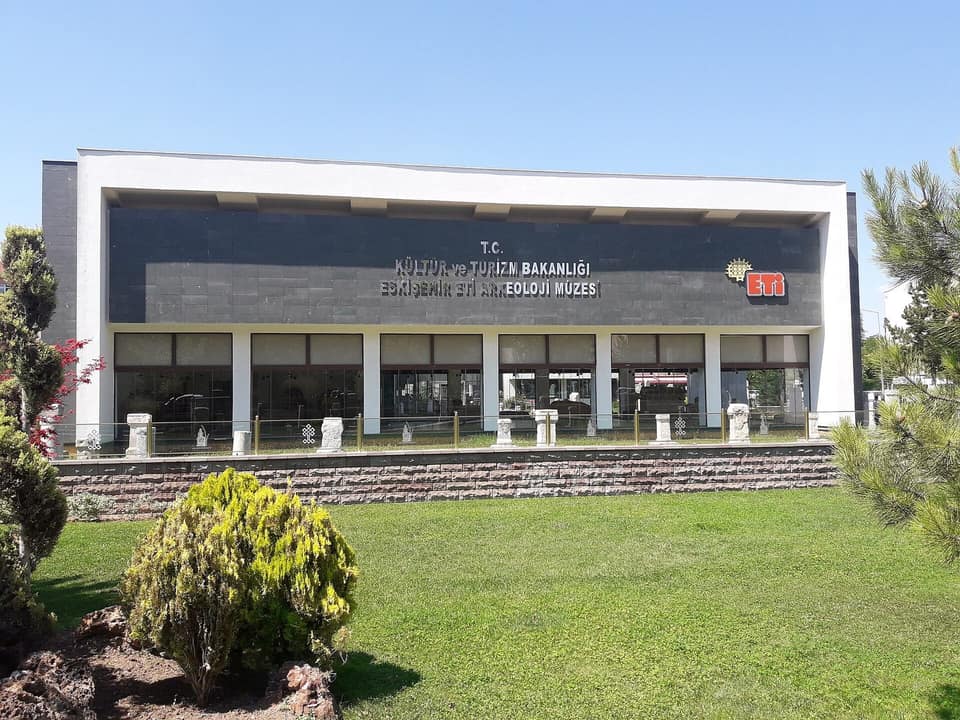
The place where you can see Dorylaion's finds together is the Eti Archaeology Museum. According to the Culture Portal, its address is Akarbaşı Mahallesi, Atatürk Bulvarı No 64, Odunpazarı. The provincial directorate tells the museum's history this way: in 1945 a storage museum was formed in the Alaaddin Mosque with movable cultural property gathered from the province and its districts. In 1966 the Eskişehir Museum Directorate was formally established in the Kurşunlu Mosque Complex, and in 1974 a new building in Akarbaşı came into service. In 2001 the building, which had become inadequate, was closed to visitors and research; construction of the new museum was completed in 2010 and the museum opened on 28 May 2011. The new building, set on an area of about 1300 square metres, consists of three blocks and has 4000 square metres of usable space. The first floor of blocks B and C is entirely an archaeological exhibition hall. The ground floor of block C holds a semi-open display and temporary exhibition hall, and the ground floor of block B a multipurpose hall. The museum garden also displays immovable cultural property. The inventory lists 20,080 objects; about 1,993 of them are displayed in roughly 1,800 square metres of indoor space, and the rest are kept in storage.
A look from the museum at Eskişehir's other archaeological sites
The museum's display is not only about Dorylaion. According to the Culture Portal, excavations and finds from areas such as Dorylaion, Pessinus (Sivrihisar-Ballıhisar), Han Yazılıkaya, Keçiçayırı (Seyitgazi-Bardakçı), the old Hittite necropolis of Çavlum village (Odunpazarı), Demircihöyük (near Çukurhisar), Karacahisar and Küllüoba (Seyitgazi-Yenikent) are displayed chronologically. This list makes the museum a gateway to the open-air sites of Eskişehir province. A visitor who plans to go to Han Yazılıkaya can read that site better by seeing its finds in the museum first. Pessinus appears in this list only as a name and is not discussed further here. Among the displayed objects are marble statues and statuettes, architectural fragments, steles, clay vessels for daily use, idols, glass vessels, beads, metal vessels and weapons, jewellery and coins.
How to tour the museum
Because the display is arranged chronologically, the visit should follow that order. The Culture Portal says the museum covers the Neolithic, Chalcolithic, Bronze Age, Hittite, Phrygian, Hellenistic, Roman, Byzantine, Seljuk and Ottoman periods. Start with the section showing the earliest periods, then spend more time in the Hittite and Phrygian halls, because Şarhöyük's Hittite layer and Phrygian seals belong there. Hellenistic and Roman objects show settlement traces from nearer our own time. At the end of the tour, going out into the garden to look at the immovable cultural property completes what you saw inside with an outdoor scale. For a good visit, allow about two hours; for a quick tour you can concentrate only on the Dorylaion and Hittite sections. For current hours and fees, check muze.gov.tr and the Eskişehir Provincial Directorate of Culture and Tourism.
Reading the mound from a distance
If you want to look at the mound from afar after the museum, remember that the excavation area is protected and must not be entered without permission. According to the Anadolu University news item, fighting took place on the mound during the Kütahya-Eskişehir battles, and this can be traced in trench remains. The provincial directorate writes that most of the Byzantine-period wall was dismantled down to foundation level in the late nineteenth century during construction of the Istanbul-Baghdad railway. This explains why the mound today appears as little more than an earthen hill. Everything you see on the surface is only the top face of a settlement that changed through the centuries. For the excavation season and permits, ask the museum; the responsible institution will tell you when and how the work can be followed. The real story, though, rests in the museum's display cases, in the small objects that came from the mound.
Sources
- Eskişehir İl Kültür ve Turizm Müdürlüğü, Şarhöyük Kazısı, https://eskisehir.ktb.gov.tr/tr-156580/sarhoyuk-kazisi.html
- Eskişehir İl Kültür ve Turizm Müdürlüğü, Müzeler ve Ören Yerleri, https://eskisehir.ktb.gov.tr/TR-339121/muzeler-ve-oren-yerleri.html
- Kültür Portalı, Eskişehir Eti Arkeoloji Müzesi, https://www.kulturportali.gov.tr/turkiye/eskisehir/gezilecekyer/eskisehir-eti-arkeoloji-muzesi
- Anadolu Üniversitesi e-Gazete, Şarhöyük-Dorylaion kazıları yeniden başlıyor, https://egazete.anadolu.edu.tr/kampus/40949/anadolu-universitesi-onculugunde-eskisehirde-sarhoyuk-dorylaion-kazilari-yeniden-basliyor
- Cover image, Eskişehir Eti Archaeology Museum building, Nedim Ardoğa, CC BY-SA 4.0, Wikimedia Commons, https://commons.wikimedia.org/wiki/File:Eski%C5%9Fehir_Eti_Archaeology_Museum_building.jpg
Comments
Be the first to comment