

Copper, Kutnu and Mother of Pearl, the Crafts of Antep
Walking through the historic bazaars of Gaziantep, the first thing you hear is the sound of hammers. In the han district at the foot of the castle, coppersmiths are still at their benches.

Sign in to like and rate
Walking through the historic bazaars of Gaziantep, the first thing you hear is the sound of hammers. In the han district at the foot of the castle, coppersmiths are still at their benches. In the same city, striped kutnu cloth is woven from silk and cotton, mother of pearl from the Euphrates is inlaid into walnut boxes, and Antep işi embroidery is worked by drawing threads out of white cloth. This article explains how these crafts are made, how they are defined in official records and where you can see them in the city. There are no shop or workshop names; instead there is information that lets you enter the bazaar knowing what to look at.
The official record of the crafts
The crafts of Gaziantep are protected not only by tradition but also by documents. In the geographical indication records of the Turkish Patent and Trademark Office, Gaziantep Copper Handwork and Gaziantep Mother of Pearl Handwork were registered in 2012, and Antep Kutnu Cloth and Antep İşi in 2016. Gaziantep Yemeni, the local headscarf, was added to the list in 2026. Each registration document describes the product, its production stages and its inspection in detail. These documents are the most reliable source for understanding which technique lies behind a piece you see in the bazaar.
The Coppersmiths' Bazaar and the foot of the castle
Gaziantep Metropolitan Municipality describes the Coppersmiths' Bazaar as a complex of bazaars where many craftsmen produce their work. Shops faced with wood and stone-paved streets offer glimpses of earlier times. The construction date of the shops is not known for certain, but they are thought to date from the 19th century. The single-storey shops stand inside the han district and open onto the street through arched entrances. They are built of neatly cut hard limestone, known locally as keymıh.
The Culture Portal writes that the bazaar received the Achievement Award of the Union of Historic Towns as part of the Culture Road Project. The portal states that the bazaar is in Boyacı neighbourhood, within walking distance of the city centre. Both the municipality and the portal stress that the copper craft that gives the bazaar its name is still very much alive today. Because the castle, the covered market and the bazaars are close to one another, you can explore this area in a single walk.
Copper hammered from a single piece
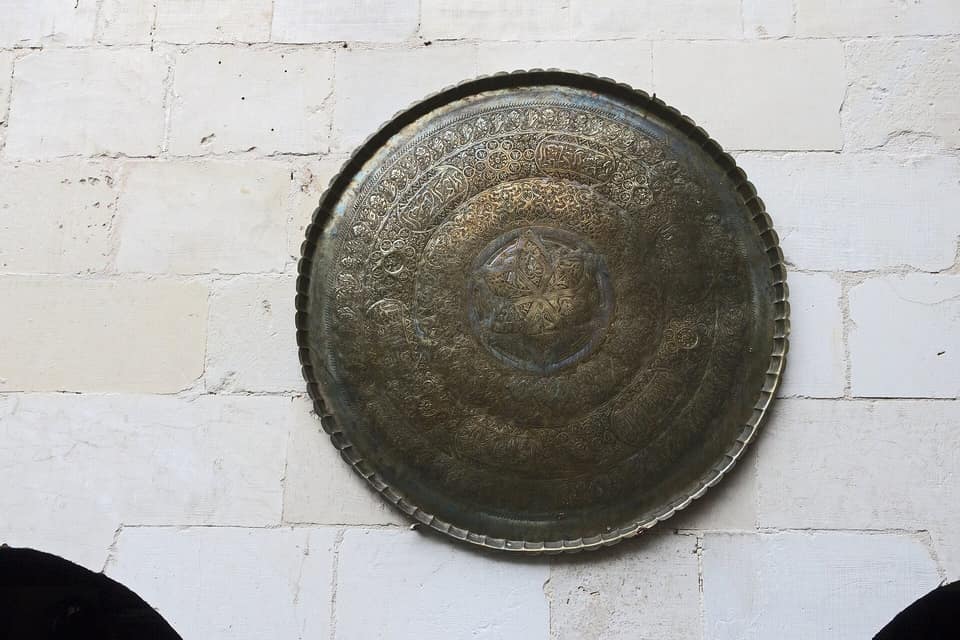
The registration document for Gaziantep Copper Handwork clearly states what makes this work distinctive. The product is monolithic, made from a single piece, and joining processes such as soldering or welding are not used. The motif is brought out by removing material from the piece with one hammer and one steel chisel; the document calls this the çalma technique and states that it is unique to the region. Simple hammering and incising methods are known as well, but it is the çalma technique that sets Antep work apart.
According to the document, the copper sheet is first shaped on spinning benches, and there are nearly five hundred variations of this shaping. The engraving master then designs the motif and decorates the surface by striking a steel chisel about ten centimetres long, with a tip angled between sixty and ninety degrees, with a hammer. The copper hardens after each stage and has to be annealed again. Working a single piece sometimes takes weeks and sometimes months. Forty-one main motifs are used in Gaziantep copperwork; most are Seljuk and Ottoman motifs, alongside nature scenes and the master's own designs. The document states that a good engraving master takes fifteen to twenty years to train.
The document also describes the journey of the copper before it becomes a sheet. Ingot copper is melted in rolling mills and cast into moulds, drawn to the required thickness between rollers, and softened again by annealing in a furnace because it hardens. Copperware meant for the kitchen is tinned; if an aged look is wanted, the piece is dipped in diluted acid, burned, varnished and then tinned. The registration document further states that the products are inspected at least twice a year by a commission made up of representatives of the Gaziantep Chamber of Industry and the Gaziantep Union of Chambers of Tradesmen and Craftsmen.
Euphrates mother of pearl on walnut
According to the document for Gaziantep Mother of Pearl Handwork, mother of pearl or ivory is inlaid with special steel chisels into walnut, hornbeam and occasionally rosewood. The work is enriched with silver or brass wire through filigree. The document says that the mother of pearl comes from freshwater mussels taken from lakes, streams and rivers, preferably from the Euphrates. According to the document, atpako wire is also used alongside silver, lead and brass wire. In Gaziantep, mother of pearl inlay is generally a trade passed down from father to son.
Production begins with preparing the wood. Walnut and hornbeam free of knots and cracks must be dried for at least two years. The motif is drawn on the wood, channels are cut with a chisel, and annealed wires are hammered into them. The places for the mother of pearl are then carved out; the mussel shell is broken with a tool called keltepen and shaped with stone tools. The pieces are glued in one by one with a paste made from yoghurt glue and walnut sawdust and left to dry for at least a day.
The document lists three techniques: setting or inlay, veneering and paste work. By motif and style of use the work is divided into four main groups, and in Gaziantep the Istanbul style and the Damascus style predominate. In the Damascus style, only one face of thick white stone mother of pearl is smoothed, and fine wires are hammered around it. In the final stage the piece is stained brown with acid or blackened by burning, sanded and given two or three coats of shellac polish.
Striped kutnu and thread-drawn Antep işi
The document for Antep Kutnu Cloth defines kutnu as a kind of satin cloth with lengthwise stripes that has been produced in Gaziantep for centuries. Its warp was originally fine silk and its weft cotton; over time artificial silk came into use for the warp. According to the warp thread count and the weave, it is divided into kutnu, meydaniye and alaca kutnu. Names such as Hindiye, Kemha, Mercan, Şahiye and Mecidiye are variety names given according to colours and stripe widths.
The document describes the production stages one by one. Warp threads are wound on a four-winged warping frame called devere and coloured with the tie-dye technique. For sizing, natural tragacanth gum obtained from the apricot tree is used; it strengthens the threads and gives them shine. Once woven on wooden hand looms, the cloth is now woven on dobby and jacquard looms. After weaving the cloth is passed through a calender; when it is fed in damp and folded, moiré patterns appear on its surface. The document stresses that the distinctive weaving, weave structure and dyeing of kutnu rest on a technique passed from father to son and on the handwork of masters, so it requires skill built over years. Kutnu is used in traditional garments, folk dance costumes, waistcoats, scarves, bags and upholstery.
Antep işi is an embroidery and, according to its document, is practised by the local people of the Gaziantep area. Antique Antep işi is worked on white or cream cloth with white, yellow and cream threads, while coloured Antep işi uses threads of different colours. What sets it apart from other embroideries is that threads are first drawn out of the cloth for the pattern, and the remaining threads are then wrapped and shaped with different needle techniques. The document states that Antep işi cannot be unpicked and that the pattern is usually prepared without drawing, by counting and pulling threads directly from the cloth. In the past cambric, poplin and kahke cloth were used as the ground; today kutnu is used alongside linen and silk. In file work, threads are drawn from the cloth at equal intervals to open small square gaps, and a pattern is then worked over this net with a needle technique called mercimek ajuru. The edges are often finished with needle lace; the document says the mulberry leaf, metelik and half metelik models are preferred for this lace.
Bayazhan, a showcase of the crafts
A good starting point for seeing the crafts together is the Bayazhan Gaziantep City Museum in the city centre. According to the municipality's page, the han was built in 1909 by the tobacco merchant Bayaz Ahmet Efendi and opened as the city museum in 2009. In the museum, local crafts such as kutnu, mother of pearl and copper engraving are recreated with mannequins in themed sections. Models of the city's important buildings are also on display. Before your visit, check the museum's current status and opening hours on the municipality's official page.
What to look for in the bazaar
When you look at a copper piece, first touch its surface; in the çalma technique the motif is brought out by removing material, so the transition between relief and hollow is clear. On a mother of pearl box, wires and pieces sitting flush with the surface, without gaps, are a sign of good finishing. In kutnu, you can see the difference between the shining warp and the matt weft when you hold the cloth to the light.
When you buy a registered product, looking for the geographical indication emblem on it is the official way to know it was produced according to the conditions in the document. Remember that a master's piece is the product of weeks of work, and instead of bargaining, try asking the master about the technique. A walk that links this area at the foot of the castle with Bayazhan lets you see the crafts of Gaziantep both in the museum and where they are made.
Sources
- Gaziantep Metropolitan Municipality, Coppersmiths' Bazaar, https://gaziantep.bel.tr/tr/tarihi-ve-kulturel-eserler/tarihi-carsilar-pazarlar-ve-bedestenler/bakircilar-carsisi
- Culture Portal, Gaziantep Coppersmiths' Bazaar, https://www.kulturportali.gov.tr/turkiye/gaziantep/gezilecekyer/bakircilar-carsisi
- Gaziantep Metropolitan Municipality, Bayazhan Gaziantep City Museum, https://gaziantep.bel.tr/tr/tarihi-ve-kulturel-eserler/muzeler/bayazhan-gaziantep-kent-muzesi
- TÜRKPATENT, Gaziantep Copper Handwork registration document, https://ci.turkpatent.gov.tr/Files/GeographicalSigns/159.pdf
- TÜRKPATENT, Gaziantep Mother of Pearl Handwork registration document, https://ci.turkpatent.gov.tr/Files/GeographicalSigns/160.pdf
- TÜRKPATENT, Antep Kutnu Cloth registration document, https://ci.turkpatent.gov.tr/Files/GeographicalSigns/199.pdf
- TÜRKPATENT, Antep İşi registration document, https://ci.turkpatent.gov.tr/Files/GeographicalSigns/200.pdf
- TÜRKPATENT Geographical Indications Portal, Gaziantep Yemeni, https://ci.turkpatent.gov.tr/cografi-isaretler/detay/11584
Comments
Be the first to comment