

City of Black Diamonds, the Mining History of Zonguldak
Whichever road brings you into Zonguldak, the first thing the city tells you is how young it is.

Sign in to like and rate
Whichever road brings you into Zonguldak, the first thing the city tells you is how young it is. Its neighbours on the Black Sea coast, Ereğli, Filyos and Amasra, have been harbour towns since antiquity, while Zonguldak only appeared as a settlement in the second half of the 19th century. The history page of the Zonguldak Provincial Directorate of Culture and Tourism says it plainly: the city's history is far more recent than that of the region, and the town came into being with the working of the coal mines around it. This article follows that story through official records, from the discovery of hard coal to state ownership of the mines, and shows where you can still see that past in the city today.
A state in search of coal
The story actually begins not in Zonguldak but in the naval dockyard of Istanbul. According to the history published by the Turkish Hard Coal Authority, at the end of the 18th century the hard coal that industry needed was brought in from abroad. As the navy tried to keep pace with the technology of the age, the demand for coal from the Tophane arsenal, the Mint and the Dockyard grew, and the financial burden of imports reached a point the treasury could no longer bear. It was therefore decided to look for coal at home. Letters and samples of hard coal were sent to every level of the administration, and it was announced that anyone who found such stones would be rewarded.
Uzun Mehmet and 1829
The stone they were looking for was found near Karadeniz Ereğli. According to the Turkish Hard Coal Authority, on 8 November 1829 a naval private named Uzun Mehmet found an outcrop of hard coal, a seam exposed at the surface, along the Viran stream by the Köseağzı Mill at Ereğli. The sultan of the day, Mahmud II, rewarded the discovery. The same history describes this find as the foundation of today's coal industry and accepts that Uzun Mehmet came from the village of Kestaneci in Ereğli. Historians do not agree on the details of the story. A study published in the journal Osmanlı Bilimi Araştırmaları points out that different accounts present Uzun Mehmet sometimes as a discharged naval private and sometimes as a member of the local notables, and give the date of the discovery as either 1822 or 1829. Drawing on archive documents, the same study also notes that there were working mines in the Zonguldak-Ereğli basin by 1841. In other words, 1829 is less a precise starting line than the year the city's own founding story has embraced.
1848, the year on the emblem
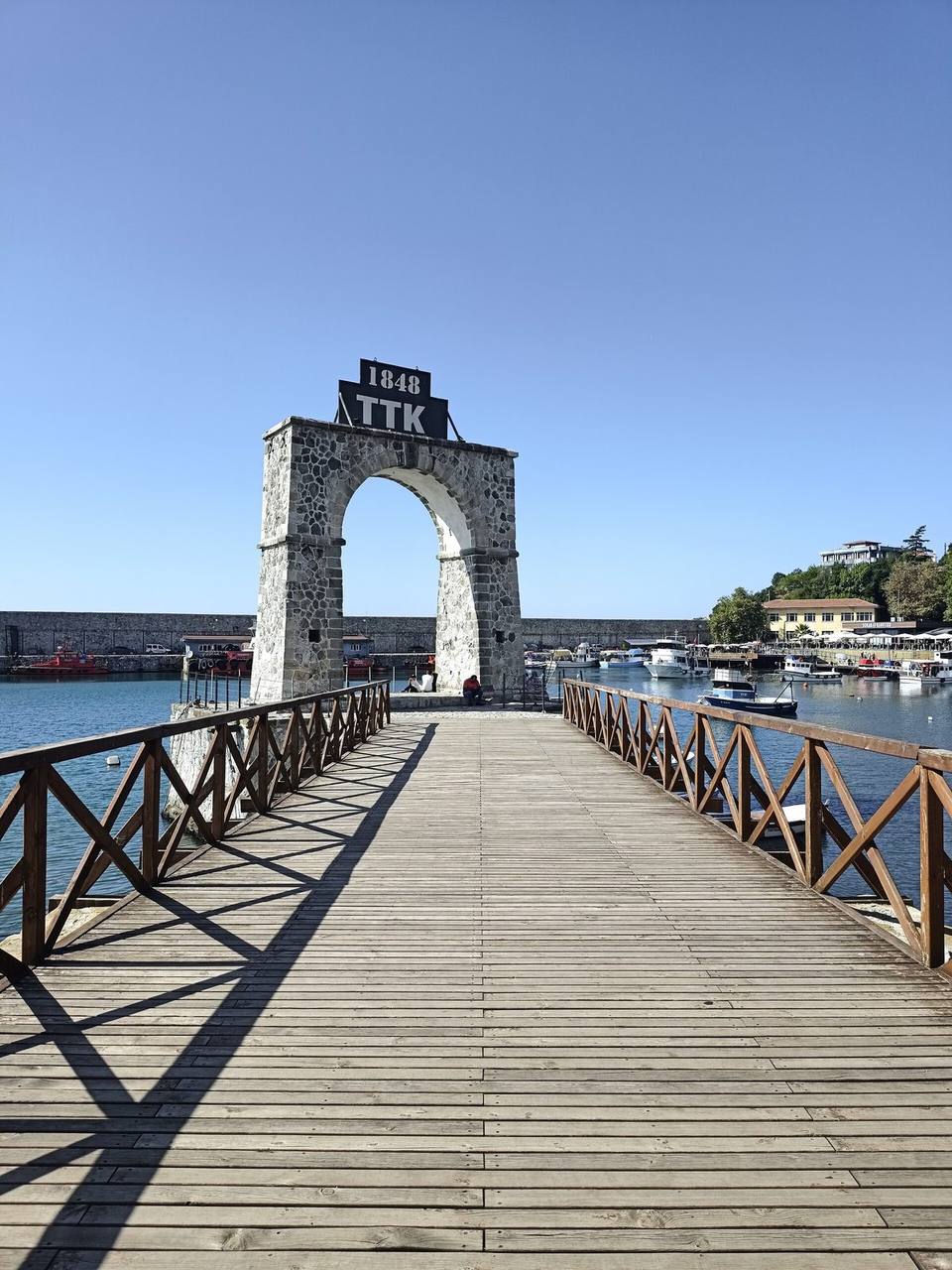
According to the Authority, regular coal production in the basin began in 1848. That year the boundaries of the basin were drawn for the first time and mining was run on behalf of the Hazine-i Hassa, the sultan's privy purse. The Turkish Hard Coal Authority counts this year as the start of the industry and puts it on its emblem. The "1848 TTK" sign above the stone arch of the old coal pier in the harbour is the most visible trace of that tradition in the city.
In its early years the basin passed through many hands. In 1849 the operation was leased to bankers from Galata. In 1851 two English mining engineers, brothers, were brought to the basin together with eight mine overseers. The first shafts in the Kozlu and Üzülmez area were opened in this period, and work began on laying a railway along the shore. During the Crimean War the operation of the mines at Kozlu, Zonguldak and Üzülmez came under British and French control, and the coal they produced supplied the fleets of those countries. The Authority's history records that narrow-gauge decauville lines and new railways were laid in this period, and that the first mines regularly supported with timber props were opened.
Dilaver Pasha and rotating shifts
In 1865 the administration of the basin was given to Dilaver Pasha, with the titles of District Governor of Ereğli and Superintendent of the Imperial Mines. Under the pasha a regulation of one hundred articles was prepared, covering everything from the management of the mines and the delivery of coal to the supply of pit props and the working arrangements of the miners. According to an article by Büşra Yüksel of Bülent Ecevit University in the journal İş ve Hayat, this text, officially titled the Regulation of the Ereğli Imperial Mines Administration, came into force in 1867 and is regarded as the first regulation of working life. It limited the working day to ten hours and set up a rotating system. Workers from the same village were split into two groups, and while one group worked in the mine the other returned home to tend its fields. For many years this arrangement gave Zonguldak mining the identity of the worker who travelled back and forth between village and pit. The Authority's history also notes that part of today's Üzülmez production area takes its name, Dilaver, from the pasha.
Shafts, inclines and the harbour
From the 1880s foreign capital began to flow into the basin. According to the Provincial Directorate of Culture and Tourism, the mines were run by British, French, German, Belgian, Russian, Greek and local companies. In 1885 the first shaft of the basin, Kurci Shaft number one, was opened at Kozlu. In the same year the basin's first incline, a device that carried coal along a sloping track, was built at a mine in Alacaağzı. In 1893 the contract to build Zonguldak harbour, its loading facility and several railway lines was awarded to the Ereğli Company. The provincial directorate's history says that with the harbour breakwater the area of activity expanded and the population and number of buildings in the settlement grew rapidly.
After 1896 coal seams began to be named after the person who first found them. In 1902 the Ereğli Company opened the Gelik-Asma aerial ropeway, about 5,200 metres long. By 1909 there were more than three hundred local and foreign mine operators in the basin.
From a locality to a province
This activity changed the settlement too. According to the provincial directorate, until 1896 official correspondence referred to Zonguldak as "the locality called Zonguldak", attached to the district of Ereğli. This locality, a quarter of the village of Elvan, became a township in 1899. In 1910 the Directorate of the Ereğli Mines moved from Kozlu to a newly built office in Zonguldak. The town was raised to the status of a sub-province in 1920, and on 1 April 1924 it became the first province created after the proclamation of the Republic.
In the early years of the Republic new steps were taken to regulate working life in the basin. Law number 151 of 1921 was one of the first laws governing the rights of mine workers. According to the history of the Amelebirliği, now attached to the Ministry of Labour and Social Security, the fourth article of this law required every mining operation to set up a mutual aid fund. With the regulation approved by the Council of Ministers on 22 July 1923, the Amelebirliği, the country's first social aid institution, opened in December of that year. In 1924 Türkiye's first school of mining engineering also opened in Zonguldak.
The move to state operation
The 1930s were the years in which the state entered the basin directly as an operator. According to the Turkish Hard Coal Authority, in 1937 all the assets of the Ereğli Company were transferred to Etibank and the Ereğli Coal Enterprise was founded. Law number 3867 of 1940 decided that all the mines between Amasra and Ereğli would be operated by the state. In 1948 the Çatalağzı Thermal Power Plant went into service, and the coal of the basin began to be turned into electricity as well. The Turkish Coal Enterprises Authority, founded in 1957, took over the Ereğli operations. Finally, in 1983 the General Directorate of the Turkish Hard Coal Authority was established. Today the Authority continues production through its Armutçuk, Amasra, Kozlu, Üzülmez and Karadon hard coal enterprises.
Where to see it today
The place where this past is told most completely is the Zonguldak Mining Museum and Coal Experience Mine. According to the Provincial Directorate of Culture and Tourism, the museum was founded on the proposal of the Governorship with the approval of the Ministry, and it opened on 9 December 2016 on Bülent Ecevit Avenue in the Çınartepe quarter. It is Türkiye's first mining museum and has become a member of the European Route of Industrial Heritage (ERIH). According to the Turkish Museums website, the museum consists of a thousand square metres of indoor galleries, a garden display area, and the training facilities of the Turkish Hard Coal Authority with a gallery about 700 metres long.
The foyer, designed around the slogan "Zonguldak, Capital of Labour", tells of the relationship between mining and social life. On show are equipment from the old radio station, records, film projectors and the championship trophies of the city's football club. A weighing scale and a cash register from the Merkez Ekonoma, the shop where miners did their shopping, are also here. According to the Governorship's museum website, the giant model in the middle of the ground floor shows in miniature how hard coal is extracted from the underground gallery, processed and transported. Apprentice students began building this model in 1983 and completed it in a second phase of work in 1984. The upper floors explain underground surveying instruments, excavation work and the division of labour in mining. How coal forms through its successive stages is shown with kiosks, projections and fossil leaves and stems from different geological periods. A product tree display sums up at a glance how many different industries use coal as a raw material.
The training mine next to the museum was once where miners were trained before going underground. According to the Governorship's museum website, it is now open to visitors as the Coal Experience Mine, together with a mine lift simulator. Check the current information on the museum and Turkish Museums websites for opening days, hours and admission.
The city's second landmark is the Uzun Mehmet Monument. According to the Kültür Portalı, the monument was built in three months in 1973 to mark the fiftieth anniversary of the Republic, under the supervision of its architect Yılmaz Soylu. It was placed on the Balkaya ridge so that it could be seen from every part of the old city centre. Its surroundings were laid out as a picnic area and walking path in 1983. The monument stands on the Zonguldak-Kozlu road, about 2 kilometres from the city centre.
The third stop is the harbour itself. The old coal loading pier, listed as the Şarjöman Rapid Pier among the places to visit by the Provincial Directorate of Culture and Tourism, reaches out into the sea along a wooden walkway. At its end stands a stone arch topped by the sign reading 1848 and TTK.
A suggestion for one day
Start the day with the museum, because what you see at the later stops only makes sense with the context you gain there. In the afternoon, take the Kozlu road up to the Uzun Mehmet Monument and look down on the old city centre, this time from above. End the day in the harbour, at the tip of the pier. Passing through quarters such as Kozlu and Üzülmez after reading their names in the museum makes you realise that every name on the map corresponds to a mine or a seam. If you plan to reach the monument and the pier on foot, wear comfortable shoes.
Sources
- Zonguldak Provincial Directorate of Culture and Tourism, History, https://zonguldak.ktb.gov.tr/TR-383139/tarihce.html
- Zonguldak Provincial Directorate of Culture and Tourism, Zonguldak Mining Museum, https://zonguldak.ktb.gov.tr/TR-383126/zonguldak-maden-muzesi.html
- Zonguldak Provincial Directorate of Culture and Tourism, Places to Visit, https://zonguldak.ktb.gov.tr/TR-383121/gezilecek-yerler.html
- Turkish Hard Coal Authority, History, https://www.taskomuru.gov.tr/kurumsal/tarihce
- Zonguldak Governorship, Zonguldak Mining Museum, https://www.zonguldakmadenmuzesi.com/
- Turkish Museums, Zonguldak Mining Museum, https://www.turkishmuseums.com/museum/detail/2257-zonguldak-maden-muzesi/2257/1
- Kültür Portalı, Uzun Mehmet Monument, https://www.kulturportali.gov.tr/turkiye/zonguldak/gezilecekyer/uzun-mehmet-aniti
- Ministry of Labour and Social Security, Amelebirliği History, https://csgb.gov.tr/amelebirligi/baskanlik/tarihce/
- Büşra Yüksel, The First Regulation of Labour Relations, the Dilaver Pasha Regulation, İş ve Hayat, https://dergipark.org.tr/en/download/article-file/404438
- Kahraman Şakul, The First Ottoman Coal Mining Venture, Osmanlı Bilimi Araştırmaları, https://dergipark.org.tr/en/download/article-file/670661
Comments
Be the first to comment