

Behind the Screen of Karagöz and Hacivat, Following Shadow Theatre in Istanbul
The light comes on and a still, coloured picture falls on the white screen. A reed pipe sounds, the picture is lifted away, and a thin voiced man with an upturned moustache arrives.

Sign in to like and rate
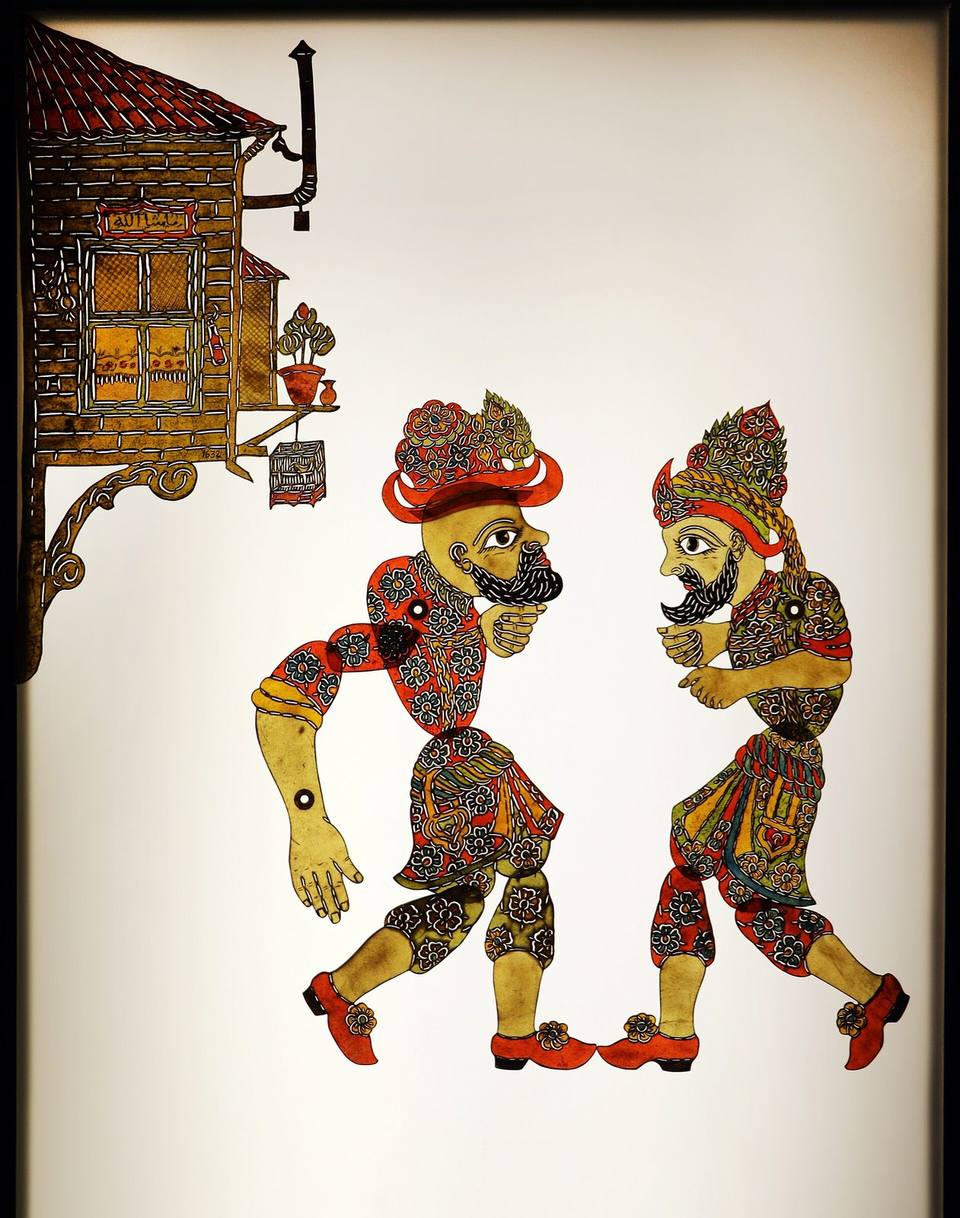
The light comes on and a still, coloured picture falls on the white screen. A reed pipe sounds, the picture is lifted away, and a thin voiced man with an upturned moustache arrives. Soon his deep voiced neighbour, with an odd cap pulled over his bald head, will join him, and the two will start talking past each other as they have done for centuries. This is the screen of Karagöz and Hacivat. A handful of figures cut from hide, a lamp and one master's voice are enough to build an entire city.
Karagöz entered UNESCO's Representative List of the Intangible Cultural Heritage of Humanity in 2009. Its roots are debated, but its Ottoman story, which begins with artists brought to Istanbul from Egypt, can be traced in the documents. In this piece we go behind the screen to see how shadow theatre is put together, what parts a play has and who appears on it. Then we follow the story from the legend in Bursa to the Ramadan nights of Direklerarası, and show where you can watch Karagöz in Istanbul today and where to see the figures up close.
What Lies Behind the Screen
Karagöz is a shadow play. The Culture Portal of the Ministry of Culture and Tourism defines it as a play in which human, animal and object shapes made of camel or buffalo hide are fixed to rods and moved across a white screen lit from behind. UNESCO's description says the same thing. The figures, called tasvir, are made of camel or ox hide, held on rods in front of a light source, and their shadows fall on a cotton screen.
The word shadow is a little misleading, because what you see on the screen is not black silhouettes but coloured pictures. According to the TDV Encyclopedia of Islam, the hide of the figures is thinned and made translucent through several processes and coloured with vegetable dyes. The light passes through the hide and the colours fall on the screen like stained glass. Turkish Wikipedia gives the height of the figures as usually 32 to 40 centimetres. The largest, Himmet Ağa the woodcutter from Kastamonu, reaches 50 centimetres.
The figures are worked with one or two horizontal rods inserted into holes placed so that they balance. The encyclopedia also mentions vertical rods known as fır döndü. The figures' arms and legs move at the joints. When Karagöz's head flops back or Hacivat raises an arm, what you are watching is a small game at the master's fingertips.
In the past the light came from a candle or a kind of oil lamp called şem'a. Today an electric bulb is used. Old masters also called the white screen the mirror, ayna. Before the play begins a figure called the göstermelik is placed on the screen. It is a still picture that stands on the screen to music at the start of the show. As UNESCO describes it, it sets the scene, hints at the themes of the play and vanishes to the shrill sound of a whistle.
The Hayali and His Team
The master who performs Karagöz is called the hayali or hayalbaz. The Culture Portal notes that the hayali is trained in a master and apprentice relationship, and that his helpers are the apprentice, the yardak, the dayrezen and the sandıkkar. According to Turkish Wikipedia, the yardak is the master's assistant and accompanies him on percussion, the dayrezen keeps the rhythm and the sandıkkar carries the equipment. The Culture Portal adds that an apprentice's training begins with fixing the figures to their rods.
UNESCO's description sets out the same arrangement. The figures are worked by one lead artist, the hayali. He may have one or more apprentices who learn the craft by helping to make the figures and by accompanying the action with music. However crowded the screen becomes, every figure is in the same master's hands.
The play has its music too. The nareke played at the opening is, as Turkish Wikipedia describes it, a pipe made of reed, similar to a shepherd's flute. The TDV Encyclopedia of Islam notes that Karagöz plays developed a music with fixed rules over time and that Etem Ruhi Üngör published 215 of the shadow play songs with their notation. UNESCO also writes that the play is woven from singing, tambourine music, poetry, tongue twisters and riddles, with puns and imitations of regional accents as its salt and pepper.
The Four Parts of a Play
According to the TDV Encyclopedia of Islam, every Karagöz play is made up of four independent parts. Knowing this structure makes it much easier to follow what happens on the screen.
- Mukaddime, the prologue. The göstermelik is removed, Hacivat appears and recites a semai and the screen poem, the perde gazeli. English Wikipedia cites his opening cry, "Yar bana bir eğlence", oh for some amusement, as the hallmark of this part. Karagöz then arrives, the two exchange a few words and come to blows.
- Muhavere, the dialogue. A conversation between Karagöz and Hacivat on a set subject that can be stretched as long as the performer likes. Riddles, puns and misunderstandings are its raw material.
- Fasıl, the main play. The other characters enter and the plot unfolds. The encyclopedia writes that the subjects of these plays have passed from generation to generation down to our day and include classic love stories such as Ferhad and Şirin, Leyla and Mecnun, and Tahir and Zühre.
- Bitiş, the ending. A short close that always runs the same way. As English Wikipedia tells it, Hacivat complains that Karagöz has ruined everything and brought down the screen, and Karagöz asks that his transgressions be forgiven.
One name is mentioned in almost every screen poem, that of Şeyh Küşteri, whom Karagöz performers regard as the creator of their art. The question of who he was takes us to Bursa, but first let us meet the two heroes of the screen.
Who Are Karagöz and Hacivat
Even their names reveal the characters. According to English Wikipedia, Karagöz means black eye, while Hacivat derives from the name Hacı İvaz. Turkish Wikipedia notes that Karagöz wears a cap called the ışkırlak on his hairless head. Hacivat is known by his curled moustache.
The TDV Encyclopedia of Islam describes Karagöz as an honest man of the people who says what he thinks. For that reason he is pushed aside, is usually out of work and gets into trouble. He speaks in a deep voice. Hacivat is scheming, well spoken, adapts to everyone, acts as go between in everyone's affairs and is a soother and peacemaker. He is a thin voiced Istanbul gentleman. The Culture Portal puts the same contrast more briefly. Karagöz is uneducated, brave and down to earth, while Hacivat is educated, knowledgeable and cunning.
All the humour of the play springs from the clash of these two languages. Hacivat builds ornate sentences with Arabic and Persian words, and Karagöz hears them as they sound and turns them into something else entirely. As English Wikipedia sums it up, Karagöz usually outwits his educated neighbour with street wisdom, yet his own schemes always backfire. The audience laughs at both, at one for taking himself too seriously and at the other for never taking anything seriously.
A Crowded Screen
Once the main play begins, the screen turns into an Istanbul neighbourhood. The TDV Encyclopedia of Islam lists a wide range of characters. Among those who speak in a polished Istanbul accent are Çelebi, a spendthrift fond of young ladies, the drowsy and sluggish Tiryaki, and the flustered, chattering Beberuhi. Among those who speak in the accents of their home regions are the woodcutter from Kastamonu, the cook from Bolu, and types from Kayseri, Karaman and Eğin, the Laz or Black Sea man and the Kurd. Persian, Arab, Albanian, Rumelian and Tatar types also take the stage. Greek, Armenian and Jewish characters, along with the Tatlısu Frengi, are part of this crowd.
To these are added the bully Tuzsuz Deli Bekir, the female characters or zenne who appear in different roles depending on the play, and the cabaret singer and the conjurer that UNESCO mentions separately. We have already noted that Himmet Ağa, the woodcutter from Kastamonu, is the largest figure on the screen.
This crowd is a mirror of the people of Ottoman Istanbul who rubbed shoulders in the street. Each type arrives with his own accent, his own troubles and his own weaknesses. The humour comes from the accents and the misunderstandings. If you are watching Karagöz for the first time, knowing about this variety in advance helps you understand why the voices on the screen sound so different from one another.
The Legend in Bursa
The most often told Karagöz story is set in Bursa. According to the legend recounted in the TDV Encyclopedia of Islam, a mosque was being built in Bursa in the time of Sultan Orhan. Hacivat was a mason and Karagöz a blacksmith, and their witty exchanges kept the other workers from their work. When construction fell behind, Sultan Orhan had both of them beheaded. As the Culture Portal tells it, the sultan later regretted this, and a man named Şeyh Küşteri made likenesses of the pair and performed them on a screen. That is why Karagöz performers regard Küşteri as the creator of the art. The Culture Portal's Hatay page records another version of the story, in which Karagöz was a blacksmith from the village of Samakol in Thrace.
These stories should be heard as legends. The TDV Encyclopedia of Islam says so plainly. Since there is no document or evidence, these accounts do not mean much, and what the sources say about Şeyh Küşteri is not only inconsistent but also contains no information linking him to Karagöz.
Bursa still claims the story. The encyclopedia writes that a grave in the Çekirge quarter has been said to belong to Karagöz. The Culture Portal notes that a monumental tomb was built for Karagöz in Bursa in 1950 and that the city's Karagöz Museum holds regular performances. Thrace has its share too. According to the encyclopedia, a large statue of Karagöz was erected in a wide square in Kırklareli in 1993. If you are planning a day trip to Bursa, adding the Karagöz Museum makes a visit that completes the Istanbul screen.
From Egypt to Istanbul
The documented side of the history comes by a different road. The TDV Encyclopedia of Islam discusses three views on the origin of Karagöz. It finds the idea of a Central Asian origin weak, since shadow theatre was unknown among the Turks of Central Asia. It also considers the idea that it came from India with Roma migrations inconsistent, since no trace of shadow theatre is found in Türkiye before the 16th century. The documented route is Mamluk Egypt.
According to the encyclopedia, the Egyptian historian Ibn Iyas recorded that in 1517 a shadow player gave a performance in Cairo in the presence of Sultan Selim I. The show was liked and the performer was invited to Istanbul. The encyclopedia also states that some six hundred Egyptian artists came to Istanbul with Selim. English Wikipedia notes that in the 17th century Evliya Çelebi pushed the tradition back even further, to the reign of Bayezid I, but the documents begin in the 16th century.
The play changed once it reached Istanbul. According to the encyclopedia, the figures of Mamluk shadow plays were single coloured and did not let light through. In the 17th century Ottoman artists, thanks to their skill in leatherwork, made the figures translucent and gave them movable joints. The name Karagöz also first appears in that century. So the colourful, jointed figures you see on the screen today are the work of Ottoman craftsmen.
From here the play spread across the empire. The encyclopedia writes that besides Anatolia, Karagöz reached Algeria, Tunisia, Egypt, Romania, Yugoslavia, Syria, Lebanon and, at a later date, Greece. In Greece the hero became known as Karagiozis.
Ramadan Nights and Direklerarası
Karagöz was at its liveliest in Ramadan. UNESCO writes that it was performed in coffeehouses, gardens and public squares, especially during the month of Ramadan and at circumcision feasts. The Culture Portal adds that it was also performed in homes and open spaces in the past and is mostly staged in theatres today, while Ramadan performances remain lively. The picture English Wikipedia paints is a familiar one. After a day of fasting, crowds would pour into the streets after iftar and fill the coffeehouses where Karagöz was playing.
In Istanbul the address for those nights was Direklerarası. According to the TDV Encyclopedia of Islam, Direklerarası stood on the road between Vezneciler and Şehzadebaşı. It took its name from the arcades resting on low marble columns in front of the shops on both sides. These shops were built by Damat İbrahim Paşa to provide income for his complex near the Şehzade Mosque. Turkish Wikipedia dates them to 1728 and 1729 and says the market had 82 shops.
After 1826 Direklerarası became Istanbul's busiest market and its favourite place for strolling and entertainment. According to the encyclopedia, traditional performing arts such as orta oyunu, the meddah storyteller and Karagöz were staged here. Some of the first theatre stages were also set up here. Wikipedia adds that in the 19th century, especially in the months of Ramadan, Karagöz shows, wrestling bouts and conjuring acts took place here. As Beyoğlu rose as the new entertainment centre, Direklerarası was slowly forgotten. According to Wikipedia the market was largely demolished during urban works in 1958 and only a very small part survives.
Walking along Şehzadebaşı Avenue today, you have to imagine where those arcades stood. The walk is still worthwhile. As you head from the Şehzade Mosque towards Vezneciler, you know that crowds once filled exactly this stretch on Ramadan nights, waiting at coffeehouse doors for the screen to light up. Vezneciler metro station is a convenient place to start.
A Hayali from Istanbul
One of the important masters who carried Karagöz into the 20th century was from Istanbul. According to a 2020 report by Anadolu Agency, Mehmet Muhiddin Sevilen, known as Hayali Küçük Ali, was born in Istanbul in 1886. He trained under Hayali Saraç Hüseyin and gave his first performance, Hımhımlı Mandıra, in 1900 in the Draman quarter of Fatih when he was only 14. From 1909 he worked as a clerk at the Istanbul Post Office without giving up Karagöz. In 1934 he moved to Ankara and for twenty years voiced Karagöz plays on the radio, bringing the art to the whole country. He died in Ankara on 7 December 1974. According to the report, his figures and sound recordings are kept in public archives today.
His story also shows how Karagöz lives. A master, an apprentice, performances in neighbourhood streets and coffeehouses, and then a new medium such as radio. UNESCO's description stresses the same continuity today. The play is now also staged in performance halls, schools and shopping centres in large cities, yet transmission still passes from master to apprentice.
Karagöz on the UNESCO List
Karagöz was inscribed on UNESCO's Representative List in 2009 by decision 4.COM 13.73. The listing describes the technique of shadow theatre, the contrast between the two heroes and the social role of the play together. It gives particular weight to the link with Ramadan and circumcision feasts, to the figures being worked by a single lead artist, and to transmission through apprenticeship. UNESCO also writes that this traditional theatre strengthens a sense of cultural identity while bringing people closer together through entertainment.
Being on this list does not mean being put away in a museum. What UNESCO calls intangible heritage is a practice that lives today and passes to new generations. In the case of Karagöz it means that the screen is still set up, new hayalis are still being trained and the play is still watched together with children.
Where to Watch It in Istanbul Today
Karagöz performances have no fixed calendar and programmes change from year to year and season to season. The places below have recently included shadow theatre. Always check their current programmes before you go.
- Ramadan events. In İBB Kültür AŞ's Ramadan programme for 2026, between 21 February and 14 March, the Panorama 1453 History Museum hosted a Hacivat and Karagöz shadow play and a meddah performance for children. Entry was free with a QR code from the Radar Türkiye app. Before each Ramadan, follow Kültür AŞ's announcements and the event listings in Radar Türkiye.
- Atatürk Cultural Centre. In January 2026 a Karagöz shadow play was staged in AKM's children's programme. The adventure began with Hacivat offering a job to the unemployed Karagöz and brought in characters such as Beberuhi, Çelebi and the Laz. The event was ticketed. Check AKM's current event calendar for similar plays.
- Bursa. If you want to watch Karagöz in the city of its legend, the Karagöz Museum in Bursa holds regular performances according to the Culture Portal. It fits into a day trip to Bursa by fast ferry.
Seeing the Figures Up Close
The best way to see the figures behind the screen up close in Istanbul is the Museum of Turkish and Islamic Arts in Sultanahmet. In the Istanbul Governorship's 2019 introduction to the museum, the deputy director explains that the ethnography section displays collections on 19th century Istanbul themes such as coffee, the hamam, women's dress, mansion life, the calligrapher, Karagöz and the Grand Bazaar. The same introduction lists Hidayet Gülen's Karagöz collection among the must see pieces of the ethnography section.
According to the introduction, the ethnography area is reached by the stairs after you have seen the divan section. Look closely at the figures in the lit cases and you will see how thin the hide has been made, how finely the cut work is done and how the colours come alive with the light. Since displays may change over time, we suggest asking the museum before you go whether the figures are still on show. Check the museum's official website for current opening hours as well.
It is easy to combine this visit with a walk through Direklerarası on the same day. Look at the figures in Sultanahmet in the morning, take the T1 tram to Beyazıt and walk from there through Vezneciler to Şehzadebaşı. That way you see both the figures and the street where they were once performed.
A Few Tips for Watching Karagöz
If you are watching Karagöz for the first time, especially with children, these small preparations will enrich the experience.
- Arrive early and sit directly opposite the screen. The image is projected from behind, so the colours look their brightest from the front.
- Do not take flash photos. The magic of the play comes from the light behind the screen, and a flash both washes out the colours and disturbs other viewers.
- Tell children about the two heroes before the show. A child who knows that Hacivat speaks in flowery phrases and Karagöz misunderstands him catches the jokes much faster.
- Listen for the regional accents and the wordplay. Most of the humour lies in the words. If you have guests who are new to Turkish, a short summary of the story beforehand will help them.
- Do not miss the close, when Karagöz asks for his transgressions to be forgiven. Not leaving before the screen goes dark is the least respect one can show this tradition.
- You can follow Karagöz into the cinema too. English Wikipedia writes that the roots of Yeşilçam comedy reach back to traditional performing arts such as the meddah, orta oyunu and Karagöz and Hacivat.
Sources
- UNESCO, Karagöz, https://ich.unesco.org/en/RL/karagoz-00180
- TDV Encyclopedia of Islam, Karagöz, https://islamansiklopedisi.org.tr/karagoz
- TDV Encyclopedia of Islam, Direklerarası, https://islamansiklopedisi.org.tr/direklerarasi
- Culture Portal of Türkiye, Karagöz, https://www.kulturportali.gov.tr/portal/karagoz
- Culture Portal of Türkiye, Shadow Play, Karagöz and Hacivat (Hatay), http://kulturportali.gov.tr/turkiye/hatay/kulturatlasi/golge-oyunu-karagoz
- KÜLTÜR.İSTANBUL, İBB Kültür AŞ Ramadan events 2026, https://kultur.istanbul/kultur-as-ile-ramazan-etkinlikleri/
- Atatürk Cultural Centre, Karagöz Shadow Play, https://akmistanbul.gov.tr/tr/etkinlik/karagoz-golge-oyunu
- Istanbul Governorship, Museum of Turkish and Islamic Arts, https://istanbul.gov.tr/istanbulun-muzeleri-turk-ve-islam-eserleri-muzesi
- Anadolu Agency, Hayali Küçük Ali, the master who devoted his life to Karagöz, https://www.aa.com.tr/tr/kultur-sanat/omrunu-karagoz-sanatina-adayan-usta-hayali-kucuk-ali/2067232
- Turkish Wikipedia, Karagöz ve Hacivat, https://tr.wikipedia.org/wiki/Karag%C3%B6z_ve_Hacivat
- Turkish Wikipedia, Direklerarası, https://tr.wikipedia.org/wiki/Direkleraras%C4%B1
- Wikipedia, Karagöz and Hacivat, https://en.wikipedia.org/wiki/Karag%C3%B6z_and_Hacivat
Comments
Be the first to comment