

Anzer Honey and the Bees of the Flowering Valley
A honey named after a valley When honey is mentioned in Rize, the first name that comes to mind is Anzer, high above İkizdere.
 Radar TürkiyeNovember 24, 2026
Sign in to like and rate
A honey named after a valley
When honey is mentioned in Rize, the first name that comes to mind is Anzer, high above İkizdere. The İkizdere page of the Rize Provincial Directorate of Culture and Tourism lists Anzer Yaylası, where the famous Anzer Balı is made, among the well-known highland pastures of the district, together with the Çağrankaya and Ovit pastures. The folk cuisine page of the same directorate also records that beekeeping still keeps its importance in the region and that the internationally known Anzer honey is produced here.
What sets Anzer honey apart from an ordinary flower honey is the close bond it has with the place whose name it carries. This bond has been the subject of both an official registration and scientific studies. Knowing where the honey comes from and what the criteria that define it tell you lets you look at the meadow with different eyes as you explore the highlands.
What a designation of origin means
In Türkiye, geographical indications fall into two main types. According to the Provincial Directorate's information page, a designation of origin is the name of a product that takes all or its essential qualities from the natural and human factors of a particular geography, and whose production, processing and all other operations take place within the boundaries of that area. For an indication of source, it is enough for at least one of these operations to take place in the region, and the product may also be made outside it.
Among the registered products of Rize, Anzer Balı stands out as a honey recorded as a designation of origin. According to the registration record, the application was filed on 26 May 2011 and the product was registered on 16 February 2021. The time between application and registration also shows how precisely the identity of a honey has to be described. A designation of origin means that the product can only gain its qualities when it is produced in the place it belongs to; in other words, what makes Anzer honey Anzer honey is the valley itself.
Registration protects the rights not of a single producer but of all producers who follow the conditions in the certificate. As the information page stresses, the aim is to prevent the registered name from being used on products that lack the required qualities and to keep consumers from being misled. For a product with a high reputation, this protection also safeguards the work of the genuine producer.
The U-shaped valley
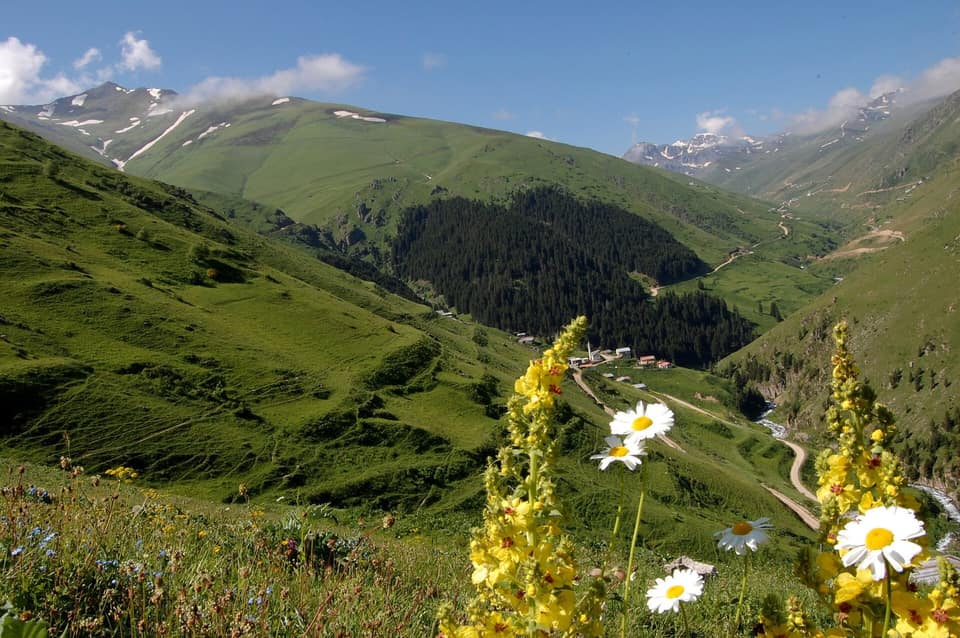
The registration certificate describes the area where the honey is produced almost like a map. Anzer honey is produced in a valley on the Anzer plateau about 13 kilometres long, 4 kilometres wide at its narrowest point and 9.5 kilometres at its widest. The valley rises from an altitude of 1750 metres to 3150 metres. The honey-producing parts of this U-shaped valley are surrounded on the east, west and south by mountain ranges rising above 3000 metres.
According to the certificate, this sheltered setting creates a distinctive ecosystem that sets the valley apart from its surroundings in terms of climate, vegetation and other natural features. These differences are reflected in the nectar, and from there in the honey. The summary of a 2006 study by the Apiculture Research Institute also describes the plateau as a rainy place with low average temperatures and few sunny days. Altitude figures differ between sources; the range given in the registration certificate is the official definition.
The trace of alpine meadows
According to the registration certificate, the vegetation of the valley is alpine and carries a rich diversity, including endemic species. The way to understand which flowers a honey comes from is pollen analysis; the pollen grains counted under the microscope show which plants the bee has visited.
The definition of Anzer honey rests precisely on this analysis. According to the certificate, the dominant pollen comes from the legume family, Fabaceae. It is accompanied by pollen from the daisy family, the borage family that includes the forget-me-not genus, the grass family, the rose family, the geranium family and the mint family. Forget-me-not pollen is present in the honey in minor or rare amounts, and this is the main distinguishing feature listed in the certificate.
The most instructive part of the definition, however, is what must not be in the honey. Chestnut and rhododendron pollen are never found in Anzer honey. The certificate also sets an upper limit for pollen count and requires that the honey contain no added pollen.
A 2017 study that examined the plants visited by bees supports this picture. In the study published in the journal Mellifera, samples were collected with pollen traps from two apiaries on the plateau between June and August 2013, and the most frequently visited plants were found to belong to the geranium family. The same study also measured that the protein content of the collected pollen varied over a wide range from sample to sample.
A bee that withstands the cold
Making honey in a high and misty valley also demands special qualities from the bee. The registration certificate states that Caucasian and Caucasian hybrid bees are used in the production of Anzer honey and lists the reasons. These bees are resistant to disease and strong, they can fly even in cold and foggy weather, and their tongues are longer than those of other bee breeds.
The Apiculture Research Institute study, for its part, draws attention to the difficulties the plateau faces. According to the summary, grasses are often mown during the main nectar flow, the number of hives per unit area has risen sharply in recent years, and honey yield per colony has remained very low. The study aimed to increase honey and pollen yield by identifying the vegetation and the plant density during the bees' active season. These findings show how important the protection of the flowering meadows is for the future of the honey.
What to look for in the jar
Anzer honey is offered to consumers as strained honey. According to the certificate, it crystallises in a cold environment and takes on a creamy texture. Its moisture content is below twenty percent. Values such as its sugar composition, proline content, fructose to glucose ratio, free acidity, electrical conductivity and diastase number meet the limits set in the Turkish Food Codex Communiqué on Honey.
A 2019 study examining the chemistry of the honey was published in the Uludağ Bee Journal. The researchers carried out pollen analysis on samples taken from the Anzer plateau and measured total phenolic and flavonoid content and antioxidant capacity. According to the study's conclusion, Anzer honey is not especially rich in phenolic compounds, but the variety of the phenolic compounds it contains is remarkable. Pinocembrin, hesperidin and chrysin stand out among the compounds measured. This result is a reminder that the value of the honey should be sought not in exaggerated claims but in its documented composition.
When buying, the most reliable criterion is whether the product carries the registered name and whether it matches the description in the registration certificate. All production stages of a product with a designation of origin must remain within the defined area. Since prices and points of sale change, it is best to get up-to-date information from local institutions.
Anzer in the pasture season
For those who want to see the honey at its source, the right time is the pasture season. According to the Provincial Directorate's highlands page, life in the high pastures covers a period of about three months, from the beginning of June to the first week of September. The fact that the samples of the pollen study were collected between June and August also shows that bees move from flower to flower on the plateau during these months.
The first stop on the journey is İkizdere. The district is 56 kilometres from the centre of Rize and was founded at the point where the Çamlık and Cimil streams meet; it also takes its name, meaning twin streams, from them. The Provincial Directorate presents the district as a good place for highland tourism, nature walks and birdwatching. Before heading up to Anzer, asking local institutions about road and weather conditions will make things easier at this altitude, where fog and rain are frequent.
As you walk on the plateau, take a close look at the flowers. The family names in the certificate are the meadow right in front of you; the small flowers of the legumes, the yellow and white heads of the daisy family and the slender-stalked flowers of the geranium family are the table the bees visit all day long. Keeping away from the hives, not entering the beekeepers' working areas without permission and not trampling the flowering meadows are important both for your safety and for the future of the honey. Remember that mornings on the plateau can be cool and afternoons misty, and bring layers of clothing with you.
Sources
- Rize Provincial Directorate of Culture and Tourism, Anzer Balı, https://rize.ktb.gov.tr/TR-256618/anzer-bali.html
- Rize Provincial Directorate of Culture and Tourism, Coğrafi İşaret ve Geleneksel Ürün Adı Korumasına İlişkin Bilgi, https://rize.ktb.gov.tr/TR-256611/cografi-isaret-ve-geleneksel-urun-adi-korumasina-iliskin-bilgi.html
- Rize Provincial Directorate of Culture and Tourism, İkizdere, https://rize.ktb.gov.tr/TR-256719/ikizdere.html
- Rize Provincial Directorate of Culture and Tourism, Yaylalar, https://rize.ktb.gov.tr/TR-112782/yaylalar.html
- Rize Provincial Directorate of Culture and Tourism, Halk Mutfağı, https://rize.ktb.gov.tr/TR-191577/halk-mutfagi.html
- Malkoç et al., Phenolic Composition and Antioxidant Properties of Anzer Honey from Black Sea Region of Turkey, Uludağ Arıcılık Dergisi 19(2), 2019, https://dergipark.org.tr/en/pub/uluaricilik/article/602906
- Gençay Çelemli et al., Protein Analysis of Anzer Bee Pollen by Bradford Method, Mellifera 17(1), 2017, https://dergipark.org.tr/tr/pub/mellifera/article/377511
- Yaşar et al., Anzer doğal florasında bulunan ballı bitkiler ile balarısının nektar ve polen toplama aktivitelerinin saptanması, Apiculture Research Institute, 2006 (FAO AGRIS record), https://agris.fao.org/search/zh/records/64724fd753aa8c896305deb5
Comments
Be the first to comment