

Antalya's Monumental Trees, From Thousand Year Old Cedars to the Gedelme Plane Tree
What makes a tree a monument When people think of Antalya, the sea, ancient cities and waterfalls usually come to mind first.
 Radar Türkiye24 Kasım 2026
Sign in to like and rate
What makes a tree a monument
When people think of Antalya, the sea, ancient cities and waterfalls usually come to mind first. Yet in the mountains behind the city and in village squares there are living things that have been standing for longer than many of those cities. The booklet "Antalya'nın Önemli Anıt Ağaçları" (Antalya's Important Monumental Trees), published by Antalya Metropolitan Municipality in 2021, records these old trees by travelling from district to district. According to the booklet, Antalya, with its districts stretching from Alanya to Kaş, is one of the provinces of Türkiye with the tallest monumental trees and the largest number of them.
In the scientific definition, a monumental tree is one whose age, diameter and height exceed the usual measurements of its species, which holds a special place in local culture and history, and which lives long enough to form a bond between generations. The booklet explains that these trees are divided into groups such as dimensional, historical and folkloric. Monumental trees are defined as a natural heritage that must be placed under absolute protection, must not be cut down for any reason and must not be moved elsewhere.
According to the booklet, there are 160 monumental trees in Antalya registered by the General Directorate of Nature Conservation and National Parks and by the General Directorate for the Protection of Natural Assets. Many more trees are still waiting to be registered. From among them, the booklet examines 17 important trees selected from Elmalı, Kemer, Kaş, Kumluca, Korkuteli, İbradı and the city centre.
The tar tree, the Taurus cedar
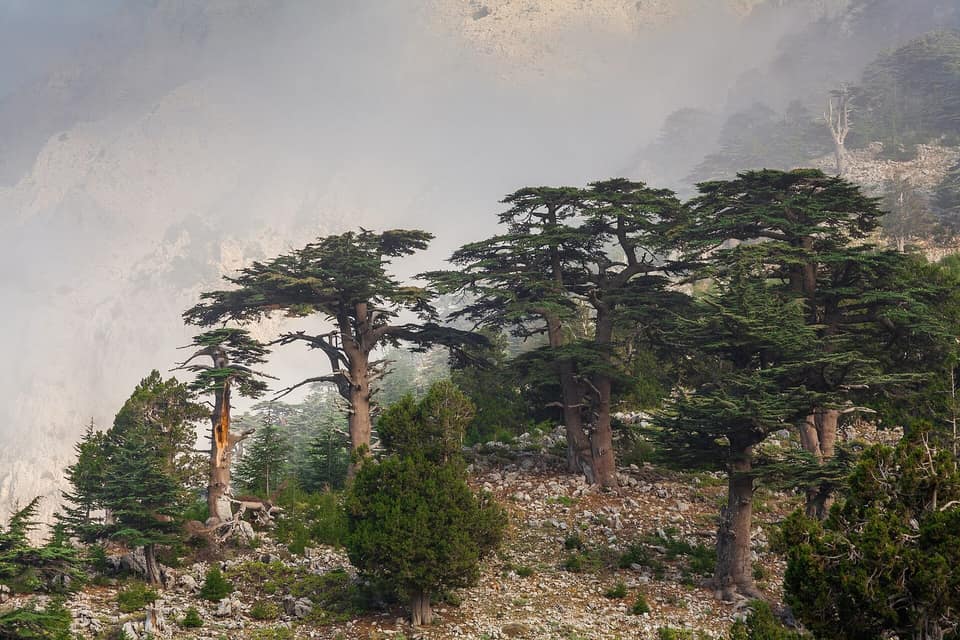
A single species makes up most of this list, the cedar. The booklet refers to these trees as the Lebanon cedar or, by its local name, the Taurus cedar. The same source explains that the crown of the Lebanon cedar, pyramid shaped when young, comes to resemble an umbrella as it ages. The bark of old trees takes on a scaly structure with lengthwise cracks, and its colour turns a blackish ash grey.
Locally the cedar is often called "katran" or "katran ağacı", the tar tree. The booklet writes that this name comes from its black resin, which resembles pitch. Its timber is valued for its softness, its scent and its durability. That is why it is a tree that was used in ancient times for the construction of palaces and great buildings.
Çığlıkara, Türkiye's store of cedars
The heart of Antalya's cedar forests lies in Elmalı. According to the booklet, the Çığlıkara Forest on the border between Elmalı and Finike lies 55 kilometres from Elmalı and 165 kilometres from Antalya, and covers an area of 15,889 hectares. The same source states that the forest holds 30 percent of Türkiye's cedar forests and is one of the rarest cedar forests in the world. The finest area of distribution of the Taurus cedar is the Çığlıkara and Çam Kuyuları locality on the Beydağları range.
Çığlıkara is today a nature reserve. Junipers also grow among the cedars of the forest, and many trees were registered as monumental trees in 1995. The most famous of them stand out for their size. Koca Katran, near the village of Doğantaş, is 32.3 metres tall with a trunk diameter of 2.5 metres, and its age is given as about 2000 years. Koç Sedir, near the village of Kızılağaç in Elmalı, is the tallest tree on the list at 38 metres.
Aslan Ardıç in the same forest, a juniper 23.2 metres tall with a trunk diameter of 3 metres and a trunk circumference of 9.52 metres, is about 1700 years old. The cedar near the village of Karamık is known locally as "Katil Sedir", the Killer Cedar. The booklet relates that the name comes from two people who climbed it to collect honey from its trunk and fell to their deaths.
There is one condition for seeing these trees. The trees inside the nature reserve are used for scientific research, and in the booklet's table all of them are marked as accessible "with a guide". Before planning a visit, you need to contact the Antalya unit of Nature Conservation and National Parks.
The Elmalı Cedar Research Forest
For old trees that can be visited independently, Elmalı has another address. Koca Sedir, in the Elmalı Cedar Research Forest near the village of Göltarla, is 32.5 metres tall with a trunk diameter of 2.29 metres. According to the booklet, its age was determined as 898 in 2010, and it was declared a natural monument in 2002. The tree has survived to the present day because it was rejected and left standing during the fellings between 1927 and 1936.
Şah Ardıç in the same forest is another giant, 22.8 metres tall with a trunk diameter of 2.42 metres. According to the booklet, it is also known locally as "Kokulu Ardıç", the Fragrant Juniper, because it is said to have taught the mountains of Elmalı to smell sweet. Both trees are shown in the table as suitable for independent access.
The oldest cedars in the world
There are old cedars beyond Elmalı too. The Lebanon cedar at the Gedik Çukuru locality of the village of Kızılağaç in Kaş is about 1500 years old and 26 metres tall. It stands within a dense forest and can be visited independently.
The Dibek Nature Reserve in Kumluca holds perhaps the most remarkable tree on the list. Known locally as "Ambar Katran" or "Dibek Sedir", the tree is 2346 years old according to a 1984 study on which the booklet draws. The same source presents it as the oldest cedar tree in Türkiye and in the world. It is 25 metres tall with a trunk diameter of 2.62 metres. Because the tree stands on very steep ground, there is a difference in height of 110 centimetres between the lower and upper edges of its base.
The Gedelme plane tree and the plane trees of the towns
After the cedars, the second great family is the plane trees. The plane tree that stands on the Gedelme highland of the village of Kuzdere in Kemer, at an altitude of about 600 metres, is also known locally as the "Octopus Plane". The booklet gives the age of this oriental plane as about 2700 years. It is 28 metres tall, its trunk diameter is 4.54 metres and its crown is 14.26 metres wide. The tree was registered in 2003 and is suitable for independent visits.
In the Çamyuva area of Kemer there is also an oriental plane about 1000 years old and 21 metres tall. In Korkuteli, three plane trees stand right in the town centre, the oldest given as 1001 years old. One of them stands on the central reservation of Alaeddin Keykubat Avenue.
It is also possible to see a monumental tree in the centre of Antalya. The oriental plane at the Kırcami locality of Muratpaşa is about 700 years old, 30 metres tall and 4.7 metres in trunk diameter. The chestnut tree in the centre of İbradı, 19 metres tall with a trunk circumference of 13 metres, is estimated to be between 1000 and 1100 years old.
A juniper by the sea
The youngest but perhaps most surprising tree on the list is in Konyaaltı. The juniper at Gökçam was noticed during the municipality's Yeşilçam Nature Walking and Cycling Trail project and was registered as a monumental tree in 2021. It is about 500 years old, 13 metres tall and 110 centimetres in trunk diameter.
According to the booklet, the juniper is a tree that normally grows at high altitudes. What makes this tree different is that it grew at sea level and has lived for centuries. The booklet also explains that the juniper needs a thrush known in Turkish as the ardıç kuşu, the juniper bird, in order to spread. The birds feed on juniper berries, and the digested seeds fall to the ground and sprout.
Crafts that come from the tree
Cedar and juniper are not just scenery, they are also part of everyday life in the region. "Traditional Cedar Tar Making", listed in the national inventory with a 2023 identification form, is one of the oldest examples of this relationship. According to the Provincial Directorate of Culture and Tourism, cedar tar is a dark black, dense substance obtained from the Taurus cedar, which is locally called the "tar tree".
Traditional production is based on the dry distillation, in an airless environment, of the lower trunk and roots of the cedar, which are rich in tar, in specially prepared kilns. The kiln works as a kind of still, and the heat and pressure force the resin out as tar. In the region, tar has traditionally been used in folk medicine and in the care of animals. According to the provincial directorate, this craft was widespread in the Taurus Mountains until recently, but today it is carried on with traditional methods only in the Geçmen neighbourhood of Elmalı.
The juniper also yields a flavour. Andız molasses, another entry in the inventory, is made by processing the extract obtained from the cones of the prickly juniper, locally called "andız" or "enek". According to the provincial directorate, this molasses can be eaten as a food and also goes into desserts such as saraylı and helva.
Notes for a visit
Touring the monumental trees calls for a full day's plan, because most of them stand in mountain villages far from one another. The Kırcami plane tree and the Gökçam juniper can easily be seen from within the city. The Gedelme plane tree and the interior of Kemer, the plane trees of Korkuteli and the chestnut of İbradı can each be part of a day trip.
The trees at Çığlıkara, however, require permission and a guide in advance, because the area is a nature reserve. Check the weather and road conditions before setting out on mountain roads. Do not climb the trunk of a tree, do not light fires over its roots and do not leave marks by handling its bark. As the booklet stresses, these trees can be passed on to future generations only when they are embraced as the shared heritage of society.
Sources
- Antalya Metropolitan Municipality, Department of Urban History and Promotion, Antalya'nın Önemli Anıt Ağaçları, 2021, https://antalya.bel.tr/Content/UserFiles/Files/ANTALYA'NIN%20%C3%96NEML%C4%B0%20ANIT%20A%C4%9EA%C3%87LARI.pdf
- Antalya Provincial Directorate of Culture and Tourism, Geleneksel Sedir Katranı Yapımcılığı, https://antalya.ktb.gov.tr/TR-366104/geleneksel-sedir-katrani-yapimciligi.html
- Antalya Provincial Directorate of Culture and Tourism, Andız Pekmezi Yapımı ve Tüketimi Gelenekleri, https://antalya.ktb.gov.tr/TR-476409/andiz-pekmezi-yapimi-ve-tuketimi-gelenekleri.html
- Antalya Provincial Directorate of Culture and Tourism, SOKÜM İl Envanteri 2026, https://antalya.ktb.gov.tr/Eklenti/152997,sok-m-il-envanteri-2026pdf.pdf?0
- Wikipedia, Çığlıkara Nature Reserve, https://en.wikipedia.org/wiki/%C3%87%C4%B1%C4%9Fl%C4%B1kara_Nature_Reserve
Comments
Be the first to comment