

Antalya's Market Kitchen, From Tahini Piyaz to Tirmis
The market's own kitchen When people think of food in Antalya, hotel buffets or seaside restaurants may come to mind first, but the city's real taste memory is kept in the small counters and bakeries of the old market.
 Radar Türkiye24 Kasım 2026
Sign in to like and rate
The market's own kitchen
When people think of food in Antalya, hotel buffets or seaside restaurants may come to mind first, but the city's real taste memory is kept in the small counters and bakeries of the old market. Between 2012 and 2014, folklore researchers of the Antalya Provincial Directorate of Culture and Tourism recorded these counters one by one during their fieldwork. The resulting book, "Traditional Handicrafts and Crafts in Antalya", describes piyaz making, serpme börek making, bağaça baking, kadayıf making and tirmis selling as professions in their own right, alongside copperwork and carpet weaving. The market kitchen is made up of dishes that are also cooked at home but whose true masters work in the market. Behind each of these dishes lies a skill and a tradition passed from master to apprentice.
Some of these flavours are under official protection. Türkiye became a party in 2006 to UNESCO's 2003 Convention for the Safeguarding of the Intangible Cultural Heritage, and a provincial inventory board was set up in Antalya in 2008. According to the provincial directorate, the number of elements from Antalya recorded in the national inventory reached 68 in 2026. On that list, tirmis culture entered in 2013, piyaz making in 2019, serpme börek making and yanıksı ice cream making in 2023, and Elmalı leblebi making in 2024.
Tahini piyaz, Antalya's signature
In many parts of Türkiye, piyaz comes to the table as a meze or a salad. In Antalya, however, piyaz is a dish in its own right, and the directorate's book stresses this clearly. GoTürkiye, the ministry's promotional site, also writes that piyaz is eaten as a main dish in Antalya and its districts. What makes the difference is the tahini sauce called "tarator", or "talatur" in the local pronunciation.
According to the book, preparation starts a day in advance. The dried beans are soaked in water overnight so that they soften, and the tarator is prepared the same evening. Tahini is whisked with lemon juice and a few spoonfuls of warm water, crushed garlic and a little olive oil are added, and the sauce is left to rest. The next day the beans are boiled, placed on a plate and covered with the tarator. Onion, tomato, boiled egg and parsley are added alongside, and finally chilli flakes and vinegar are drizzled over the top.
In the past, the beans for piyaz were the small Çandır beans. The book notes that, because of rising demand, small beans from the Konya area are also used today. That is why small rather than large beans on the plate are a mark of quality. In the market, piyaz is served next to köfte, and it is also eaten on its own as a meal.
The şiş köfte and piyaz pair
In the market, piyaz is often accompanied by köfte, and the best-known form of that köfte in Antalya is şiş köfte. According to GoTürkiye's description, only salt is added to the minced meat, with no breadcrumbs or spices. The köfte are threaded lengthwise onto skewers and cooked over charcoal. They are served on warm pide with oven-cooked onion, tomato and pepper on the side. Cumin also comes with the plate.
For anyone wanting to try this pair, the best approach is to visit the köfte and piyaz counters around the old market at lunchtime. To enjoy the full taste of the tahini sauce, you can adjust the vinegar and chilli flakes yourself.
Dough tossed by hand, serpme börek
Serpme börek takes its name from the way its dough is opened. According to the recipe in the book, flour, salt and water are kneaded, the dough is divided into balls and left to rest on oiled trays. The balls are then flattened with a rolling pin and opened by tossing them in the hands. The most distinctive feature of the börek is how extremely thin the dough is stretched. A filling prepared in advance is placed on the dough, spices are added, and it is folded and baked in the oven.
Serpme börek comes in two main kinds, with minced meat and with cheese. The börek is eaten hot, with tea or ayran on the side. The book explains that the masters who make and sell this börek in the market form a distinct profession, and that the tradition has been handed down from generation to generation. The entry of serpme börek making into the national inventory in 2023 also shows that this profession is still alive. Stopping at a börek counter for breakfast is also a good chance to watch how the master thins the dough in the air.
Bağaça and kadayıf, the sweet side of the bakery
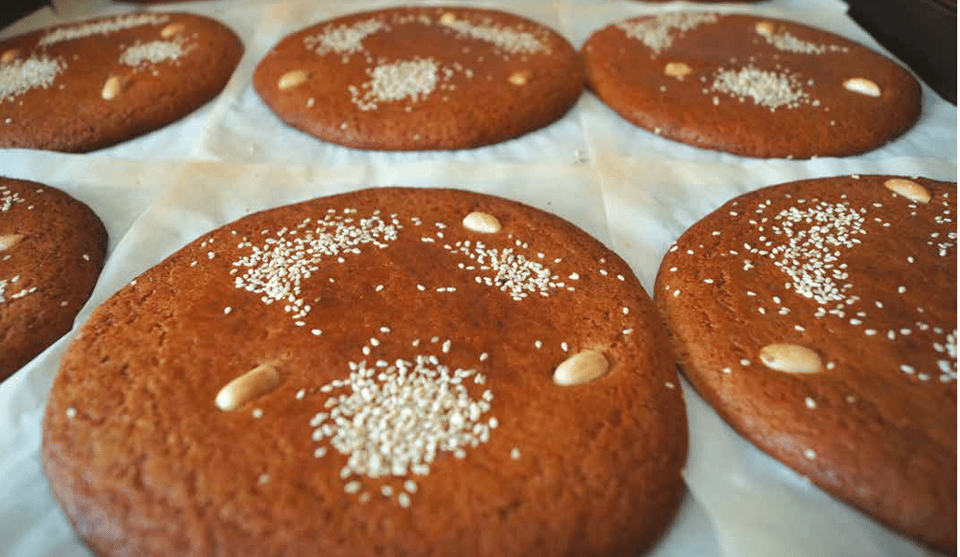
Bağaça is a tahini bun that belongs to Antalya's market kitchen. According to the directorate's book, it is made with flour, butter, sugar, tahini, sesame, mastic and cinnamon. The dough is leavened with chickpeas. The chickpeas are broken, soaked and left for about half a day. This starter is mixed with flour and water, and tahini, mastic, butter, cinnamon and sugar are added. The rested dough is weighed, divided into balls and opened by hand into circles on a marble counter. The tops are brushed with butter, decorated with pistachios, almonds and sesame, and baked briefly in a brick oven heated with wood fire.
The book reports that, thanks to the chickpea starter, bağaça is gentle on the stomach and keeps you full for a long time. Today bağaça is a souvenir flavour that visitors to the city also take home with them. The book names a bakery in Kaleiçi, opened in the 1940s and run for three generations, among the living representatives of this craft. You will recognise it when you see a round bun with a brown surface sprinkled with sesame.
Another product of the same bakery culture is Arap kadayıfı. Known in some other parts of the country as taş kadayıf or yassı kadayıf, this dessert has a dough made of semolina, flour, hot water and yeast. The runny batter is poured onto a metal griddle heated with wood fire, and only one side is cooked. The kadayıf is filled with crushed walnuts, cinnamon and sugar, dipped in egg, fried and then soaked in warm syrup. In the book's recipe, rose geranium leaves are also added to the syrup boiled from sugar and water, and the syrup is finished with lemon.
Tirmis, the city's fading snack
Perhaps the most surprising product of Antalya's market kitchen is tirmis. The book introduces tirmis as a snack particular to the Antalya region and gives the plant's scientific name as Lupinus albus. In different parts of Türkiye it is known by names such as termiye, acı bakla or delice bakla. It is also eaten as a snack in Konya and Isparta. Because it is eaten in a similar way in Egypt, Portugal and Spain, it is counted among the shared flavours of the Mediterranean.
Tirmis is made from the ripe seeds of the plant, and before eating they go through a process called "sweetening". The seeds are soaked in water for a day, brought to the boil once and then kept in a container whose water is changed every day. After about ten days their bitterness and smell are gone. The thin skin of the salted tirmis is peeled off by hand or with the mouth, and the yellow, fleshy inside is eaten. According to the book, tirmis has a slightly astringent taste.
The street vendors who sell tirmis in the market are called "tirmisçi". According to the book, tirmis sellers appear in front of schools, at weddings and at football matches, and tirmis is measured with a tea glass and sold in a paper cone. Sales are made mostly in autumn, winter and spring, because tirmis spoils quickly in the summer heat. The region even has a saying: "The tirmis seller goes to a wedding uninvited." The book also notes that demand for tirmis has declined and that the very existence of this profession is under threat. If you are in Antalya in winter, buying a cone of tirmis is one of the shortest ways to touch the city's local culture.
Yanık ice cream and mountain milk
The summer face of the market kitchen is yanık ice cream. According to GoTürkiye, this ice cream is made with the milk of goats from the Taurus Mountains, cream, salep and sugar. Yanıksı ice cream making was recorded in the national inventory in 2023. GoTürkiye writes that this ice cream is a local favourite for cooling down on hot summer days.
Leblebi and helva in Elmalı
For anyone heading inland from the city centre, Elmalı should be a separate stop. According to the directorate's book, Elmalı leblebi is known throughout the region, and visitors to the district do not leave without stopping at the shopping street known as the "helva makers' market". Making leblebi is a long process. Large red chickpeas are selected, roasted three times over hearths built of brick and mud with wood burning beneath, rested in sacks for days between roastings, and finally separated from their skins. According to the book, turning chickpeas into leblebi takes about a month and a half.
The sesame helva made in the same market is also one of Elmalı's well-known flavours. Sugar, soapwort water and red and white sesame are stirred in copper cauldrons and then cut into small flat pieces. The helva is offered to guests at weddings and on holidays. Elmalı leblebi making entered the national inventory in 2024.
Practical tips
The best way to get to know the market kitchen is to spread it across the flow of a single day. Start the morning with serpme börek and tea, try şiş köfte with tahini piyaz at lunch, and pick up a bağaça from a bakery in the afternoon. Look for tirmis counters in the winter months and for yanık ice cream in summer. Most of these dishes are the work of market tradespeople. Check current opening hours with the place you plan to visit in advance.
Sources
- Antalya Provincial Directorate of Culture and Tourism, Antalya'da Geleneksel El Sanatları ve Zanaatlar, https://antalya.ktb.gov.tr/TR-293914/antalya39da-geleneksel-el-sanatlari-ve-zanaatlar.html
- Antalya Provincial Directorate of Culture and Tourism, Somut Olmayan Kültürel Miras, https://antalya.ktb.gov.tr/TR-290817/somut-olmayan-kulturel-miras.html
- Antalya Provincial Directorate of Culture and Tourism, SOKÜM İl Envanteri 2026, https://antalya.ktb.gov.tr/Eklenti/152997,sok-m-il-envanteri-2026pdf.pdf?0
- GoTürkiye, Antalya Taste, https://goturkiye.com/antalya/taste
Comments
Be the first to comment