

Adapazarı's Old Center, the Uzun Çarşı and the Museums Around It
Adapazarı, a late Ottoman city Before you begin exploring the old center of Adapazarı, it helps to know what kind of city it is. Kültür Portalı describes Adapazarı as a late-period Ottoman city.

Sign in to like and rate
Adapazarı, a late Ottoman city
Before you begin exploring the old center of Adapazarı, it helps to know what kind of city it is. Kültür Portalı describes Adapazarı as a late-period Ottoman city. According to the same source, bazaars cluster around the mosques. The age of the city's oldest institutions is on average between two hundred fifty and three hundred years. This gives the visitor an important yardstick. Adapazarı is not a many-layered capital like Istanbul or Bursa. It is a plainer road city that grew through trade. This article describes the Uzun Çarşı, the commercial backbone of the city, and the two museums close by within one walking line. We mention mosques only as elements of the bazaar's surroundings. The earthquakes of the city's recent past are also mentioned in places, but only as short notes based on documents. The aim is to understand the old center and show how you can walk it. Large city-scale structures such as bridges are not the subject of this article.
The birth of the Uzun Çarşı
To understand how the bazaar took shape, one must look at Kültür Portalı. The bazaar runs parallel to a main axis that developed beside a stream and marsh line. In other words, the form of the bazaar follows the line left by the natural limits of the city. The Sakarya Provincial Directorate of Culture and Tourism presents the bazaar as one of the oldest and most deep-rooted bazaars of Adapazarı surviving from the Ottoman period. According to the same page, the bazaar is the city's main commercial center. On the origins of the tradesmen, the provincial directorate and Kültür Portalı write the following: its first founders were Armenians and Greeks, and in the later period most tradesmen were Balkan immigrants. We give this only as historical information reported by the sources. We draw no inferences and add no commentary. The bazaar's name also comes from its structure. You see a long commercial axis lined with shops on both sides. Following this axis as you walk is the easiest way to understand the bazaar. Along the line, pay attention to the rhythm of the façades and the arrangement of windows and eaves.
Earthquakes and the bazaar
The recent history of Adapazarı is remembered through earthquakes, and the bazaar cannot be thought apart from this story. According to Kültür Portalı, there was no serious destruction in the Uzun Çarşı and its surroundings in the 1999 earthquake. This information has led the bazaar's old building fabric to be mentioned as a section that stood within the damaged city center. The timber and low-rise character of the buildings is often cited in this context. What matters for the visitor is that the bazaar they walk today carries a cross-section of the city's memory. If you want to see the city's relation to earthquakes in more detail, you can visit the museum described later in this article. While walking in the bazaar, look at traces of repair on the façades and at renewed surfaces. They show that the buildings have been maintained over time.
Restoration and today's bazaar
The present appearance of the bazaar is the result of work spread over years. Kültür Portalı mentions works carried out in the bazaar by the Adapazarı Municipality in 1991 and 1992. The Uzun Çarşı was restored in 2017. How the bazaar changed after that date has become the subject of an academic study. The 2022 DergiPark article by Çilli and Özbayraktar, published in the journal Kent Akademisi, examines the spatial character and collective memory of the bazaar. In the article, the situation after the 2017 restoration was assessed through interviews with sixteen tradesmen. The article states that dissatisfaction was found regarding changes such as opening the top of the bazaar. We relay this finding without generalising, within the article's own framework. The study rests on an interview group limited to sixteen people. So it cannot be said to reflect the view of all tradesmen. As visitors, we make no assessment of the current shop and tradesman situation. Observe the result of the restoration, the bazaar's present pedestrian layout and façade surfaces for yourself by walking.
Walking the bazaar
It is easy to start the bazaar walk from the Gümrükönü line. The Sakarya Provincial Directorate of Culture and Tourism writes that around the bazaar there are Şemsiyeli Park and the Orhan, Ağa and Orta mosques. These mosques appear as elements of the surroundings during the walk. We look only at the mass of the buildings and their relation to the bazaar. The clustering of bazaars around mosques is today's trace of the urban order described by Kültür Portalı. It is good to take a short break in Şemsiyeli Park during the walk. The same provincial directorate presents Çark Caddesi as a pedestrian street closed to traffic. The street lies in the middle of the historic Uzun Çarşı, the mosques, the Train Station, Şemsiyeli Park, Kent Park and Millet Bahçesi. We recommend the street only as a pedestrian connection. When moving from the bazaar to the museums, you can use this pedestrian line. In the bazaar, instead of reading shop names or signs, look at the shape of the façades, the rooflines and the width of the street. Morning hours are calmer for photography and the light is softer.
The Sakarya Museum
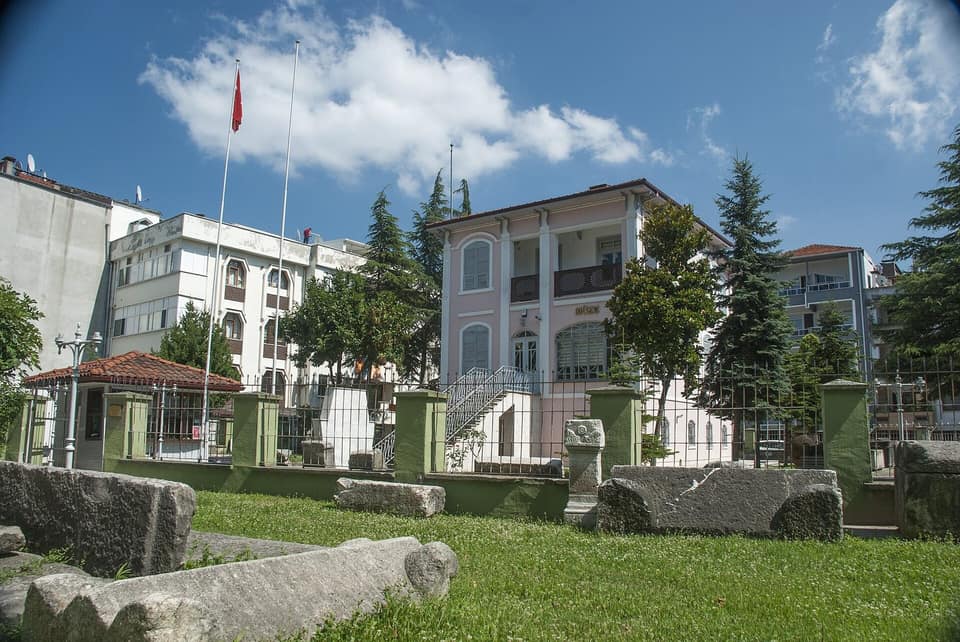
The first museum stop of the walk is the Sakarya Museum. The General Directorate of Cultural Heritage and Museums of the Ministry of Culture and Tourism writes that the museum is on Milli Egemenlik Caddesi in Semerciler Mahallesi and opened on 21 June 1993. According to Kültür Portalı, the building is a three-storey house built between 1910 and 1915. The building was registered in 1983 as an example of civil architecture. It was damaged in the 1967 earthquake. The Ministry rebuilt it in reinforced concrete, faithful to its original exterior. The building is also known as the Atatürk House. The museum was opened to visitors in 1993. In the garden, architectural fragments from the Roman and Byzantine periods are displayed. It is good to examine them before going in. In the museum's halls there are ethnographic works from prehistoric, Roman, Byzantine and Ottoman periods. The building also has a conference hall and an art gallery. For opening days, hours and entry conditions, check the current information on muze.gov.tr and Kültür Portalı. Touring the halls in chronological order lets you read the region's history from beginning to end.
The Adapazarı Earthquake and Culture Museum
The second museum is the Adapazarı Earthquake and Culture Museum, which deals directly with the city's recent past. According to Kültür Portalı, the museum, attached to the Adapazarı Municipality, opened in 2004. It serves in an area of four hundred fifty square metres. Photographs from before and after the 1967 and 1999 earthquakes are displayed here. The display also includes a vibrating earthquake stand, a seismograph and construction materials. These sections show the scientific and technical side of the event to the visitor. You can use the photographs to compare the old image of the city with today's city. The aim in the museum is to inform, not to frighten. In the construction materials section, notice how building materials are displayed. The museum's working schedule and entry conditions may change, so check the current pages of the Adapazarı Municipality and Kültür Portalı. Visiting the museum after the historic fabric of the Uzun Çarşı lets you see the city's different layers of time together. For those coming with family, the seismograph and the vibrating stand are an interesting stop.
Practical information
It is possible to build this walk on foot within the city, because the bazaar and its surroundings are close to one another. Çark Caddesi eases the way as a pedestrian connection. Check urban transport options and the connections around the Train Station from current sources before you set out. The order we suggest is this: first walk the bazaar in the morning, then move on to the Sakarya Museum, and end the day with the Earthquake and Culture Museum. For museum hours, look at muze.gov.tr, Kültür Portalı and the Adapazarı Municipality pages. In the bazaar, the shop and tradesman situation may vary over time. So it is more accurate for you to see the current situation by walking. When taking photographs, respect people's privacy. Comfortable shoes and water are sufficient equipment. At the end of the walk you will have seen as a whole what line the old city center has followed from its past to today.
Sources
- Sakarya Provincial Directorate of Culture and Tourism, Tarihi Uzun Çarşı, https://sakarya.ktb.gov.tr/TR-340362/tarihi-uzun-carsi.html
- Kültür Portalı, Uzun Çarşı, https://www.kulturportali.gov.tr/turkiye/sakarya/gezilecekyer/uzun-carsi385728
- Adapazarı Kaymakamlığı, Uzun Çarşı, https://www.adapazari.gov.tr/uzun-carsi
- Kent Akademisi, DergiPark, https://dergipark.org.tr/en/pub/kent/article/1016903
- Sakarya Provincial Directorate of Culture and Tourism, Çark Caddesi, https://sakarya.ktb.gov.tr/TR-340492/cark-caddesi.html
- Kültür Portalı, Sakarya Müzesi, https://www.kulturportali.gov.tr/turkiye/sakarya/gezilecekyer/sakarya-muzesi-ataturk-evi
- General Directorate of Cultural Heritage and Museums, Sakarya Museum, https://kvmgm.ktb.gov.tr/TR-44136/sakarya-muze-mudurlugu.html
- Kültür Portalı, Adapazarı Deprem ve Kültür Müzesi, https://www.kulturportali.gov.tr/turkiye/sakarya/gezilecekyer/adapazari-deprem-ve-kultur-muzesi
Comments
Be the first to comment