

A Visitor's Guide to Bodrum Castle and the Museum of Underwater Archaeology
Bodrum Castle rises in the middle of the town, on a rocky peninsula that separates two harbours. This guide explains how the castle came to be, what can be seen inside it today, and how to plan a visit.

Sign in to like and rate
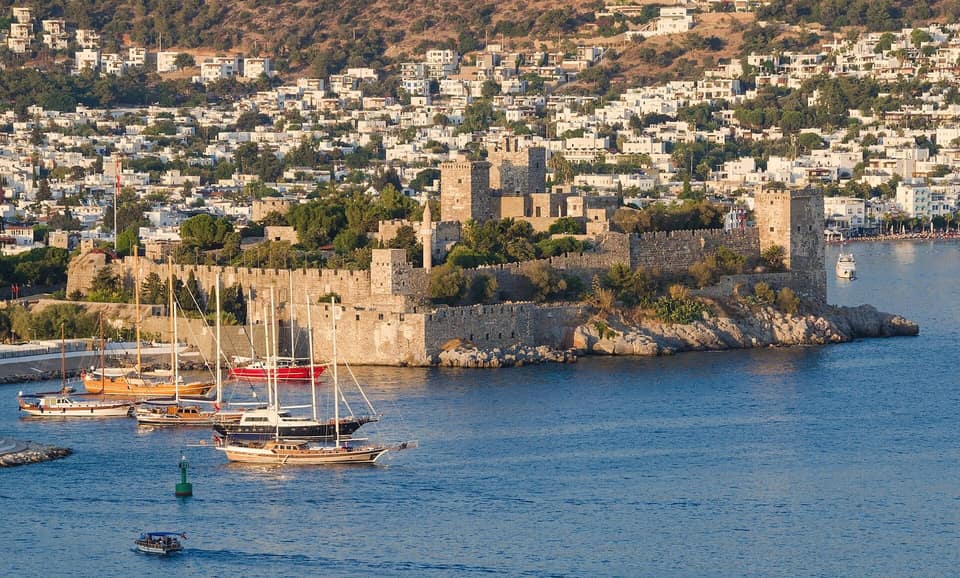
Bodrum Castle rises in the middle of the town, on a rocky peninsula that separates two harbours. This guide explains how the castle came to be, what can be seen inside it today, and how to plan a visit.
Why the castle stands on this peninsula
According to the Ministry of Culture and Tourism museum page, the rocky ground beneath the castle was an island in antiquity. It was later joined to the town and became a peninsula. The Bodrum Municipality page notes that the castle is surrounded by sea on three sides and stands between two harbours. This position makes the structure an instantly recognisable mass from both sea and land. Visitors arriving by boat first meet its outer walls, while those on foot walk toward it along the end of the harbour front.
The sources do not agree on exactly when construction began. According to them, work was started by the Knights of Saint John in the early 15th century, around 1406, and continued with interruptions until the early 1520s. The Ministry page gives 1406-1523, while the municipality page gives 1406-1522. For this reason it is safer to think of a long building process stretching over about a century and a half than to tie the castle to a single year. According to the municipality page, the knights also used stones from the Mausoleion, which had collapsed in an earthquake. If you look closely at the walls, you will notice that the colour of the stone and the quality of the masonry are not the same everywhere.
A multinational building
One of the most interesting features of the castle is that it is not the work of a single nation. The Ministry page says that the inner castle contains the French, Italian, German and English towers as well as the Snake Tower. The municipality page and the Ministry's virtual museum page also call the Snake Tower the Spanish Tower. These names preserve the memory of the different national groups among the knights who took charge of separate parts of the castle.
The plan is close to a square and measures 180 by 185 metres. The highest point of the castle is the French Tower, which stands 47.50 metres above sea level. Because the castle lies between two harbours, its upper levels allow you to look out over both of them. The Snake Tower takes its name from the snake relief at the end of its lower-floor entrance, and according to the virtual museum page it served as an infirmary in the time of the knights. The semicircular tower seen to the east of the Snake Tower is the German Tower. The same page says that it stands on the inner moat wall, that it was built between 1437 and 1440, and that its north face carries four medallions arranged in a diamond pattern. Details like these turn the towers from simple viewpoints into individual buildings worth studying.
Walls, seven gates and the moat
According to the Ministry page, the parts of the castle outside the eastern wall are reinforced with double walls. To reach the inner castle you pass through seven gates. The virtual museum page says that the entrance is made through the first gate at the north-west corner. Coats of arms sit above the gates, and they use crosses, plain or horizontal bands, dragons and lions. Looking for the coats of arms as you pass the seven gates turns the visit into a small game of discovery.
The other prominent elements are the water-filled moat, the drawbridge, the control tower and the cannon keep. The virtual museum page says that the north and west moats were crossed by a drawbridge in the time of the knights. The large building with thick walls and a sloping roof on the west side is the cannon keep. The inner castle has 14 cisterns, six of which belong to the chapel. These cisterns show how water supply was planned for conditions of siege. Reading the towers, gates and cisterns as parts of one defensive system makes the castle much easier to understand.
The Ottoman period and the prison years
According to the municipality page, after the island of Rhodes was taken in 1522 the knights left Bodrum and its surroundings on 5 January 1523. The castle passed under Ottoman rule, and the virtual museum page records that the old chapel inside it was converted into a mosque with the addition of a minaret. This is one of the most visible Ottoman interventions in the architecture of the building.
From 1895 onward the castle was used as a prison. According to the municipality and Ministry pages, a bath building was added in the late 19th century during this period, and the structure took on an Ottoman character. The virtual museum page says that the bath stands against the south wall and consists of an entrance, a cooling room, a hot room and a furnace room. The tughra of Mahmud II is also counted among the notable features of the castle. The bombardment of 26-28 May 1915 during the First World War left the castle half ruined, in the words of the municipality page, and it was abandoned. This event marked the start of a long period when the castle stood empty.
From castle to museum
According to the virtual museum page, the castle became a Museum Directorate in 1963, and the first exhibition hall opened on 6 November 1964. Other sources give 1960 as the year of the museum's foundation, so the safest way to describe the conversion is to place it roughly in the 1960s. The same page explains that the towers and various spaces of the castle were turned into exhibition halls.
The Ministry's museum page notes that in 1995 the museum received a Special Commendation in the European Museum of the Year Awards. The castle occupies an area of about 33.5 decares, and objects are also displayed in its open areas. A visitor therefore walks through a medieval fortress and tours a museum at the same time. This double character makes the visit much longer and more varied than a trip to a single museum building.
What to look at in the museum
According to the Ministry's museum page, because of restoration only the Uluburun and Shipwreck sections are currently open to visitors. It is therefore important to check on muze.gov.tr which sections are open before you go. The other halls described below are collections presented on the Ministry's virtual museum page, and their current status should be confirmed on the official site.
If you want to follow the traces of the Uluburun finds, the description of the Glass Hall on the Ministry page mentions glass ingots dating to the 14th century BC and recovered from the Uluburun shipwreck off Kaş. The amphora display, according to the same page, is placed under a canopy in the lower courtyard, and the objects are arranged chronologically from the 14th century BC to the jars of today. Chian, Knidian and Byzantine amphorae are introduced one by one, and the display ends with a jar made in modern Geyre. The Glass Shipwreck section shows the finds of an 11th-century ship found at a depth of 32 metres in Serçe Limanı, about 24 miles west of Marmaris. The ship was excavated in 1977-1979 by a Turkish and American team led by Prof. Dr. George F. Bass, and it was about 16 metres long and 5 metres wide. The Tektaş Burnu Shipwreck dates to 440-425 BC, lies at a depth of 38-43 metres, and was excavated between 1999 and 2001. The page also presents the Snake Tower, the German Tower and the Carian Princess Hall.
How to visit
According to muze.gov.tr, the official address of the museum is Çarşı Mahallesi, Kale Caddesi, No 36. The same page states that an audio guide service is available and that MüzeKart is valid. Opening and closing times, the entrance fee and night museum information can change, so check current details on muze.gov.tr.
It makes sense to structure the visit as follows. First take a short walk along the outer walls between the harbours to see how the building sits between the two seas. Then enter through the north-west corner and move forward, looking for the coats of arms on the seven gates. Visit the amphora display in the courtyard, check which towers are open, and watch both harbours from the higher parts of the castle. Since some passages may be steep or sloping, comfortable shoes are a good idea.
Near the castle there are also traces of the ancient city of Halicarnassus. The Ministry page says that this city developed on the peninsula where the castle stands, on the site of a small settlement called Zephyria, and that its growth coincided with the time of the Carian satrap Mausolus. In this way a castle visit becomes a window onto the many layers of the peninsula's history.
Sources
- Bodrum Sualtı Arkeoloji Müzesi, T.C. Kültür ve Turizm Bakanlığı, https://muze.gov.tr/muze-detay?sectionId=BSA01&distId=MRK
- Bodrum Sualtı Arkeoloji Müzesi (sanal müze), T.C. Kültür ve Turizm Bakanlığı, https://www.ktb.gov.tr/genel/SanalMuzeler/bodrumsualti/bilgi.htm
- Bodrum Kalesi, Bodrum Belediyesi, https://www.bodrum.bel.tr/page.php?id=20%2Fbodrum_kalesi
- Bodrum Kalesi, Vikipedi, https://tr.wikipedia.org/wiki/Bodrum_Kalesi
Comments
Be the first to comment