

A Day Trip to Eskişehir by High-Speed Train, from the Station to Odunpazarı
Eskişehir is one of the few cities in Türkiye that you arrive at by train and explore on foot.

Sign in to like and rate
Eskişehir is one of the few cities in Türkiye that you arrive at by train and explore on foot. The high-speed train stops here, right in the middle of the line between Ankara and Istanbul, and the moment you walk out of the station door you find tram tracks, the Porsuk River a few stops away and, a little further up, the bay-windowed houses of Odunpazarı. The GoTürkiye route page, to which the Eskişehir Provincial Directorate of Culture and Tourism redirects its transport page, also underlines this closeness and describes the city as a favourite for day trips from the big cities. This article builds, from the sources, a day that runs from the station to Odunpazarı for a traveller who gets off the train in the morning and boards it again in the evening. Timetables and ticket prices change often, so we do not give them here; when planning the journey, check the current information on the official channels of TCDD Taşımacılık.
Three lives of a station
Eskişehir's relationship with the railway goes back more than a hundred and thirty years. According to the Eskişehir entry of the TDV Encyclopedia of Islam, the Anatolian railway reached Bilecik in 1891, arrived in Ankara by way of Eskişehir within two years, and the line between Eskişehir and Konya was built in 1896. The encyclopedia calls this development a turning point for the city; the oldest industrial establishment in town is also the railway workshop founded in 1894. In other words, the traveller who arrives by train today enters Eskişehir along the very route that made it grow.
Today's station building is the second generation. According to the page of the Provincial Directorate of Culture and Tourism, its foundation was laid in 1953, it entered service on 4 November 1955, and its design belongs to Professor Orhan Safa. The Eskişehir Garı article on Turkish Wikipedia adds a few more details to that moment: the site on which the building stands exceeds three thousand square metres, and the opening ceremony turned into a crowded city gathering. The third life began on 13 March 2009, when the high-speed train between Ankara and Eskişehir reached the station. The same article explains that in 2014 the station was completely renewed together with the Eskişehir City Tunnel, and that trains now enter it without crossing level crossings. When you step down onto the platform, look up at the tall arched facade of the main building; watching the airy station architecture of the fifties from the new platforms is the first small pleasure of this trip.
From the station into town by tram
In front of the station is a stop of EsTram, Eskişehir's rail public transport system. According to Turkish Wikipedia, construction began in the summer of 2002, services opened on 24 December 2004, and the network today consists of nine lines linking the city's hospitals and universities. The stop beside the station is called Ulus Anıtı and also appears on maps with the word station in brackets. Boarding is paid with the city's shared transport card, EsKart. Line numbers and routes change from time to time, so check which tram to take on the board at the stop or on the operator's official website.
On trams heading to the centre you reach the bazaar area within a few stops. The same article describes the ES-ES Çarşı stop on İki Eylül Caddesi as the point where passengers transfer between lines. If the weather and your time allow, you can also walk from the station into the centre; the northern side of the city, built on the plain, makes for an easy walk.
A first stop on the banks of the Porsuk
Everyone who comes to the city sooner or later ends up on the banks of the Porsuk River. The Provincial Directorate of Culture and Tourism presents Eskişehir as one of the rare cities in Türkiye with a river running through it and notes that the Porsuk roughly divides the city in two, with the Tepebaşı district to the north and Odunpazarı to the south. The TDV Encyclopedia of Islam also points to the different character of the two banks. The business area north of the river stands out with its multi-storey office blocks, while the south keeps the texture of a traditional bazaar; the Köprübaşı area connecting the two is a zone of transition.
According to the Directorate, boat trips on the river were an old tradition that came to an end when the river became polluted, and that revived once the sewer system was fixed and the river was rehabilitated. Today excursion boats leaving from Köprübaşı and Venetian-style gondolas move along this stretch of the river. If you arrived by the morning train, a short walk along the bank is the easiest way to fall into the rhythm of the city. For the excursion boats, get current information from the announcements of the operating institution.
The Adalar area near Köprübaşı has a history of its own as well. According to the Directorate's page, the area was once known as Yalaman Island because it belonged to a well-known family of the city. Filled with open-air cinemas in the 1960s, music halls in the 1970s and fairgrounds in the 1980s, the riverside turned into today's promenade at the end of that decade. Since you will spend the afternoon in Odunpazarı, it is a good idea to see Adalar again on your way back to the evening train.
Up to Odunpazarı by way of Hamamyolu
GoTürkiye's forty-eight-hour plan for Eskişehir suggests climbing from the banks of the Porsuk up to historic Odunpazarı along Hamamyolu Caddesi. This walk is a passage between two eras of the city. You rise slowly from the new city built on the flat plain towards the old core leaning against the hills to the south.
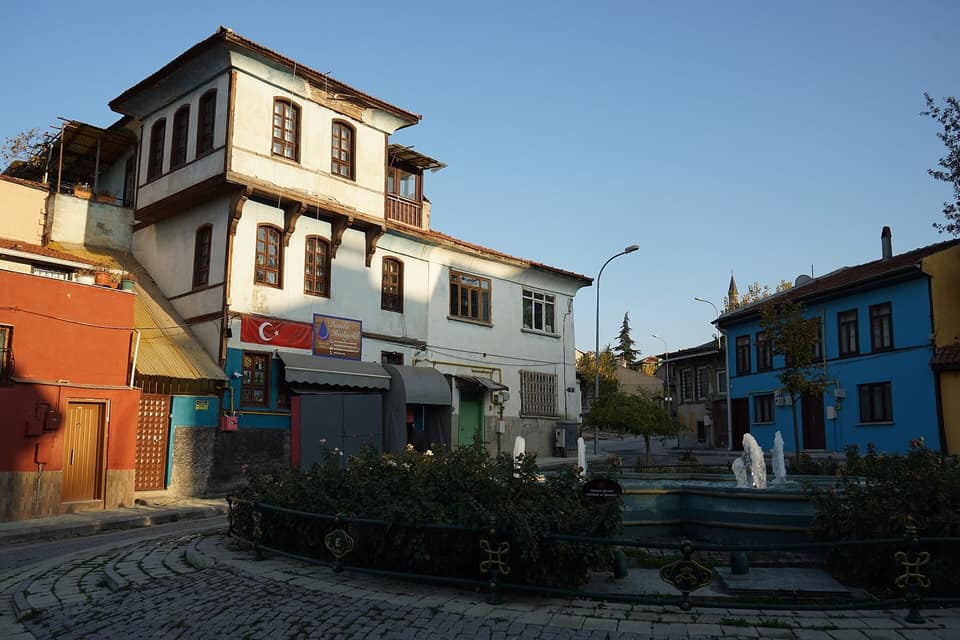
The TDV Encyclopedia of Islam defines Odunpazarı as the old core of Eskişehir. It explains that the neighbourhood lost its importance as a residential area for a time, that some historic houses were demolished when a road was opened, and that the district was declared a historic conservation area to protect these houses. The Provincial Directorate of Culture and Tourism gives today's picture. Under the Odunpazarı Municipality's project to keep the houses alive, three hundred houses on thirty streets, one complex, two caravanserais, fifteen fountains and one inn were restored or rebuilt faithfully to the original. Five of the streets mentioned by Evliya Çelebi in his Seyahatname still carry the same names today.
When you step into the streets, the first thing to catch your eye will be the colour of the facades. The Directorate describes the houses as brown-framed between white walls, sometimes with indigo blue or brick red facades. The street-facing sides of the houses project outwards on brackets. The ground floors held the kitchen, stable, laundry or storeroom, and the family lived on the upper floors. Do not be afraid of getting lost on the winding slopes and in the dead-end lanes; the neighbourhood is small and every slope brings you out onto a square.
The complex, the inn and meerschaum
According to the Directorate, the Kurşunlu Complex at the heart of the neighbourhood was built for the vizier Çoban Mustafa Paşa between 1517 and 1525. Its architect is generally held to be Acem Ali, who was chief architect before Mimar Sinan. The former madrasa section of the complex now houses the Meerschaum Museum. The Culture Portal writes that the museum was opened in 2008 by the Odunpazarı Municipality. GoTürkiye's plan explains that in the handicrafts bazaar in the guest-house section of the complex you can see examples ranging from reed-flute making to marbling and from calligraphy to silverwork.
A little further down stands the inn where, from the 1850s, market traders, travellers and villagers stayed together with their animals; GoTürkiye remembers it as the inn of the merchants who came to sell wood. According to the Provincial Directorate of Culture and Tourism, the building, which had fallen into ruin over time, was rebuilt in 2006 under the name Atlıhan with care for its original architecture. Today workshops where meerschaum is carved operate in the rooms of the two-storey inn. We tell the story of meerschaum, from the mine to the craftsman's bench, in a separate article on this site; if you have an hour left before your train, spend it in this inn.
Two contemporary museums among the old houses
On the same street in Odunpazarı you can see the past and the present side by side. According to the Directorate's page, the building of the Odunpazarı Modern Museum was designed by Kengo Kuma and his office, brought to life by the Eskişehir-born architect and collector Erol Tabanca, and has welcomed visitors since 2019. Its exhibition spaces, spread over about four thousand five hundred square metres, show works from the collection alongside temporary exhibitions. The stacked timber beams of the building converse with the wooden texture of the surrounding houses; before going in, it is worth watching it for a while from the opposite pavement.
The Contemporary Glass Arts Museum right next door, according to the Directorate, is Türkiye's first museum of contemporary glass art, opened on 1 December 2007. Founded in cooperation between the Metropolitan Municipality, Anadolu University and the Friends of Glass group, the museum displays, across three halls, works made with techniques ranging from hot glass blowing to cold shaping. The Culture Portal writes that the collection contains works by fifty-eight Turkish and ten foreign artists.
Planning the day
The most common mistake on a day trip is trying to fit everything in. The order in this article was set up for a calm day that starts in the morning on the banks of the Porsuk and spends the afternoon in Odunpazarı. Museums may be closed on certain days of the week and exhibition programmes change; before boarding the train, check the current visiting information of each on its own official website. The slopes of Odunpazarı are cobbled, so wear comfortable shoes that do not slip.
GoTürkiye's plan recommends tasting çibörek, which has become part of Eskişehir's cuisine, while walking around Odunpazarı, and ending the day with Balaban kebab. Heading back to your evening train, you can again walk down Hamamyolu, stop by the banks of the Porsuk, and take the tram to the station from around Köprübaşı. As you look out of the window on the way home, remember this: the line you are riding continues the route that turned Eskişehir into today's city when the first rails were laid across this plain a hundred and thirty years ago.
Sources
- Eskişehir Provincial Directorate of Culture and Tourism, TCDD Eskişehir Train Station, https://eskisehir.ktb.gov.tr/TR-336966/tcdd-eskisehir-tren-gari-tepebasi.html
- Eskişehir Provincial Directorate of Culture and Tourism, Odunpazarı Houses, https://eskisehir.ktb.gov.tr/TR-336894/odunpazari-evleri.html
- Eskişehir Provincial Directorate of Culture and Tourism, Porsuk River, https://eskisehir.ktb.gov.tr/TR-336964/porsuk-nehri.html
- Eskişehir Provincial Directorate of Culture and Tourism, Adalar, https://eskisehir.ktb.gov.tr/TR-336963/adalar.html
- Eskişehir Provincial Directorate of Culture and Tourism, Kurşunlu Mosque and Complex, https://eskisehir.ktb.gov.tr/TR-336893/kursunlu-camii-ve-kulliyesi-odunpazari.html
- Eskişehir Provincial Directorate of Culture and Tourism, Atlıhan Handicrafts Bazaar, https://eskisehir.ktb.gov.tr/TR-347094/atlihan-el-sanatlari-carsisi-odunpazari.html
- Eskişehir Provincial Directorate of Culture and Tourism, OMM Odunpazarı Modern Museum, https://eskisehir.ktb.gov.tr/TR-470159/omm---odunpazari-modern-muze-odunpazari.html
- Eskişehir Provincial Directorate of Culture and Tourism, Contemporary Glass Arts Museum, https://eskisehir.ktb.gov.tr/TR-339434/cagdas-cam-sanatlari-muzesi-odunpazari.html
- Türkiye Culture Portal, Contemporary Glass Arts Museum, https://www.kulturportali.gov.tr/turkiye/eskisehir/gezilecekyer/cagdas-cam-sanatlari-muzesi
- Türkiye Culture Portal, Meerschaum Museum, https://www.kulturportali.gov.tr/turkiye/eskisehir/gezilecekyer/luletasi-muzesi
- GoTürkiye, 48 Hours in Eskişehir, https://goturkiye.com/tr/eskisehir/48-saatte
- GoTürkiye, Eskişehir Routes, https://goturkiye.com/tr/eskisehir/eskisehir-rotalari
- TDV Encyclopedia of Islam, Eskişehir, https://islamansiklopedisi.org.tr/eskisehir
- Wikipedia, Eskişehir Garı, https://tr.wikipedia.org/wiki/Eski%C5%9Fehir_Gar%C4%B1
- Wikipedia, EsTram, https://tr.wikipedia.org/wiki/EsTram
Comments
Be the first to comment